What Is Twill Fabric? The Complete Guide to Weaves, Types, and Uses
Reach into your closet and pull out a pair of jeans. Run your fingers along the surface — those faint diagonal lines you feel are not a printing effect or a design choice. They are the weave itself. That subtle texture is the signature of twill, one of the oldest and most versatile fabric structures in existence. Twill shows up in denim, chinos, herringbone blazers, upholstery fabric, and even military-grade workwear. Yet most people have no idea they are wearing or sitting on it every single day. This guide answers the question “what is twill fabric” from the ground up — covering its structure, history, types, properties, and practical uses — so you can make smarter decisions whether you are designing a garment, sourcing materials, or simply curious about what your clothes are actually made of.
What Is Twill Fabric?
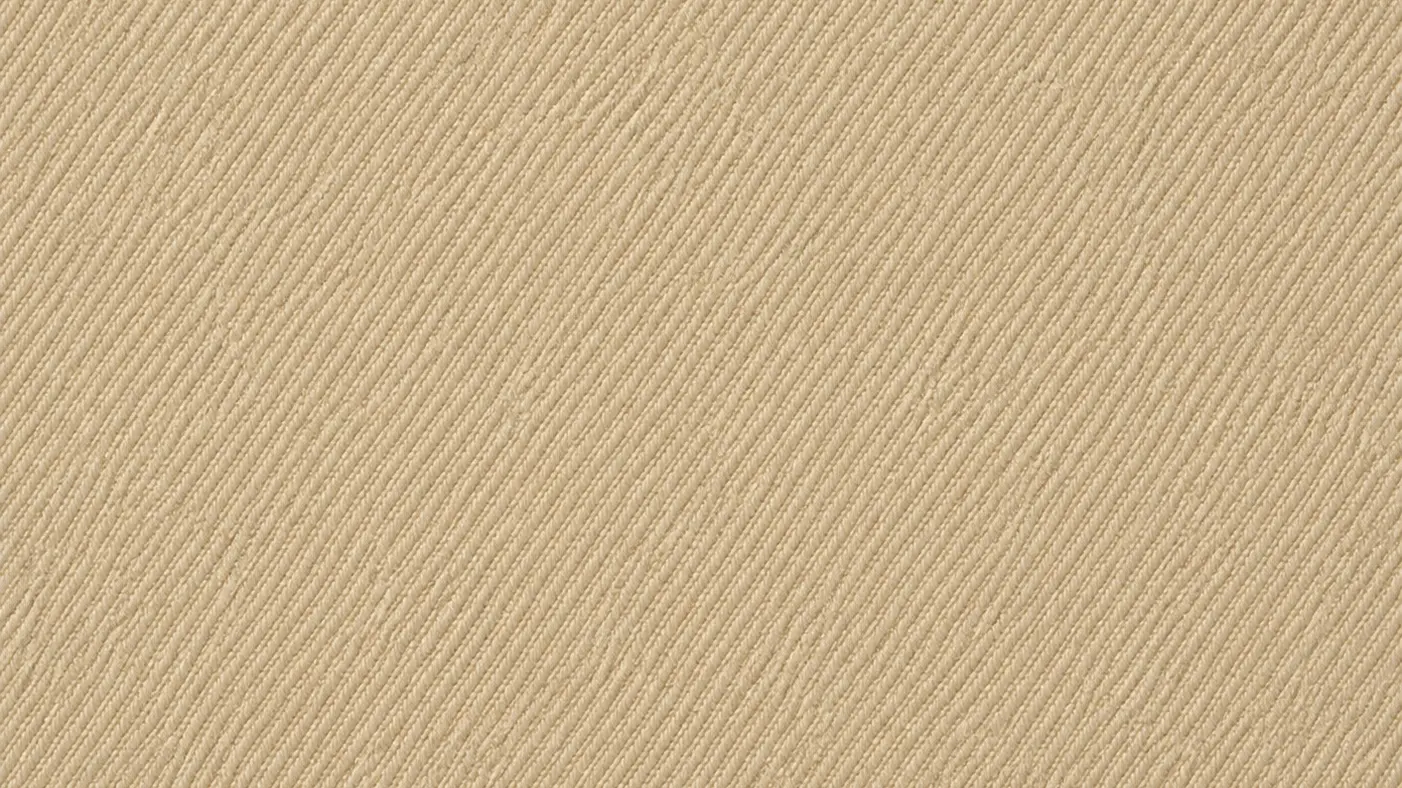
Twill is not a fiber. It is a weave pattern.
That distinction matters. When a fabric is described as “twill,” it means the threads have been interlaced in a specific way that creates a diagonal line across the surface — not that the fabric is made from a particular material like cotton or polyester. The same weave can be applied to wool, silk, synthetic fibers, or any combination thereof.
In weaving, two sets of threads work together: warp threads run lengthwise on the loom, and weft threads run across. In a twill weave, the weft passes over one or more warp threads, then under two or more, with each row offset by one position. That offset is what creates the diagonal rib, known as the wale.
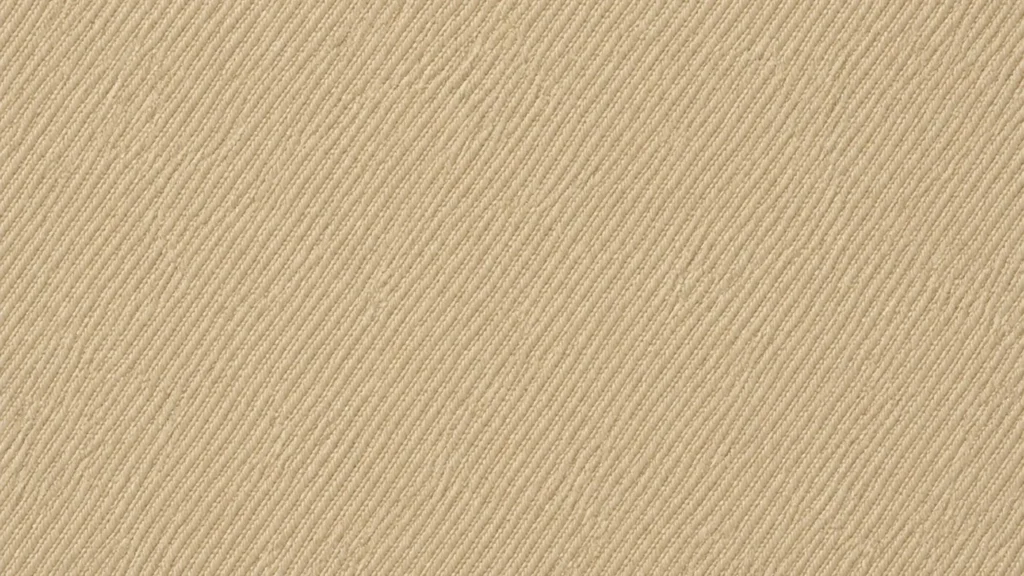
Twill sits alongside plain weave and satin weave as one of the three fundamental weave structures. Plain weave crosses weft over warp in a simple one-over-one pattern — think a basic cotton shirt. Satin weave uses long floats that create a smooth, lustrous surface. Twill sits between the two: more durable than satin, softer and more flexible than plain weave.
The weave is often described using a fraction. A 3/1 twill, for example, means the weft passes over three warp threads, then under one. A 2/2 twill is balanced, going over two and under two. These ratios affect the angle of the diagonal, the weight of the fabric, and how the front and back faces differ in appearance.
History & Origin of Twill
Twill is ancient. Archaeological evidence places it in use across Europe and Asia thousands of years ago, long before it had a consistent name. Iron Age textile fragments recovered from European bog sites show clear diagonal weave structures, indicating that the technique predates recorded fashion history by a significant margin.
The word “twill” itself comes from the Old English twili, which was a partial adoption of the Latin bilix — roughly meaning “two-threaded.” This etymology ties the term closely to British textile culture, though the technique was practiced independently across many civilizations.
For most of history, twill was a practical choice. Its tight structure made it resistant to wear, which suited clothing for laborers, soldiers, and travelers. Wool serge — a twill weave — became standard fabric for European military uniforms from the medieval period onward.
The Industrial Revolution changed the scale entirely. Mechanized looms could produce complex twill structures faster and more cheaply than handlooms, leading to mass-market textiles. This era gave rise to two twill fabrics that remain ubiquitous today: denim, first used for miners’ workwear in the mid-19th century, and gabardine, patented by Thomas Burberry in 1879 as a weatherproof outer fabric.
From workwear staple to fashion mainstay, twill’s trajectory over the past two centuries reflects how function and aesthetics can reinforce each other over time.
How to Identify a Twill Weave
The clearest indicator of a twill weave is a visible diagonal line running across the fabric surface. On denim, these lines angle from the lower left to the upper right — this is called a Z-twill or right-hand twill. Less commonly, the diagonal runs in the opposite direction, which is an S-twill or left-hand twill.
Here is a quick way to check:
- Hold the fabric up to a light source at an angle.
- Look for repeating diagonal ridges rather than a grid or flat surface.
- Compare the front and back — twill fabrics typically have a distinct face side with pronounced texture, while the reverse is flatter or shows a mirrored pattern.
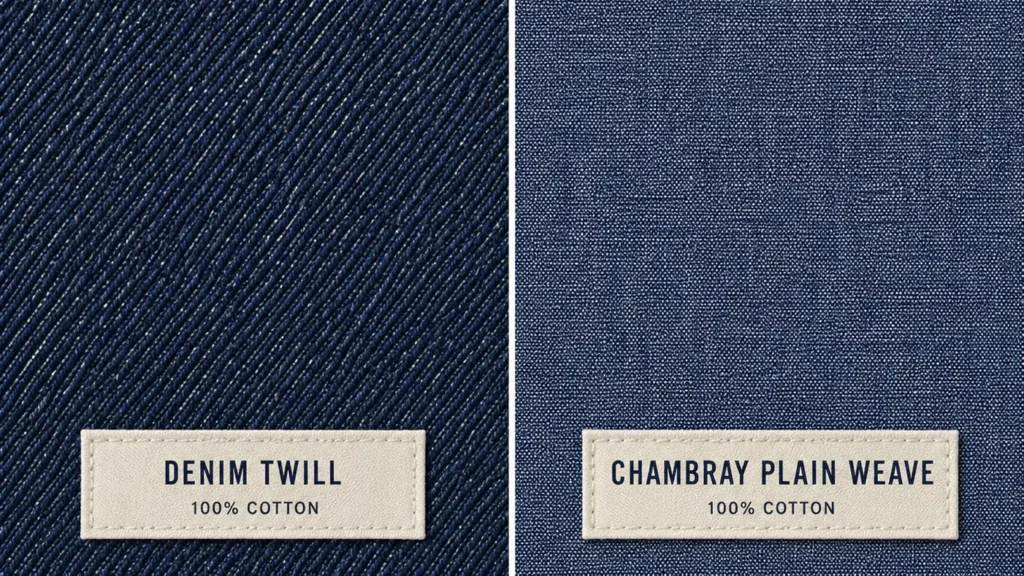
The classic comparison is denim versus chambray. Both are cotton fabrics, both are often blue, and both get used in casual clothing. But chambray is a plain weave — smooth, with no diagonal lines. Denim is a twill — the warp threads (usually dyed indigo) dominate the face, while the undyed weft shows on the reverse. That is why the inside of most jeans is noticeably lighter in color than the outside.
Properties & Characteristics of Twill Fabric
The diagonal structure gives twill a distinct set of physical properties that set it apart from other weave types.
Durability. Because the weft floats over multiple warp threads, there are fewer interlacing points per square inch compared to plain weave. This means each thread has more room to absorb friction and flex without breaking. Twill fabrics generally hold up well to repeated use and washing.
Drape. The reduced number of interlacing points also makes the fabric more flexible. Twill moves with the body rather than against it, which is why it works well for tailored trousers, jackets, and skirts that need to hang cleanly.
Wrinkle resistance. Plain weave fabrics tend to crease easily because every thread is locked tightly against its neighbor. In twill, the diagonal structure distributes tension more evenly, so the fabric recovers from compression better and resists wrinkles during wear.
Opacity. Twill’s tight weave makes it dense enough to block light. It is rarely sheer, which makes it appropriate for workwear, uniforms, and upholstery where see-through fabric would be impractical.
Stain concealment. The diagonal texture and often multicolored yarn structure means small marks and scuffs are less visible than they would be on a smooth plain weave surface. This is part of why denim became so popular for heavy-use clothing.
Limited stretch. Standard twill without added spandex or elastane does not stretch much. This is an advantage for structured garments but a limitation for activewear or anything that requires significant body movement.
Types of Twill Fabric
Twill covers a wide range of fabrics. The differences come down to the fiber used, the specific weave ratio, and the weight of the resulting cloth.
By Fiber
| Fiber Type | Key Traits | Common Uses |
|---|---|---|
| Cotton twill | Soft, breathable, easy to dye | Jeans, chinos, casual jackets, canvas bags |
| Wool twill | Warm, resilient, naturally water-resistant | Suits, coats, military uniforms |
| Silk twill | Lightweight, lustrous, fluid drape | Scarves, ties, blouses, evening wear |
| Polyester twill | Wrinkle-resistant, colorfast, low maintenance | Uniforms, workwear, outdoor gear |
| Poly-cotton blend | Balance of breathability and durability | School uniforms, chef wear, everyday trousers |
By Fabric Variety
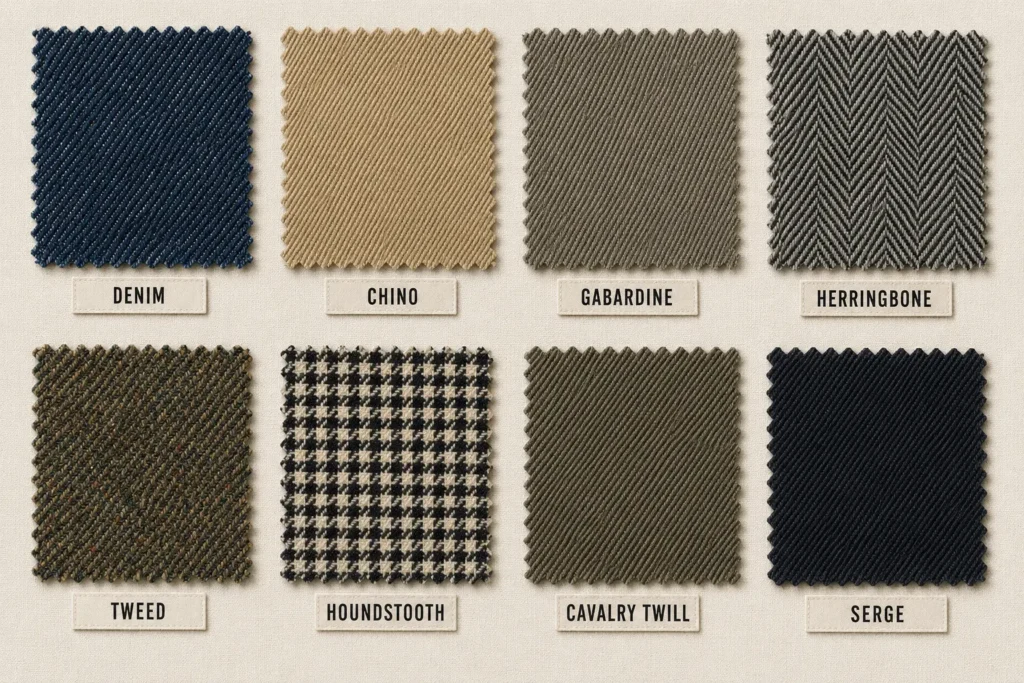
Denim is perhaps the most recognized twill in the world. It uses a 3/1 warp-faced weave, with indigo-dyed warp threads and undyed weft. The result is a fabric that is blue on the face and white-grey on the reverse, with a visible diagonal rib. Standard denim runs between 10–14 oz per square yard.
Chino is a lighter cotton twill, typically piece-dyed to a solid color on both sides. It has a softer hand and less pronounced wale than denim. Chino is the go-to fabric for casual trousers, shorts, and lightweight jackets.
Gabardine is a tightly woven, warp-faced twill — often wool — with a steep diagonal angle and a smooth back. Originally developed as a weatherproof fabric, it drapes cleanly and holds a crease well, making it popular in dress trousers and suit jackets.
Herringbone is a broken twill: the diagonal reverses direction at regular intervals, creating a V-shaped or zigzag pattern resembling fish bones. Usually made from wool or a wool blend, it is widely used in tailoring and outerwear.
Tweed uses multiple colored yarns within a twill weave to produce a textured, often flecked appearance. Traditionally wool, tweed is associated with outdoor and country clothing.
Houndstooth follows a similar logic: alternating light and dark yarns in a twill structure create the characteristic four-pointed check pattern. Scale can vary from tiny micro-houndstooth to large statement versions.
Cavalry twill features a double diagonal rib, giving it a more pronounced and rigid surface. It is commonly used in riding trousers and durable workwear.
Serge is one of the oldest named twills — a smooth, even-sided weave originally made from wool or silk. It was historically the fabric of military uniforms and formal tailoring.
Advantages & Benefits of Twill Fabric
Twill’s longevity across industries and centuries is not coincidental. Its structural advantages make it a reliable choice for a wide range of applications.
- Strength without excessive weight. The diagonal float structure makes twill more resistant to tearing and abrasion than plain weave fabrics of the same fiber count.
- Better drape than plain weave. The reduced interlacing gives the cloth a natural suppleness that tailors and garment makers prefer for structured but wearable pieces.
- Wrinkle resistance in daily use. Twill holds its shape through a day of wear better than most plain weave counterparts, reducing the need for frequent ironing.
- Effective stain camouflage. The textured surface and often mixed-color yarn construction mask minor stains and surface wear that would be obvious on a flat fabric.
- Good color retention. The tight weave holds dye evenly, which is why twill fabrics tend to keep their color through repeated washing better than more open-structured textiles.
- Versatility across weight ranges. Twill can be woven from lightweight silk for scarves to heavyweight denim for workwear, making it adaptable across virtually every clothing category.
Twill vs Plain Weave
The contrast between twill and plain weave comes up often when selecting fabric for a project, and the choice genuinely matters.
| Property | Twill weave | Plain weave |
|---|---|---|
| Surface appearance | Diagonal ribs (wales) | Flat, grid-like texture |
| Durability | Higher — diagonal float distributes stress | Lower — tight crossings limit flex |
| Drape | Soft and flowing | Stiffer and more structured |
| Wrinkle resistance | Better — fewer interlacing points | Less — threads lock tightly |
| Stain visibility | Lower — texture masks marks | Higher — flat surface shows marks |
| Breathability | Moderate | Generally higher |
| Production cost | Slightly higher — requires more loom complexity | Lower — simpler weave structure |
| Typical uses | Jeans, trousers, suits, upholstery | Shirts, bed sheets, lightweight linings |
The practical takeaway: choose twill when the fabric will face heavy use, needs to drape well, or will be worn over long periods without ironing. Choose plain weave when you need a lighter, crisper fabric — a summer shirt, a printed pillowcase, or a structured bodice where firmness is an advantage.
It is worth noting that fabric behavior is also shaped by fiber, yarn count, and finishing treatments. A heavy plain-weave canvas can outlast a lightweight cotton twill in certain applications. Weave structure is one factor among several. To explore how different fabric constructions are used in performance and specialty textiles, the FuYuan Knitting blog covers a range of related topics.
Uses & Applications of Twill Fabric
Twill’s combination of durability, drape, and visual texture makes it useful across a wider range of products than most people realize.
Apparel
The most obvious applications are in trousers. Denim jeans, cotton chinos, wool dress trousers, and gabardine suit pants all rely on twill for the same core reason: the weave holds its shape, resists wear, and hangs cleanly from the waist to the hem. Twill is also common in jackets, coats, and workwear where a fabric needs to survive prolonged physical activity.
Formal tailoring — particularly in suits and blazers — often uses wool twill or gabardine because the fabric takes a pressed crease and recovers from compression, which is critical when a jacket spends most of its life over a chair or in a bag.
Home Textiles
Upholstery fabric for sofas and chairs is frequently woven in a twill structure because of its resistance to abrasion and its ability to conceal surface wear over time. Heavier cotton and polyester twills also appear in curtains, throws, and table linens where density and opacity are desirable.
Bedding is another area where twill appears, particularly in higher thread count sheets where the diagonal weave creates a softer, more flexible fabric than an equivalent plain weave would produce.
Accessories and Specialty Items
Silk twill is the standard fabric for luxury scarves and ties — the structure holds the weave tightly enough to maintain shape while the silk fiber gives it the necessary drape and sheen. Canvas bags and backpacks often use a heavy cotton or poly-cotton twill for its resistance to tearing at the seams and stress points.
Industrial and Technical Applications
In workwear and protective clothing, twill’s tight structure provides a natural barrier against minor abrasions and dirt. Military uniforms have historically favored wool and cotton twills for exactly this reason. In industrial filtration and technical textile applications, twill weaves are selected for their controlled porosity — the diagonal float structure allows specific particle sizes to pass through while blocking others.
Where Twill Fabric Is Produced & How to Source It
Twill is produced in significant volumes across several major textile manufacturing regions.
China remains the largest producer and exporter of twill fabrics, with strong output of cotton, polyester, and blended twills at a range of weights and constructions. Manufacturers in Guangdong, Zhejiang, and Fujian provinces supply both commodity and specialty twills.
India is a major source of cotton twill, particularly heavier weights used for workwear and denim. Textile clusters in Gujarat, Maharashtra, and Tamil Nadu produce large volumes for both domestic and export markets.
Pakistan focuses heavily on denim twill, with significant mill capacity in the Punjab region supplying global denim brands.
The United States produces Pima cotton twill certified by the American Supima Association (ASA), valued for its long-fiber cotton that produces a finer, stronger yarn than standard cotton grades.
What to Check When Sourcing
When evaluating twill fabric for a specific project, the following parameters matter most:
- Fiber content: 100% cotton, 100% polyester, or a specific blend ratio (e.g., 65/35 poly-cotton). Each has different performance, feel, and washing behavior.
- Weave notation: 2/1, 3/1, or 2/2 twill — this affects the prominence of the diagonal, the weight, and the face-to-back ratio.
- Weight: Expressed in oz/yd² or g/m². Lightweight twills run around 4–6 oz; medium weight 7–9 oz; heavy twills (denim, workwear) from 10–14 oz.
- Width: Most commercial twills are available in 57–60 inch widths, though some specialty fabrics come narrower or wider.
- Certifications: For sustainable or regulated sourcing, relevant standards include GOTS (Global Organic Textile Standard), OEKO-TEX Standard 100, USDA Organic (for cotton), and GRS (Global Recycled Standard) for recycled fiber content.
Just as woven fabrics require attention to construction details, knitted fabrics have their own sourcing considerations. If you are working with stretch fabrics for lingerie, swimwear, or activewear alongside woven twills, it is worth understanding how different fabric structures behave differently in those end uses — the FuYuan Knitting guides on what is viscose fabric and what is chiffon fabric offer useful parallel context on fabric behavior and sourcing decisions.
Conclusion
Twill is one of those materials that rewards closer attention. On the surface, it is simply the fabric your jeans are made of — familiar, practical, unremarkable. But the diagonal weave that defines it has been in continuous use for thousands of years because it solves a genuine set of problems: how to make a fabric that is strong without being stiff, durable without being heavy, and textured without being rough. Whether you encounter it as heavy denim on a construction site, as fine gabardine in a tailored suit, or as silk twill in a luxury scarf, the underlying principle is the same. Understanding twill — what it is, how it is structured, and why it behaves the way it does — gives you a clearer foundation for every fabric decision that follows.
FAQ
Is twill fabric stretchy?
Standard twill fabric does not stretch. The woven structure — regardless of whether it uses cotton, wool, or polyester — is dimensionally stable because the interlaced warp and weft threads lock the fabric’s shape in both directions. The only way twill gains significant stretch is if an elastic fiber such as spandex or elastane is incorporated into the yarn blend. A 98/2 cotton-spandex twill, for example, will have a modest give in one direction, while a standard 100% cotton twill will not.
What is the difference between cotton twill and regular cotton fabric?
“Regular cotton fabric” typically refers to a plain weave cotton, where threads cross in a simple one-over-one pattern. Cotton twill uses the same fiber but woven with the diagonal offset structure. The result is a heavier, denser fabric with better drape and wrinkle resistance, at the cost of some breathability and added weight. Plain cotton is generally better for lightweight shirts and summer clothing; cotton twill is better for trousers, jackets, and anything that needs to hold its shape under regular use.
Can twill fabric be used for upholstery?
Yes — heavier cotton and polyester twills are well-suited to upholstery applications. The tight weave resists abrasion and pilling better than loosely constructed fabrics, and the diagonal texture helps conceal surface wear over time. For high-traffic pieces like sofas and dining chairs, a mid-weight to heavyweight twill (10 oz and above) in a durable fiber blend tends to perform well. Lighter twills are better reserved for decorative cushions or low-use pieces.
Is denim a type of twill fabric?
Yes. Denim is a specific form of cotton twill, typically woven in a 3/1 warp-faced structure with indigo-dyed warp threads and undyed or white weft threads. The characteristic blue exterior and lighter interior of most jeans is a direct result of this weave structure: the dyed warp dominates the face while the undyed weft shows on the reverse. All denim is twill, but not all twill is denim — twill is the broader category.
How do you wash and care for twill fabric?
Care depends primarily on fiber content. Cotton and poly-cotton twills can generally be machine washed in cold or warm water with a mild detergent. Hot water increases the risk of shrinkage, especially with 100% cotton. Air drying preserves the fabric’s structure best; if using a tumble dryer, a low-heat setting reduces fiber stress. Wool twills should be hand washed or dry cleaned to prevent felting. Silk twill is best dry cleaned or carefully hand washed in cold water and laid flat to dry. For any twill garment, turning it inside out before washing helps preserve the surface texture and color of the face side.
What is the best twill fabric for workwear or uniforms?
Poly-cotton twill blends — typically 65% polyester and 35% cotton, or 60/40 in either direction — are the most common choice for workwear and uniforms. The polyester component adds wrinkle resistance, shape retention, and durability; the cotton component provides breathability and comfort against the skin. Weight matters too: lighter weights around 7–8 oz suit warmer environments and indoor work, while heavier weights of 10–12 oz are appropriate for outdoor or physically demanding conditions. For environments with specific hazard requirements, flame-resistant (FR) cotton twill is available and widely used in industries such as oil and gas, electrical work, and firefighting.