Types of Lace and 2026: How Contemporary Fashion Reimagines Fabric Heritage
Into: Lace is often poetically described as “woven air.” Its evolution—from the intricate handiwork of royal robes to the high-tech stretch of modern performance wear—marks its transformation from a simple embellishment into a sophisticated language of attitude, texture, and sustainability. In our hyper-digital world, we find ourselves craving something truly tactile. We are moving away from the sterile perfection of industrial fabrics in favor of textiles that breathe and embrace a “play of light and shadow.” Whether for a designer seeking a brand’s soul or a bride preparing for her most significant milestone, to truly understand lace is to decipher the deepest codes of elegance in fashion.
Three classic types of lace
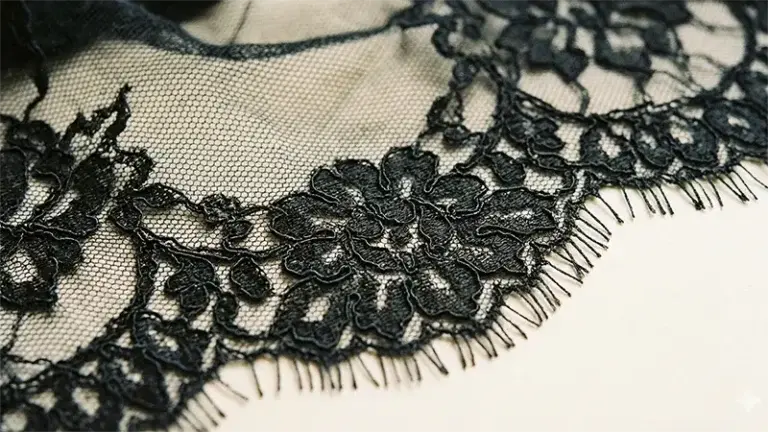
Chantilly Lace: The Misty Allure of French Romance
The lace fabric from historic Chantilly, France is very light and airy like the wisp of a cloud because of the quality of the silk thread. One of the distinctive features is the ‘eyelash trim’ that has a soft, flowing edge that feels good against your skin. In 2026, the bridal market is expected to continue to grow more natural and relaxed, making Chantilly lace a perfect fit for unlined, lightweight wedding dresses and effortless and flowing morning robes. With its fine, flat floral patterns and detailed textures, it will continue to be the best at ‘now you see it, now you don’t’ look.
Alençon Lace: The Reigning Queen of Detail
Alençon is often referred to as the ‘Queen of Lace’, and it is known for its beauty and depth. The 3-D imagery created by the use of a thicker cordonnet to outline the lace motifs creates a 3-dimensional appearance as the motifs appear to stand out from the flat mesh backing. The craftsmanship of Alençon lace produces not only a very rich visual but also an extremely durable and wrinkle-resistant product. Many of the designers on the haute couture runways in 2026 are taking advantage of its structural strength by selling bold appliqués, created by hand-cutting the lace into the appliqué shape and then sewing the appliqué onto leather and heavier satin fabrics to create an extreme contrast of tension and touch.
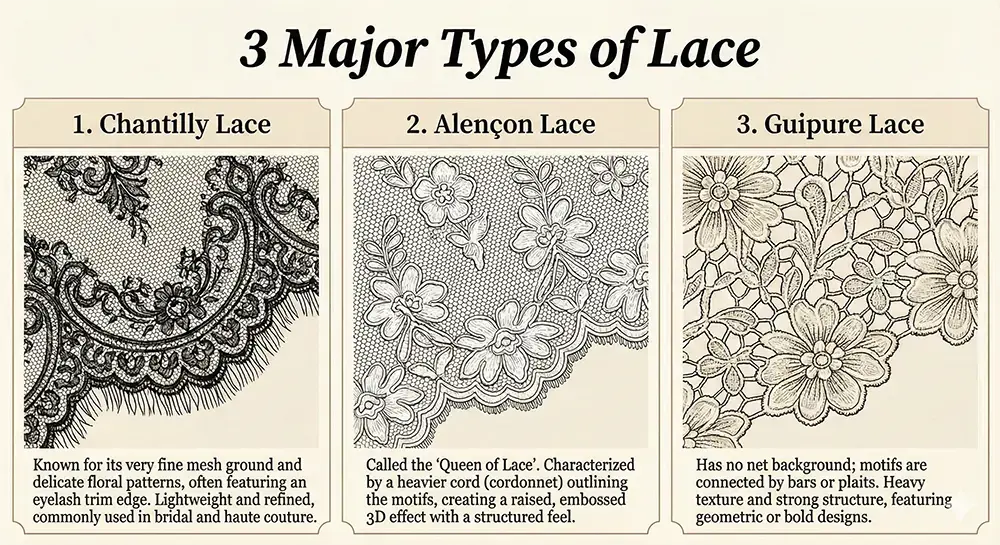
Guipure Lace: The Architectural Beauty of Weight
Guipure (also referred to as Venice lace) follows a completely different method of lace-making than other types of lace. Rather than using a netting for the base, Guipure uses a rigid framework of motifs connected together by bridges (threads). The way that these pieces come together appears almost magical; beautiful, intricate designs are stitched onto a base that can be dissolved using chemical processes via laundering. Once this occurs, the only thing that is left behind is the exquisite, yet heavy, three-dimensional design. These pieces tend to be extremely durable and therefore skeletal in construction (i.e., they do not have much weight). In 2026, Guipure is often represented as being part of minimalist designs in terms of oversized geometric shapes that eventually become sculptural garments (e.g., tops, skirts) that are very raw and industrial looking.
Multi-dimensional Lace Classification Guide
By Technical Process
Handmade Lace: In the year 2026, handmade forms of lace—like Bobbin and Needle lace—are considered a type of “fine art” within the textile arts. They are created completely independent of heavy machinery, and are created only through the fluid motion of an artisan’s fingers as they manipulate bone needle or wooden bobbin. Each mesh contains a subtle intentional imperfectness, which gives it a character (some would say “soul”) that could never be achieved through machine production of perfect, expansive identical meshes. All of the laces are created from the finest threads of linen or silk; they are typically reserved for display in museums or to be worn on a bridal gown and are therefore extremely dense but feel very light.
Raschel Lace: Raschel lace dominates the current market due to being produced through extensive usage of warp-knitting technology. As of 2026, looms will be improved to replicate complex techno-shadows of varying textures using complex programming. The most notable attributes of Raschel lace include a clean edge, flat profile and very fast production speed; therefore, Raschel lace can be used for items ranging from high street dresses to mid-range lingerie. Although perhaps not possessing the tactile quality of lace fabrics produced by hand, they have such versatility and general strength that they are clearly the fabric of choice for modern ready-to-wear garments.
Embroidered Lace: Embroidered lace is essentially a story told across a foundation often made out of sheer tulle or light organza, having intricate designs made up of threads sewn by very exacting machines. The most beautiful form in 2026 is two-dimensional embroidery. Designers are using layers of laser-cut flower petals and bits to simulate flowers “growing” out of the fabric’s surface through the stitching process. The floral shape can also be felt based on the stiffness of the underlying mesh and generally has a structured feel, making it an excellent material for creating dramatic visual focal points in a gown.
By Material & Composition
Cotton Lace: Cotton lace has an understated matte finish and feels refreshing and crisp, making it comfortable for the skin without any static cling. In 2026 as we see a huge resurgence in nature-inspired designs, cotton lace, especially Broderie Anglaise which has such beautiful cut-outs, is a now a staple summer resort fabric. The luxuriousness you would expect to see from other fabrics is replaced with simplicity and understated elegance in cotton lace. Cotton lace does not provide much stretch, but its breathability makes it an essential source of comfort throughout the summer months.
Silk Lace: This lace is made of pure mulberry silk, giving it an opalescent/pearlescent shimmer that appears to shimmer like living thing with excellent fluidity of touch and extreme coolness against skin. The fabric is light enough to be described as diaphanous (as delicate as a dragonfly’s wing), due to being made from extremely fine silk fibers. In terms of the 2026 RTW market place, silk lace has the most “in-demand” products being slip dresses and other intimate undergarments. Both for the best “second skin” effect and the highest level of luxury and comfort.
Synthetic Lace: Currently, the lace made out of a synthetic fiber (like, nylon or polyester) is the most exciting due to its ability to hold almost any color dye. The bright colors of lace match the use of neon colors in 2026 as well as block color. Lace made of a synthetic fibre is tough enough that it won’t snag, and it dries much faster than lace made of natural fibres. Through recent technological breakthroughs, synthetic fibres no longer have a “scratchy” sensation, and many now feel just as soft or natural to touch as natural fibres.
Metallic Lace: A series of very fine, coated, metallic filaments are woven together to create this category – creating a distinctive, strong, reflective shimmer which adds a more rigid or sculptural element to the overall design than many other, traditionally-finished fabrics would offer. In 2026, the metallic lace fabric is a preferred option for formal evening gowns that will be making a large visual impact in the Cyberpunk and other futuristic fashions through their energized, sparkling reflection of light. Wearing a gown made out of metallic lace fabric will create an illusion of being an illuminated piece of art that combines the delicate qualities of lace with the angular and rigid nature of high, digital design.
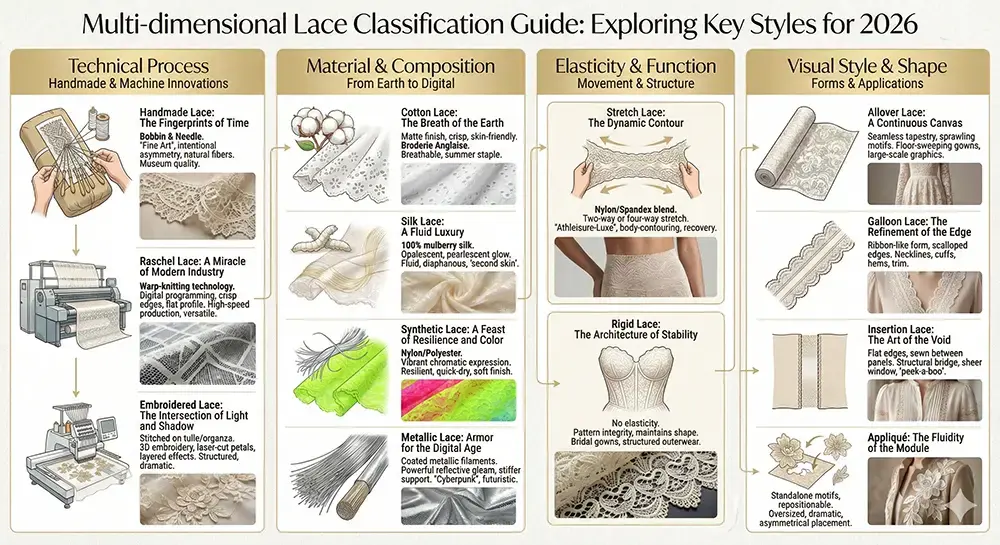
By Elasticity & Function
Stretch Lace: Nylon and spandex are blended precisely to make stretch lace so versatile and have 2-way or 4-way stretch. It has become one of the significant trends in “Athleisure-Luxe” for 2026, blending both advanced performance and upscale fashion. It is known for being able to seamlessly conform/contour to your body’s shape, and to keep its shape over time; therefore, it won’t lose or sag in shape. In addition, it serves two functions — high-performance lingerie/bodysuits give necessary structural support to the body while providing a very intricate, breathable decorative feature.
Rigid Lace: Unlike its flexible counterparts, rigid lace has no elasticity and exhibits a permanent stable structure. It is normally woven with cotton or stiffer synthetic and silk yarns but its value lies within the integrity of the pattern. The purity of Rigid Lace is in the preservation of the designer’s intent by keeping motifs from distortion while they are manipulated or draped. Rigid Lace’s nature is ideal for building the internal structure of bridal gowns, voluminous hems, and sharply defined structured outerwear that require a permanent or sculpted shape.
By Visual Style & Shape
Allover Lace: The allover lace has become a large colourful tapestry of continuous motives being repetitively placed on an entire fabric width with no edges. It is similar to typical textile fabrics in that they can be cut in many different ways along a smooth line while providing a large and flowing appearance for long flowing gowns or bold silhouettes. In the coming year of 2026, we will see a transition from using traditional, repetitive floral prints to using large scale non-repeated digital graphic art—making every garment its own unique, modern masterpiece.
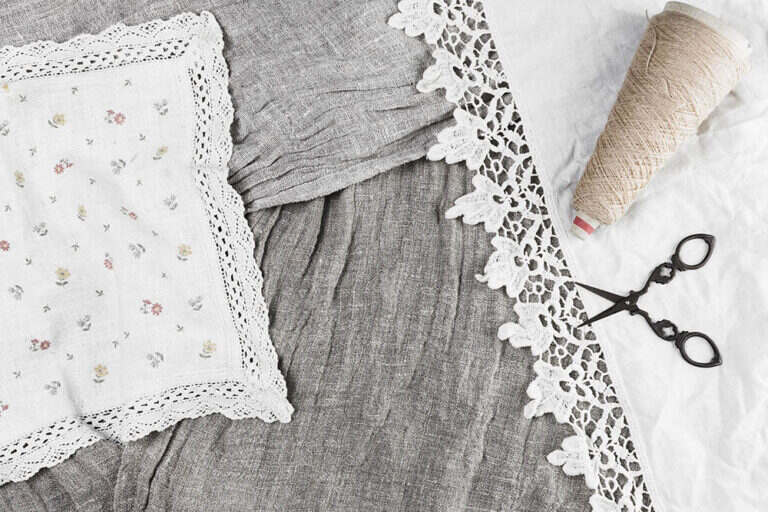
Galloon Lace: Galloon lace has a ribbon-lace appearance and is known for its ‘scallop’ edges. This versatile lace lends an elegant touch for the finishing detail at necklines and cuffs of underwear and at the bottom hem. In the year 2026, fashion is obsessed with the “art of margin” and Galloon lace will be creatively incorporated on unexpected surfaces—like the sharp edge of suit lapels and curated interior edges of upscale handbags.
Insertion Lace: Insertion lace exemplifies the elegance of a negative space. The two flat edge sides of the lace are intended for insertion between two textiles so that it serves as an invisible structural connector and a light companion to both. Included in the 2026 Victorian revival, artisans now choose this style to create more complex, ladder-like cutout shapes when adorning blouse bodices and sleeves with old-world, romantic appeal, giving sophistication and playfulness through a combination of transparent surfaces and peek a boo type characteristics.
Appliqué: In terms of lace appliqués, they can be considered fluid and unconnected modules – as an example, some appliqués could represent a single piece of artwork, such as flowers or geometric shapes. They can be hand-cut and moved to any base to fit within the designer’s overall vision. For the 2026 aesthetic, large and bold, asymmetrical placements can be used to make traditional silhouettes less monotonous and add a modern and dynamic feel to the design.
| Category | Lace Type | Primary Characteristic | Tactile & Visual Feel | 2026 Trend / Best Application |
|---|---|---|---|---|
| Technical Process | Handmade | Artisanal asymmetry | Whisper-soft, dense, natural fibers | Museum-grade archives & bespoke heirlooms |
| Raschel | Warp-knitted miracle | Flat profile, crisp, versatile | High-street fashion & everyday lingerie | |
| Embroidered | 3D-stitched on tulle | Structured, “growing” motifs | Dramatic visual anchors for evening gowns | |
| Material | Cotton | Matte & breathable | Crisp, static-free, skin-friendly | Summer resort wear & Broderie Anglaise |
| Silk | Pearlescent glow | Fluid, cool, “second-skin” thin | Luxury slip dresses & intimate layers | |
| Synthetic | Vibrant chromaticity | Resilient, quick-dry, soft finish | Neon accents & high-contrast blocking | |
| Metallic | Reflective gleam | Stiff, sculptural, iridescent | Cyberpunk aesthetics & futuristic gowns | |
| Elasticity | Stretch | Spandex blend | 4-way flexibility, high recovery | Athleisure-Luxe & contouring suits |
| Rigid | Pattern integrity | Unwavering stability, robust | Bridal architecture & structured outerwear | |
| Visual Style | Allover | Seamless tapestry | Continuous, borderless graphics | Floor-sweeping gowns & digital art prints |
| Galloon | Ribbon-like trim | Rhythmic scalloped edges | Refined margins on necklines & handbags | |
| Insertion | “The Void” bridge | Flat edges, sheer ladder-look | Victorian blouses & peek-a-boo details | |
| Appliqué | Independent module | Standalone motifs, 3D effect | Asymmetric placements & dramatic accents |
Lace by Application
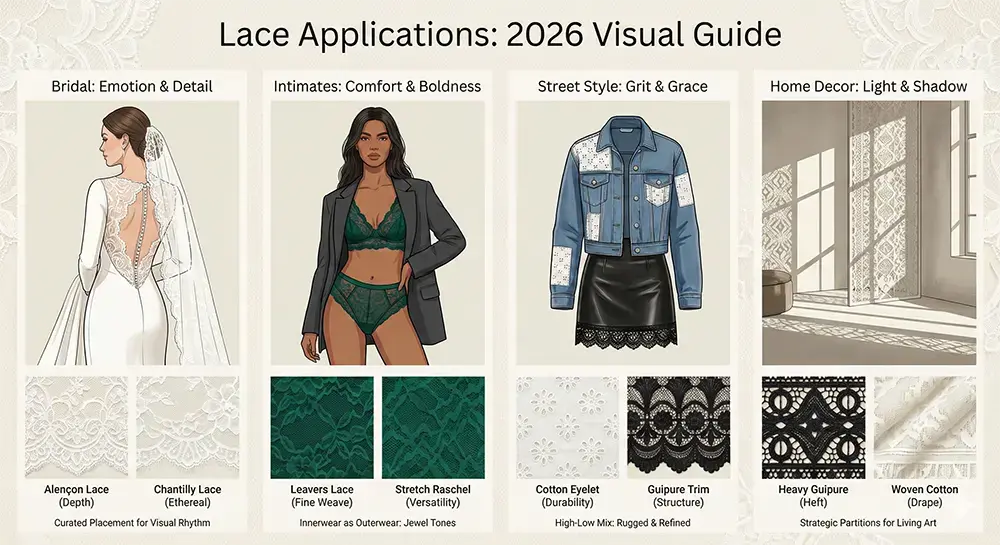
Bridal & Evening Wear
While lace has been used in many bridal gowns, as a textile, it represents more than bridal elegance and passion; lace also symbolizes bridal elegance and passion.
Selection Logic: Alençon, because of its dense construction, and Chantilly, due to its light and airy characteristics.
2026 Pro-Tip: Today’s brides are using lace more selectively than in the past. For instance, instead of using lace to cover the entire gown, she may use a strategically placed piece of lace at the back neckline of a gown that is entirely made of heavy satin or along the edge of a sophisticated cathedral veil that is three meters in length. This gives the illusion of having two distinct surfaces. The intricate detailing of lace contrasts beautifully with the smoothness of satin, and a classic design can be created by combining these two types of medium and allowing the eye to travel between each.
Luxury Lingerie & Intimates
Lace has been tested for its aesthetic appeal, as well as, its comfort against your skin. The best lace is LEAVERS lace, the very fine weave avoids any friction and is comfortable to wear for hours on end.
Selection Logic: For every day underwear, you could use STRETCH RASCHL lace and spandex, it will give you versatility in all areas.
2026 Pro-Tip: The craze for wearing “inner wear as outerwear” means that bold experimentation is encouraged. For example, try wearing a lace trimmed bralette under a loose tailored blazer. By doing this in a deep touch jaded tone, like an emerald or burgundy, you will enhance the beauty of the lace weave’s textured and craftsmanship qualities.
Ready-to-Wear & Street Style
As lace makes its transition into everyday life, it calls for an additional dose of “grit” to offset its fragility.
Selection Logic: The right fabrics to create your own lace jewellery: Select Cotton eyelet (also known as Broderie Anglaise) or Polyester mesh. Both of these fabrics are known for their durability and ease to care, so they can be laundered many times and do not require professional dry cleaning.
2026 Pro-Tip: Use the “high-low” method of mixing. The best photos taken from the street scene in 2026 show lace combined with rugged or industrial type fabrics. For example, a lace patch on a distressed denim jacket; 10cm wide of Guipure lace trim hanging below the hem of an architecturally structured leather skirt. The deliberate contrast of soft and hard is what attracts street-style photographers.
Home Decor & Lifestyle
Lace in the home is the magic of light and shadow; it’s the very essence of space being transformed by a textural medium.
Selection Logic: Go with heavyweight Guipure or woven cotton lace. When used for curtains or table coverings, heavier “heft” and drape will create soft and beautiful natural folds on windows or tables.
2026 Pro-Tip: Don’t think about getting complete floor-to-ceiling lace curtains. In the minimalist style of 2026, you’ll want to use elongated pieces of lace as partitioning screens. By hanging a piece of lace with bold geometric patterns as a projection screen, the light coming through the lace will cast dappled, architecturally shaped shadows onto the wooden floors, creating a unique work of art within the fast-paced living environment.