What is Chantilly Lace? The 2026 Complete Profile on the Queen of Fabrics
In 2026, where “quiet luxury” and the “old money” aesthetic have moved beyond mere trends into a permanent lifestyle, Chantilly lace stands as the ultimate signifier of taste. It’s a fabric that doesn’t scream for attention; it whispers of heritage, craftsmanship, and a level of detail that even the most advanced AI struggles to replicate.
Here is your deep dive into the “Queen of Lace” and why it remains the most coveted textile in the world today.
The Origin of Chantilly Lace
Chantilly Lace, which originated in the 17th Century from artisanal workshops established within its Namesake French town, was never created for mass consumption; it was made especially for members of the French aristocracy.
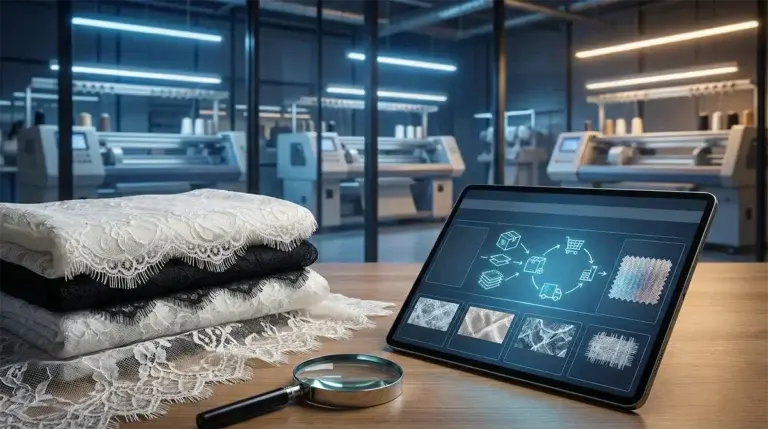
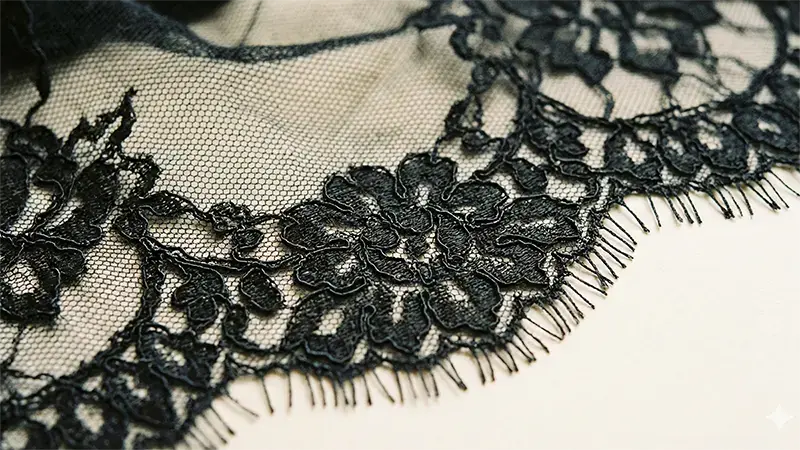
The main feature that differentiates Chantilly Lace from other thicker and more durable lace was that it was woven with a fine quality matte black silk known as Grenadine, which allowed for incredible detail and created a shadow play effect that appeared to be hovering on the skin.
Pronunciation and Naming
In order to speak like a fashion professional in 2026 you will need to use the soft sound for: ‘Ch’, instead of the ‘hard sound.’ The correct way to pronounce this amazing fabric is by saying: [Shan-ti-lee]. Chantilly originated in the town of Chantilly located in France. The lace that was created in this area was some of the most beautiful and highly skilled lace due to the techniques and skills used by the artisans who lived and worked in the area during the 1700s. This specific style of lace was created with such mathematical precision and extremely fine craftsmanship that the lace became an indication of proximity to the royal family and was therefore considered very prestigious when worn by the wearer.
What is Chantilly Lace Made Of?
Traditionally, Chantilly lace was created using a unique “Grenadine” silk—a delicate, non-glossy, black fiber that helped create the lace’s supernatural, light-as-feather quality. In 2028, advances in material science have occurred. While Mulberry silk still represents the highest level of luxury, there is an increasing use of bio-engineered and recycled high-tenacity nylons. With these materials, the lace has retained its signature “dragonfly wing” transparent quality while also increasing its ability to withstand the many stresses of modern wear and tear.
The Best Chantilly Lace in the World
The legendary birthplace of Chantilly lace in France is the Calais-Caudry region located in northern France. There is more to the Calais-Caudry region than just geography and history; there are also machines. Some of the best quality products known as “Chantilly” today continue to be created using Leavers looms, which are large, 19th-century mechanized looms that have been out of production for some time. These looms consist of thousands of individual parts and can take a single “master weaver” years to learn how to create a rhythm with one of these looms (its rhythm). Here, you will find the combination of tradition and modern fashion.
The Evolution of Chantilly Lace
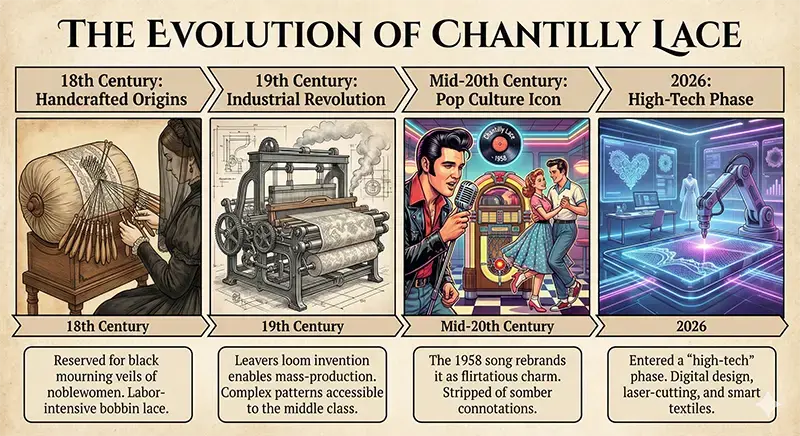
Bobbin lace was originally used by wealthy women to make special veils for their deceased loved ones. Making bobbin lace was a time-consuming process as it was done by hand with meticulous detail. The introduction of the Leavers loom in the early 1800s enabled lace manufacturers to produce intricate lace designs in large quantities making it possible for the middle class to have access to “The Dream of France.” The advent of “Chantilly Lace” in 1958 transformed bobbin lace from an item of mourning to an article of clothing, and bobbin lace will continue to evolve with the “high-tech” phase occurring in 2026.
Who Made Chantilly Lace Famous?
This unique craft has received the attention of many influential people, helping it to become a universal craft brand around the world. Madame de Pompadour (1700) was inspired by lace to create many fashionable styles for the court at Versailles. In the 1800s, Empress Eugenie’s black Chantilly lace gown created a craze for lace in Europe. The “Kate Middleton Effect” created renewed interest in delicate sleeved wedding gowns (adorned with flowers) after her wedding in 2011 and has set the bridal trend for the next 15 years.
Interesting Stories About Chantilly Lace
The transformation of the fabric took an unexpectedly sharp turn in 1958 when Jerry Lee Lewis released the song “Chantilly Lace” (originally by The Big Bopper) and the name of the fabric went from being a delicate and formal fabric used primarily in wedding gowns to a name representative of flirtation and sexiness in rock-and-roll music. The words “Chantilly lace and a pretty face” completely changed the perception of the fabric from one that was seen as a stiff historical object to one that was now seen as something exciting, fresh, and sexy. As we are now in 2026, we still see this duality in the fabric: it is still the virgin bride’s garment AND the femme fatale’s garment.
What Makes Chantilly Lace Unique?
Why is Chantilly Lace the Most Expensive?
Authentic Chantilly lace is reflective of something much deeper than price – mathematical complexity! Unlike other laces which have a thick outline called a “cordonnet” (a type of border), Chantilly uses different densities of the same fine thread to create shading and three-dimensionality. A single square meter of Chantilly may contain upwards of 12,000 individual threads, all dancing together in sync! The Leavers looms used to produce Chantilly lace operate very slowly because they break so easily when operated at higher speeds, so production yields are extremely low. Therefore, each yard of Chantilly lace becomes an extremely valued product.
Why is Chantilly Lace the Preferred Choice for Wedding Dresses?
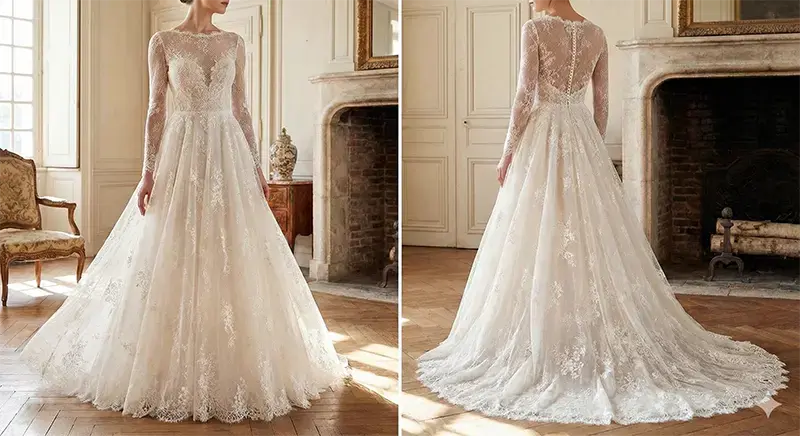
One significant factor that bridal designers of 2026 are using Chantilly is its light weight. The desire of brides today is to both dance and to move. Therefore, beadwork will ultimately weigh too much and make it more difficult to move while beading with lace work. The illusion is comparable to a “tattoo effect” which gives an image the appearance of floating directly on the body. The distinctive look provided by the eyelash trim (the thin, fringe-like edge) will have a soft, romantic appearance that no other lace will give for finishes on necklines and veils. The soft-focus lens on a camera is visually similar to this effect.
The Colors of Chantilly Lace
Is Chantilly Lace Just White?
Historically, traditionally, black was the primary color for Chantilly lace. The popularity of black Chantilly lace reached its peak in the 1800’s as black was considered the most fashionable color to wear while in mourning or for evening wear. Even though ivory and white continue to dominate the bridal marketplace, there has been a significant increase in “Midnight Jewel” colors for special occasion attire in 2026, especially pieces made from Chantilly lace. Darker colors such as emerald green, burgundy, and navy blue would have a much greater ability to showcase the delicate shadow patterns of Chantilly lace than would lighter colors like white or ivory.
What Colors Pair Well With It?
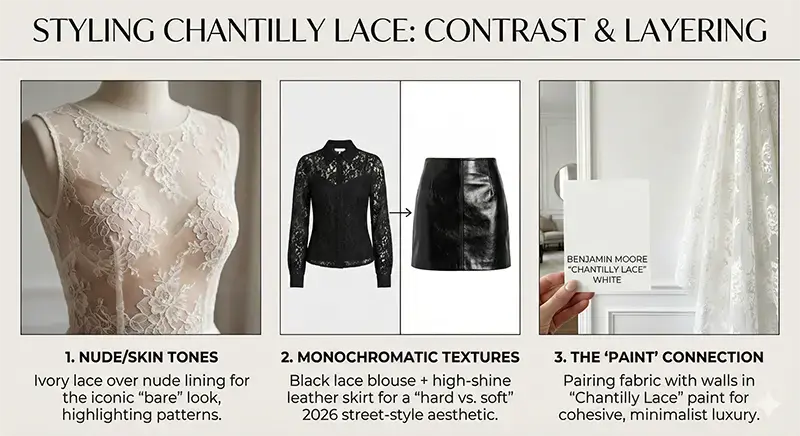
Contrast and layering are what define the style of chantilly lace.
Nude/Skin tones: by layering ivory lace over a nude lining you get the quintessential ‘naked’ look that highlights the lace’s pattern.
Monochromatic textures: combining a black chantilly lace blouse with a shiny leather skirt gives off the hard/soft juxtaposition that street-style photographers will be all over in 2026.
“Paint” Relation: ironically many people will pair this fabric with walls painted in benjamin moore’s “chantilly lace” white, providing a seamless, minimalist luxurious feel to any space.
Is Chantilly Lace Still in Style in 2026?
Where is it Still Produced?
In the year 2026, authenticity will be valued as the currency of the future. Numerous factories produce “Raschel” lace that provides similar looks to real Chantilly lace; however, there are still only a few traditional mills located in France where one can find this authentic lace; for example, such mills include Sophie Hallette and Solstiss. Many of these reginaly based authentic lace makers have maintained their tradition and continue to thrive through war and economic turmoil by taking advantage of the “Protected Geographical Indication” (PGI) status they received, hence if you are not purchasing from Calais or Caudry, you are not purchasing from an authentic lace manufacturer.
How to Tell Real from Fake?
If you want to buy quality products at the best price, pay attention to these three tips:
- Eye Inspection: Genuine Chantilly lace will be trimmed by hand at the edges. It should not feel “smooth” or look like machine cut.
- Light Test: When viewing in natural light, genuine Chantilly lace will have variations in stitch density that create depth; counterfeit Chantilly will appear “flat” or printed.
- Surface Check: Authentic Chantilly lace will have no raised threads or thick edges. Run your fingers over the flowers; if there is “bump” around them, it is most likely Alençon lace rather than Chantilly lace’s unique design.