What Is Eyelash Lace Fabric? A Complete Guide for Fashion & Bridal Designers
Published by Fuyuan Knitting | Estimated read time: 8 minutes
If you’ve ever admired the delicate, feathery edges of a bridal gown’s neckline or the soft fringe dancing along a lingerie hem, you’ve likely encountered eyelash lace fabric. Named for the fine, fringe-like threads that extend from its border — resembling a row of eyelashes — this textile is one of the most beloved materials in bridal fashion, luxury lingerie, and couture design.
In this guide, we’ll cover everything you need to know about eyelash lace fabric: what it is, how it’s made, the different types available, and how to choose the right variation for your specific design.
What Is Eyelash Lace Fabric?
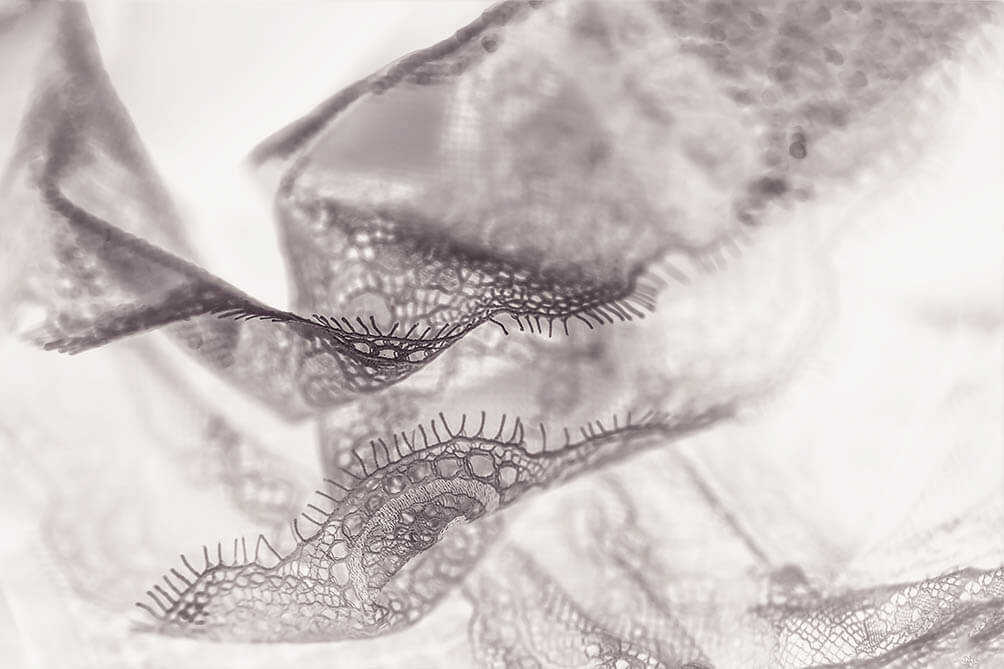
Eyelash lace fabric is a type of decorative lace characterized by its distinctive fringe-like threads that extend from one or both edges of the fabric. These fine, delicate filaments — typically 5 to 15mm in length — create a soft, wispy finish that evokes femininity and romance.
Unlike traditional Chantilly or Alençon lace, which are defined primarily by their internal pattern work, eyelash lace is distinguished by this signature edge detail. The “lashes” can be woven directly into the fabric structure or attached as a finishing detail, depending on the manufacturing method.
Eyelash lace is available in two main forms:
- Eyelash lace trim — a narrow strip (typically 1–30cm wide) used as a decorative border on garments
- Eyelash lace fabric — a full-width textile (typically 75–150cm wide) used as an all-over material for garments
Both forms share the same defining characteristic: that signature fringe edge.
How Is Eyelash Lace Made?
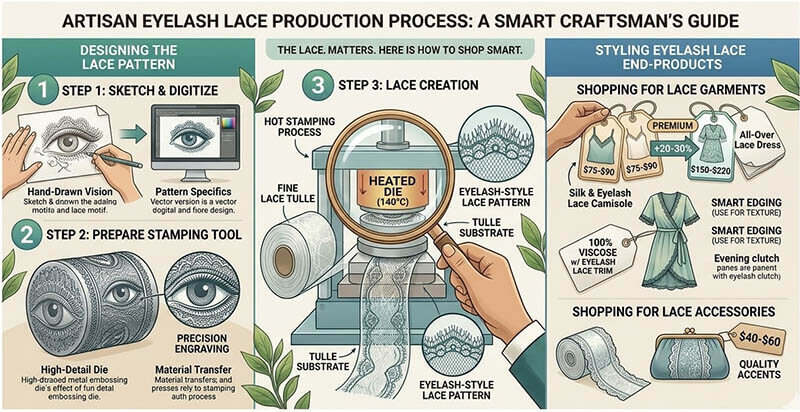
Understanding how eyelash lace is manufactured helps designers make better sourcing decisions and communicate more precisely with suppliers.
Raschel Warp Knitting
The most common production method for eyelash lace is Raschel warp knitting, a high-speed machine knitting process that creates intricate open-work patterns in a single pass. Karl Mayer Raschel machines — the industry standard — can produce wide-width eyelash lace fabric in continuous rolls.
In this process, the base lace pattern and the eyelash fringe are created simultaneously on the machine. The fringe threads are looped and then cut or left free during finishing to create the characteristic lash effect.
Materials Used
The most common fiber compositions for eyelash lace are:
| Fiber | Properties | Best For |
|---|---|---|
| 100% Nylon | Soft, lightweight, excellent drape | Lingerie, bridal overlays |
| Nylon + Polyester blend | Slightly more structured, cost-effective | Fashion garments, evening wear |
| Nylon + Spandex | Stretch properties, body-conforming | Swimwear, activewear trim |
| Polyester | More affordable, good color retention | Accessories, home décor |
At Fuyuan Knitting, we primarily work with nylon-based eyelash lace, as it delivers the superior softness and drape that bridal and lingerie designers require.
Types of Eyelash Lace Fabric
Not all eyelash lace is the same. Here are the main variations designers encounter when sourcing.
1. Classic Eyelash Lace
The most recognizable form, with a uniform fringe edge along one side of a fine mesh or floral lace base. Widely used as trim on bridal gowns, lingerie, and evening wear.
2. Double-Sided Eyelash Lace
Fringe extends from both edges of the fabric. Often used for overlays, shawls, or accent panels where both raw edges will be visible in the finished garment.
3. Chantilly-Style Eyelash Lace
Combines the intricate floral net pattern of Chantilly lace with an eyelash fringe edge. This is one of the most popular styles in bridal fashion — it adds a distinctly romantic, vintage-inspired feel to gowns and veils.
4. Corded Eyelash Lace
Features a thicker, rope-like cord outlining the lace pattern, giving it a three-dimensional quality and slightly more structured appearance. Ideal for bodices and structured wedding gown sections.
5. Stretch Eyelash Lace
Incorporates spandex or elastane into the base fabric, allowing for stretch and recovery. Primarily used in lingerie, swimwear, and fitted fashion garments where body movement must be accommodated.
6. Non-Stretch Eyelash Lace
The more traditional form, with no stretch. Used in bridal gowns, evening wear, and occasions where a stable, non-deforming textile is preferred.
Key Properties of Eyelash Lace Fabric
When evaluating eyelash lace for a design project, consider these technical properties:
Fringe (Lash) Length Standard lash lengths range from 5mm to 15mm. Shorter lashes create a subtle, refined look; longer lashes produce a more dramatic, statement effect.
Base Pattern The underlying lace pattern significantly affects the aesthetic. Common base patterns include:
- Fine mesh (most sheer and lightweight)
- Floral net (romantic, classic bridal)
- Geometric open-work (modern, fashion-forward)
Width
- Trim widths: 1cm to 30cm (used as decorative borders)
- Fabric widths: 75cm to 150cm (used as full garment material)
Transparency Most eyelash lace is semi-transparent to fully transparent. The degree of sheerness depends on the density of the base pattern and the fiber weight.
Weight Eyelash lace is generally lightweight — typically 50–120 gsm — making it ideal for layering over heavier base fabrics like satin or organza.
What Is Eyelash Lace Fabric Used For?
Eyelash lace is prized for its versatility. Here are the primary applications:
Bridal Wear
This is where eyelash lace truly shines. It appears as:
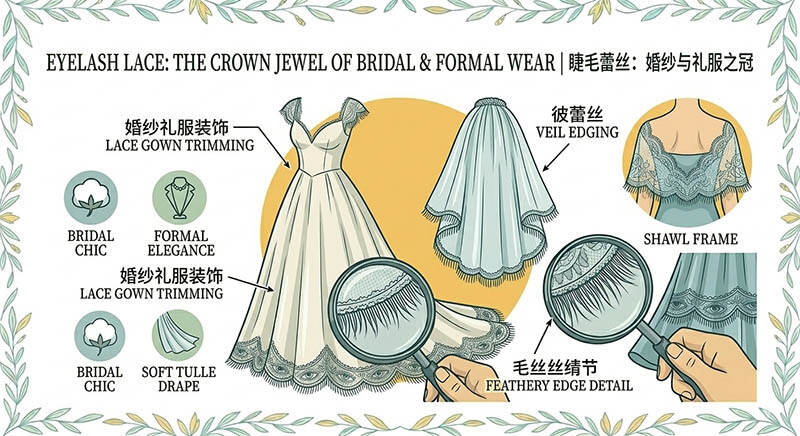
- Gown overlays — layered over satin or tulle for an ethereal effect
- Sleeve panels — creating delicate illusion sleeves
- Veil edges — one of the most iconic uses; the fringe softens the veil’s perimeter
- Neckline and hem accents — adding a finishing flourish
Lingerie
The softness and lightweight nature of eyelash lace make it a favourite for:
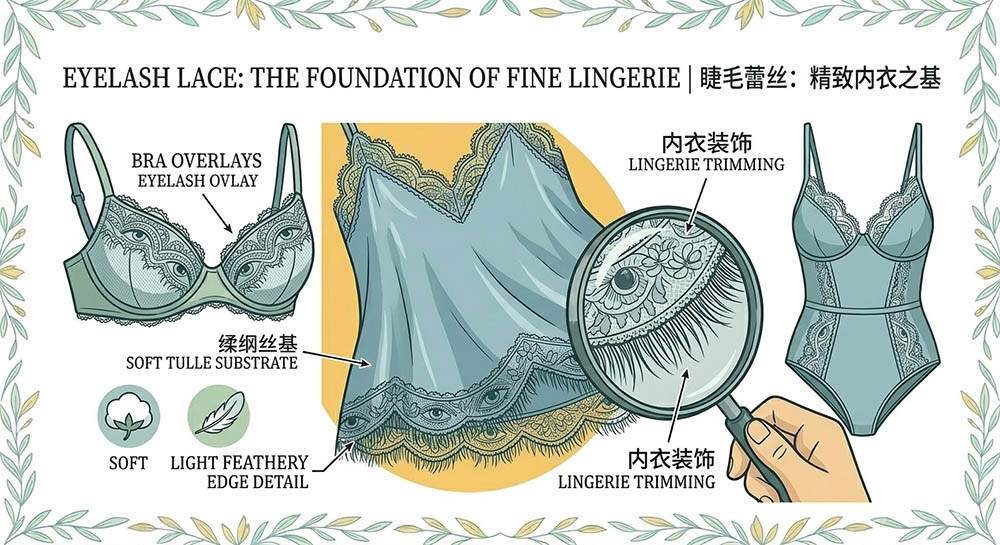
- Bra trims and underwire casing covers
- Slip and camisole hems
- Teddy and bodysuit fabric panels
Evening & Cocktail Wear
Designers use eyelash lace for:
- Dress overlays and skirt panels
- Décolletage accents on formal gowns
- Cape and shawl edging
Accessories
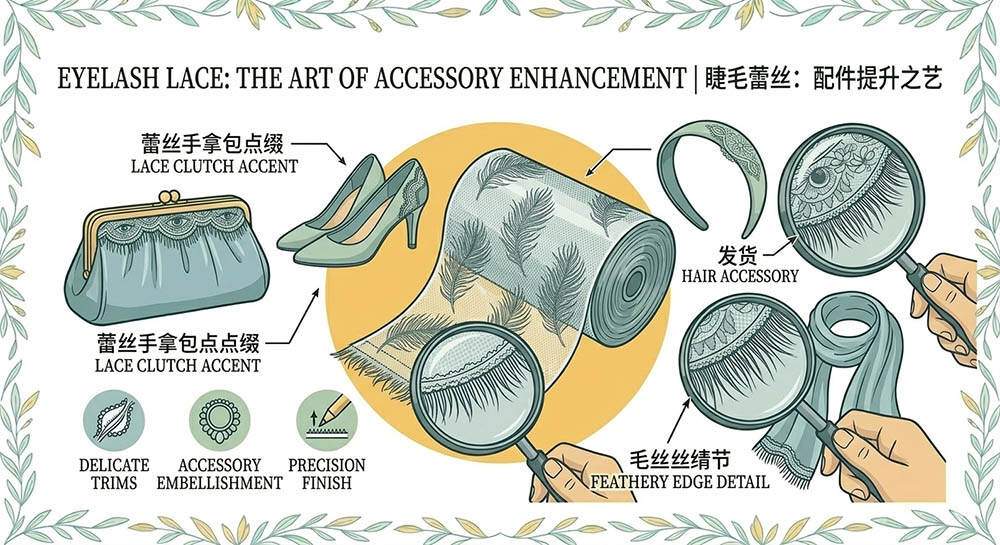
- Scarves and wraps
- Hair accessories (veils, headbands)
- Evening bags and clutch embellishments
Eyelash Lace vs. Other Lace Types: A Quick Comparison
| Feature | Eyelash Lace | Chantilly Lace | Guipure Lace | Embroidery Lace |
|---|---|---|---|---|
| Defining characteristic | Fringe edge | Fine floral net | Solid motifs, no mesh base | Embroidered patterns on mesh |
| Transparency | High | High | Low–Medium | Medium |
| Stretch | Available (with Spandex) | Usually none | None | None |
| Structure | Soft, fluid | Delicate, fluid | Structured, stiff | Medium |
| Primary use | Bridal, lingerie, trim | Bridal overlays | Wedding gowns, trim | Formal wear, bridal |
| Price range | $ – $$ | $$ – $$$ | $$ – $$$ | $$ – $$$$ |
For bridal designers, eyelash lace and Chantilly lace are often used together — Chantilly provides the body of the overlay while eyelash fringe finishes the hemline or cuffs.
How to Choose the Right Eyelash Lace for Your Design
For Bridal Gowns
Prioritize softness and drape. A 100% nylon base will move beautifully with the body. Choose a longer lash length (10–15mm) for a dramatic veil edge, or a shorter lash (5–8mm) for a refined hem accent. Ivory and champagne tones complement most skin tones and bridal palettes.
For Lingerie
Stretch eyelash lace (with Spandex) is essential for fitted pieces that need to conform to body movement. Look for a soft hand-feel and lash lengths of 8–12mm for a sensual, feminine finish. Black and nude colorways dominate this category.
For Evening Wear
Non-stretch eyelash lace in wider fabric widths allows you to cut pattern pieces for overlays and panels. A Chantilly-style base pattern adds elegance suitable for formal occasions.
For Trims and Borders
Narrow eyelash trim (2–8cm width) is the most cost-effective way to incorporate this fabric into a design. It can be applied to necklines, hems, sleeves, and cuffs of any garment type.
A Manufacturer’s Perspective: What to Ask Your Supplier
As a fabric manufacturer with years of experience producing lace for international fashion brands, we know that the details matter. Here’s what we recommend asking any eyelash lace supplier before placing an order:
- What machine is used for production? (Raschel warp knitting is the standard for quality eyelash lace)
- What is the lash length, and is it consistent across the roll?
- What fiber composition is the base fabric?
- Is OEKO-TEX Standard 100 certification available? (Essential for any garment with skin contact)
- Can custom colors be produced? (Pantone matching is standard among quality manufacturers)
- What is the minimum order quantity for custom work?
At Fuyuan Knitting, all our eyelash lace products are produced with OEKO-TEX Standard 100 certification, ensuring they are free from harmful substances — a critical requirement for bridal wear and lingerie that sits directly on skin.
Caring for Eyelash Lace Garments
Eyelash lace requires gentle handling to preserve its delicate fringe structure:
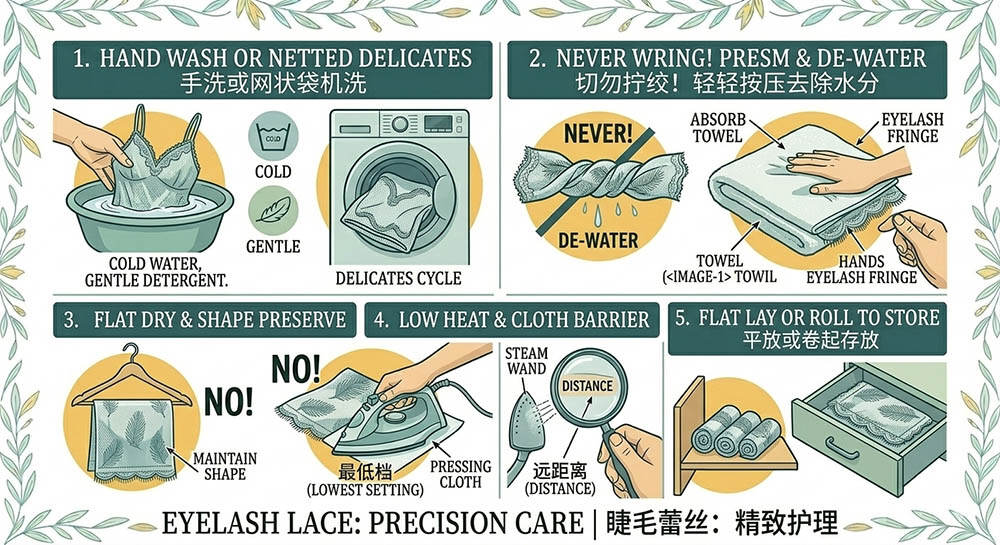
- Hand wash in cold water with a mild detergent, or machine wash on a delicate cycle in a mesh laundry bag
- Never wring or twist — press gently between towels to remove excess water
- Lay flat to dry on a clean, dry towel to maintain the shape of the lashes
- Iron on the lowest setting with a pressing cloth, or use steam from a distance — never apply a hot iron directly to the lace
- Store flat or rolled, never folded along the lash edge, to prevent permanent creasing of the fringe
Frequently Asked Questions
Is eyelash lace fabric stretchy? Standard eyelash lace has little to no stretch. However, stretch versions are manufactured with Spandex or elastane added to the base, making them suitable for lingerie and fitted garments. Always confirm the fiber composition with your supplier.
What’s the difference between eyelash lace trim and eyelash lace fabric? Eyelash lace trim is a narrow strip (typically 1–30cm wide) designed for use as a decorative border. Eyelash lace fabric is produced at full fabric widths (75–150cm) and is used to cut pattern pieces or as overlay fabric.
Can eyelash lace be dyed custom colors? Yes. Because most eyelash lace is made from nylon, it takes dye readily and can be produced to match Pantone or custom color standards. Minimum order quantities for custom dyeing vary by manufacturer — typically 50–200 meters per color.
Is eyelash lace suitable for machine sewing? Yes, with care. Use a fine needle (size 70/10 or 80/12), a slow sewing speed, and a walking foot or even-feed presser foot to prevent the fabric from shifting. Overlocking (serging) the edges is not recommended for the lash side — instead, finish with a narrow hem or leave the eyelash edge raw as a design feature.
How do I prevent eyelash lace from shedding? Some shedding of individual fringe threads is normal during cutting and initial wear. To minimize shedding, apply a small amount of fabric stiffener or clear-drying fabric glue to the cut edges (not the lash edge) before sewing.
Explore Eyelash Lace at Fuyuan Knitting
At Fuyuan Knitting, we manufacture a full range of eyelash lace fabrics and trims for bridal, lingerie, and fashion designers worldwide. Our products are:
- Produced using advanced Raschel warp knitting technology
- Available in full fabric widths and trim widths
- OEKO-TEX Standard 100 certified
- Customizable in color, lash length, and pattern
- Supported by sample programs for new customers
Whether you’re sourcing for a bridal collection, a lingerie line, or a fashion-forward evening wear range, we’re here to help you find the right eyelash lace for your design vision.
[Browse Our Eyelash Lace Collection] | [Request a Free Sample] | [Contact Our Team]
Fuyuan Knitting is a professional lace and fabric manufacturer based in China, serving fashion designers, bridal manufacturers, and apparel brands worldwide. All products are available with OEKO-TEX and GRS certification documentation.