What is Modal Fabric? Everything You Need to Know in 2026
If you’ve ever pulled on a T-shirt and thought, ‘This feels too good to be cotton’—there’s a solid chance you were wearing modal. In recent years this fabric has quietly taken over the textile industry, showing up in everything from high-end loungewear to budget basics. Yet despite its growing presence on clothing tags, most people still have no idea what modal actually is, where it comes from, or whether it deserves its eco-friendly reputation.
This guide breaks all of that down in plain terms: what modal fabric is, exactly how it’s manufactured, how it stacks up against cotton, lyocell, and viscose, where it’s used, and whether calling it ‘sustainable’ is genuinely warranted or just marketing spin.
What Is Modal Fabric?
Modal is a semi-synthetic fiber—a member of the broader rayon (regenerated cellulose) family—made from the pulp of beech trees. It sits in an interesting middle ground: not fully natural like cotton or linen, but not fully synthetic like polyester or nylon either. The cellulose that makes up the fiber is 100% plant-based, but the manufacturing process that converts raw wood pulp into a wearable textile involves a series of chemical steps.
The result is a fiber with the breathability and softness of a natural material combined with the consistency and durability you’d expect from an engineered one. Think of it as nature’s raw material, refined.
Where Modal Fits in the Rayon Family
The creation of rayon has evolved into two phases, with Modal now being the new phase. Imagine the timeline of rayon as an evolutionary process; this means rayon production was developed at different times and eventually turned into today’s fabrics. Viscose is the first generation of rayon fibers and was invented in the 1880s, making it the first regenerated cellulose fiber that could be used as a fiber for clothing. The downside of using viscose is its significant amount of chemicals required and being extremely weak when wet (when the fabric saw any moisture, it was incredibly weak and would not hold its shape after becoming wet). Because of these downsides, Modal was created to improve on these shortcomings by having much greater “wet strength” (doesn’t weaken too much with moisture) and lower shrinkage than viscose.
Other Names You Might See
Modal is commonly labelled or described by various names on garment tags or product listings including HWM rayon (High Wet Modulus Rayon) which is a technical term applied to both modal and standard viscose rayon; this is a distinct name used for modal vs standard viscose rayon in both industrial standards and certifications such as Oeko-Tex. TENCEL modal is a registered trade name of Lenzing AG, an Austrian company that manufactures the most recognized certified version of this particular type of fibre. Micromodal refers to a very fine version of this fibre, and has a noticeably softer feel than regular modal; it is frequently found in high-end underwear products.
A Brief History
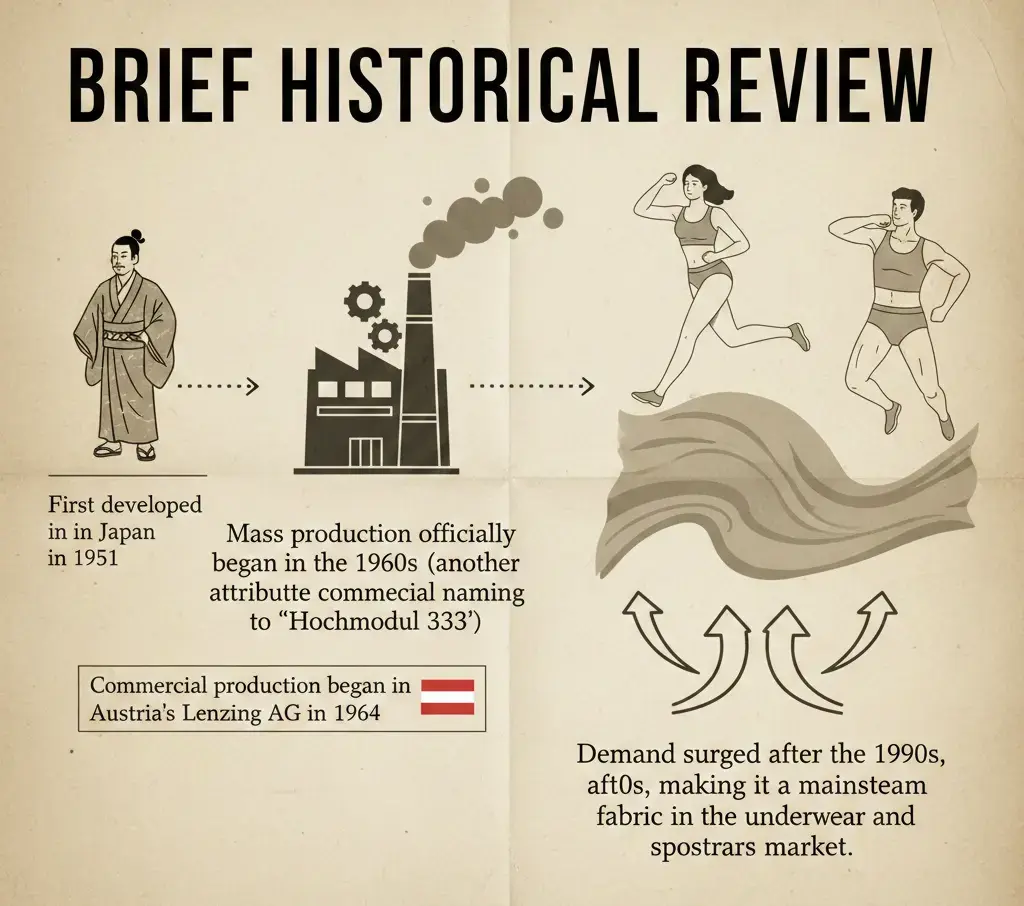
The development of modal traces back to Japan in 1951, where researchers were experimenting with ways to improve on standard viscose rayon. Commercial production began in the 1960s—the name itself reportedly derives from ‘Hochmodul 333,’ a German-language term referencing the fiber’s high modulus (resistance to stretching when wet). Lenzing AG in Austria began its commercial-scale production in 1964 and subsequently developed the TENCEL Modal brand as its certified, traceable offering. By the 1990s demand had picked up substantially, and through the 2000s modal cemented its role as a go-to material in sustainable and performance-oriented fashion.
How Is Modal Fabric Made?
Raw Material: The Beech Tree Advantage
Modal’s feedstock is a type of beech tree that is procured from Austria and surrounding Central Europe, and it is primarily derived from beech trees. The ecological advantages of beech trees include: experiencing high yield when grown in dense stands; are able to reproduce naturally with reasonable forest management; and don’t require the same level of deforestation or land clearing that is typically required by cotton. In addition, Lenzing sources modal beech trees from FSC and PEFC-certified managed forests with established replanting strategies.
When evaluating sustainability claims regarding modal, one should note that while it is true that ‘beech trees require irrigation’, the production of modal actually does use a large amount of water during the papermaking and chemical processing.
Step-by-Step Production Process
1. The logs of Beech trees are stripped of their outer bark and processed in large scale wood chippers turning them into small fragments. These fragments will be about the size of a postage stamp in character.
2. In order to extract cellulose, the chips are cooked in a chemical solution that dissolves all non-cellulose portions of the beech wood, including lignin. Once all the non-cellulose components have been removed from the chips, they are then compressed into flat, white sheets of pure cellulose.
3. Following cellulose extraction, the cellulose sheets are immersed in a sodium hydroxide (NaOH) solution, at a much less concentrated solution than would be found with regular viscose production. When the cellulose sheets are immersed in the NaOH solution, they swell up and become more chemically reactive.
4. The alkalized cellulose is passed through a shredding machine and is then aged, until it has become a viscous orange liquid. The viscous orange liquid is prepared for the next step, known as xanthation, through the addition of carbon disulfide (CS₂), creating sodium cellulose xanthate.
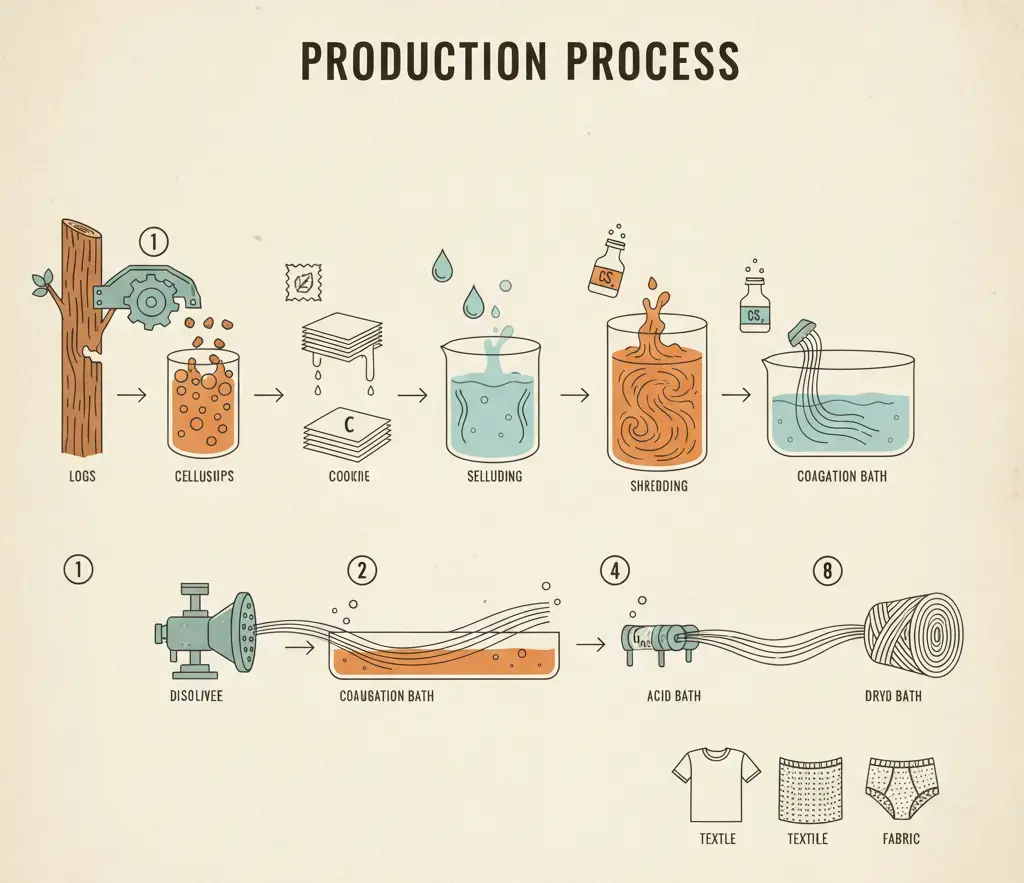
5. Once the creation of sodium cellulose xanthate is completed, it is dissolved in dilute sodium hydroxide. The new xanthate made in the previous steps will be used in the final step to make the viscose dope or wet spinning solution.
6. The viscose dope produced in the previous step will then be forced, using high pressure, through small openings in extrusion spinnerets. The viscose dope that is extruded from the spinnerets will enter a chemical coagulation bath, and when the moist dope exits the spinnerets, the dope will solidify into long, continuous filaments.
7. After exiting the spinnerets, the long, continuous filaments will pass through a sulfuric acid bath, where they will be drawn out in length creating strong modes of cellulose and enhancing their overall performance when they are completely dry, which is much improved compared to typical viscose products.
8. Once all of the filaments are dry and have no residual chemicals left and the filament being wound into a yarn, they can be woven or knitted into fabric products.
How Modal Differs from Standard Viscose
In step 7, standard viscose fibers are generally coagulated and collected without any significant tension drawing. Therefore, the cellulose chains in these standard viscose fibers are somewhat randomly oriented. In contrast, during the drawing of modal, cellulose chains are forced to align more closely with the fiber axis, resulting in improved tensile strength (particularly after wetting), reduced shrinkage, and greater retention of the shape of the fiber after multiple cycles of washing than the standard viscose fibers. Additionally, modal uses lower concentrations of chemicals and produces fewer hazardous byproducts per kilogram than standard viscose fibers; however, neither process can be considered a truly clean chemical process.
Modal Fabric Properties
Comfort and Feel
Modal’s reputation as one of the most comfortable fabrics available comes from its very fine yarn size compared to most cotton. As a result, modal fabrics have a noticeably softer surface when woven or knitted than cotton. When worn next to your skin for extended periods of time (like underwear, base layers, and sleep shirts), modal fabrics do not have prickly fiber ends or rough textures. Modal also performs exceptionally well as a result of its low-friction properties; that means there is less friction on your skin and therefore less chance of creating an irritation or injury while moving — which explains why it is so frequently used in athletic and yoga apparel.
Moisture Management and Air Circulation
Modal has been proven to absorb approximately 50% more moisture than cotton. This significant increase in moisture absorption leads to several benefits during physical activity: Sweat can be wicked away from the skin much more quickly than with cotton; wet modal fabric will not cling to your body; and wet modal will dry out quickly enough to remain comfortable during moderate-intensity levels of exercise. Modal is not a true performance fabric such as engineered synthetics, but it manages moisture very well at low and moderate levels of activity and is much less synthetic feeling than polyester.
Durability
Modal is produced using a wet modulus which results in a far better resistance to stretching beyond the normal range than that of conventional viscose yarns. As a result, modal garments are much more durable than standard viscose garments, as modal maintains both its dimensional stability after multiple washes and enables modal fabrics to retain their colour vibrancy better than viscose. In addition, modal has a migratory process for the development of pilling, therefore, modal pilling occurs at a much lower frequency compared to cotton due to modal’s longer and smoother fibres do not break down as easily due to wear and tear when compared with the shorter and coarser fibre of cotton.
Care and Maintenance
Modal is usually machine washable which allows modal to be cared for much better than most other soft fabrics, which typically require hand washing or dry cleaning. It is recommended to wash modal using cold to warm water on a gentle setting. The best way to dry modal is to avoid high heat; using high heat will cause modal fibres to shrink and become less soft over time. If ironing is needed, it is safe to use a low heat setting on your iron. Please note that using chlorine bleach will cause irreversible damage to modal.
Advantages
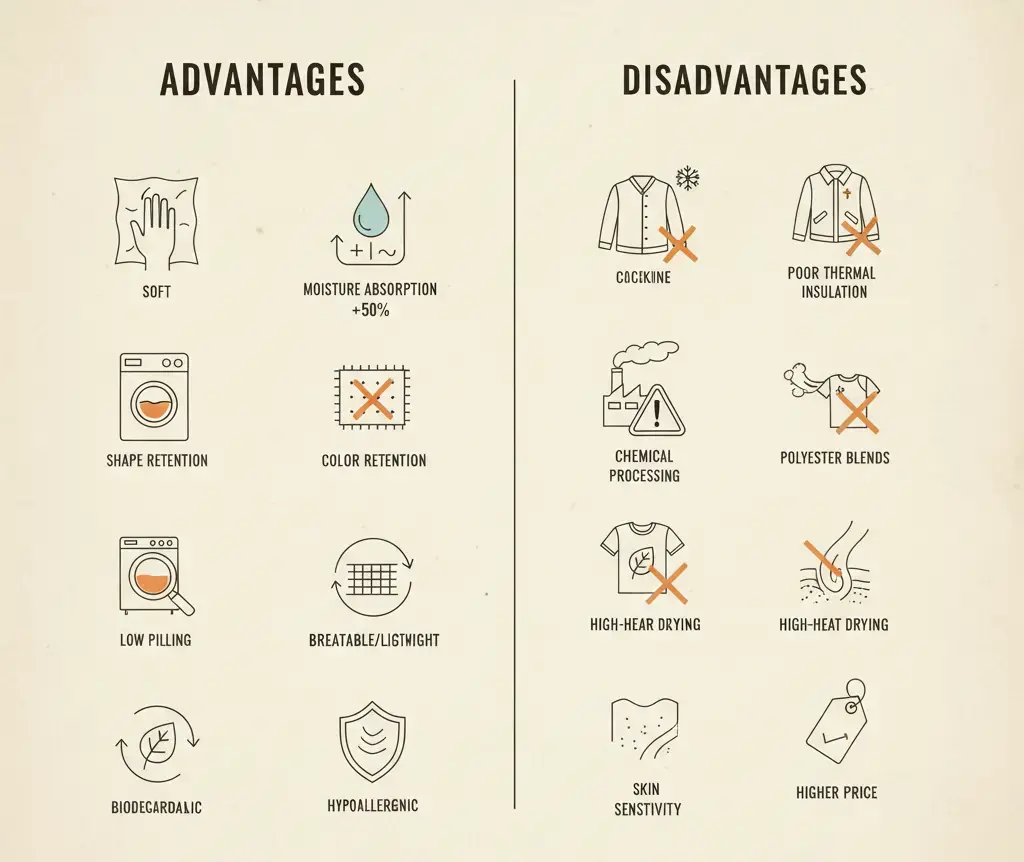
- Exceptionally soft hand feel—noticeably smoother than cotton
- 50% higher moisture absorption than cotton, stays dry longer
- Resists shrinking and shape distortion through repeated washing
- Minimal pilling due to long, smooth fiber structure
- Excellent color retention after dyeing
- Breathable and lightweight—suitable for warm climates
- Biodegradable under industrial composting conditions
- Generally hypoallergenic (when certified Oeko-Tex Standard 100)
Disadvantages
- Poor thermal insulation—not suitable for heavy outer layers
- Chemical processing raises environmental concerns if not tightly regulated
- Less eco-friendly when blended with polyester (eliminates biodegradability)
- Can be sensitive to high-heat drying and tumble-drying on hot cycles
- Some individuals may react to residual dyes or finishes (choose certified products)
- Price point is higher than standard cotton or viscose
Modal vs. Other Fabrics
Understanding what modal is becomes clearer when you put it next to the materials it most often competes with. Each fabric has specific strengths, and the right choice usually depends on what the garment needs to do.
Modal vs. Cotton
Cotton remains the default for most consumers, but modal edges it out on several performance measures. The most obvious difference is softness—modal consistently wins in side-by-side touch tests. On moisture management, modal’s absorption advantage helps it stay drier longer during activity. Where cotton has the upper hand is in naturalness (nothing artificial in the raw fiber) and price. For everyday basics on a budget, cotton still makes sense. For skin-contact items where comfort over time matters, modal is worth the modest premium.
| Feature | Modal | Cotton |
| Softness | Very high – smoother fiber | Moderate |
| Moisture Absorption | ~50% higher than cotton | Baseline |
| Shrink Resistance | Excellent | Tends to shrink without treatment |
| Durability (washes) | High | Moderate |
| Environmental Impact | Lower water use in fiber production | High water and pesticide use |
| Naturalness | Semi-synthetic | 100% natural |
| Cost | Higher | Lower |
Modal vs. Lyocell (TENCEL)
Both modal and lyocell come from regenerated cellulose and both are produced by Lenzing AG under the TENCEL brand umbrella. The key manufacturing difference is lyocell’s closed-loop solvent system, which recaptures up to 99% of the chemicals used—making it considerably cleaner to produce. In use, lyocell is stiffer and has a slightly rougher texture than modal; modal is typically silkier. Lyocell tends to be used in structured garments and denim-weight fabrics; modal is preferred for soft knits, underwear, and anything worn against skin.
| Feature | Modal | Lyocell (TENCEL) |
| Production Process | Chemical (NaOH / CS₂) | Closed-loop solvent (NMMO) |
| Softness | Higher – silky texture | Slightly stiffer |
| Environmental Profile | Good | Better (closed-loop) |
| Best For | Underwear, knits, sleepwear | Structured garments, denim blends |
| Price | Moderate | Moderate to high |
Modal vs. Viscose Rayon
Modal is essentially an improved viscose. Both use a similar chemical process and beech or other wood pulp as raw material. But modal’s tension-drawing step during production yields a fiber with meaningfully higher wet strength, less prone to stretching or losing shape when laundered. Standard viscose can feel quite limp when wet and shrink noticeably; modal doesn’t. If you’re comparing labels in a store and see ‘viscose’ on one and ‘modal’ on the other at a similar price point, modal is the better long-term buy.
| Feature | Modal | Viscose Rayon |
| Wet Strength | High (HWM process) | Lower |
| Shrink Resistance | Good | Poor without treatment |
| Chemical Use | Lower concentration | Higher concentration |
| Durability | Better | Moderate |
| Cost | Slightly higher | Lower |
Modal vs. Polyester
The two types of material are very similar to each other as they have overlapping purposes (casual basics and athletic clothing); however, they have very different characteristics when compared to each other. Polyesters are very durable, cost-effective and retain heat well, which make them a great choice for use as cold weather layers. Modal is lightweight, biodegradable (environmentally friendly), and is much more comfortable next to the skin than polyester. Every time you wash a garment containing polyester, microplastics will be released into your household water supply and eventually end up in our oceans. Modal does not shed these microplastics. If you plan to wear this fabric next to your skin in warm weather, modal is the better option. However, if you’re looking for an outdoor gear that holds up well under tough conditions, polyester and polyester blends are usually more effective.
| Feature | Modal | Polyester |
| Breathability | High | Low |
| Softness | High | Moderate (can feel plastic-y) |
| Moisture Wicking | Good absorption | Wicks but doesn’t absorb |
| Environmental Impact | Biodegradable | Sheds microplastics, not biodegradable |
| Durability | Good | Very high |
| Cost | Moderate | Low |
Modal vs. Micromodal
Micromodal is simply modal spun from ultra-fine fibers—each strand is thinner than a standard modal filament, resulting in a fabric that’s even lighter, softer, and more elastic. Where standard modal already beats cotton on softness, micromodal takes that comparison into silk-and-cashmere territory. The tradeoff is price: micromodal garments—often underwear from brands like Hanro or Icebreaker—carry a significant premium. For most everyday purposes, standard modal is more than sufficient. Micromodal earns its cost in garments where extraordinary next-to-skin comfort is the primary design goal.
Common Uses of Modal Fabric
Modal has an extraordinary versatility of uses because of its abilities to be soft, manage moisture, and be durable. Here are the ways it can be used:
Underwear/base layers – Modal is best known for underwear/base layers. Its softness, ability to absorb moisture, and ability to hold their shape make it the go-to fiber to use for bras, briefs, boxers, and fitted undershirts. Wearing clothing in direct contact with skin benefits from reduced friction and pilling.
Athletic/yoga wear – Modal provides the breathability and stretch (especially with knitted constructions) to fulfill the needs of moderate-intensity workouts. Although it may not be sufficient for high-sweat workouts when you require a technical performance fabrication, it is still an excellent option for yoga, Pilates, and from-studio-to-street looks.
T-Shirts and casual tops – Modal T-Shirts have a very flattering drape, last longer than cotton in terms of maintaining their color, and appear to be newer after going through washing cycles than cotton.
Sleepwear/loungewear – Because modal can retain its softness and help regulate body temperature, it is an obvious material choice for pajamas and robes, where comfort during prolonged skin-to-skin contact is an important design feature.
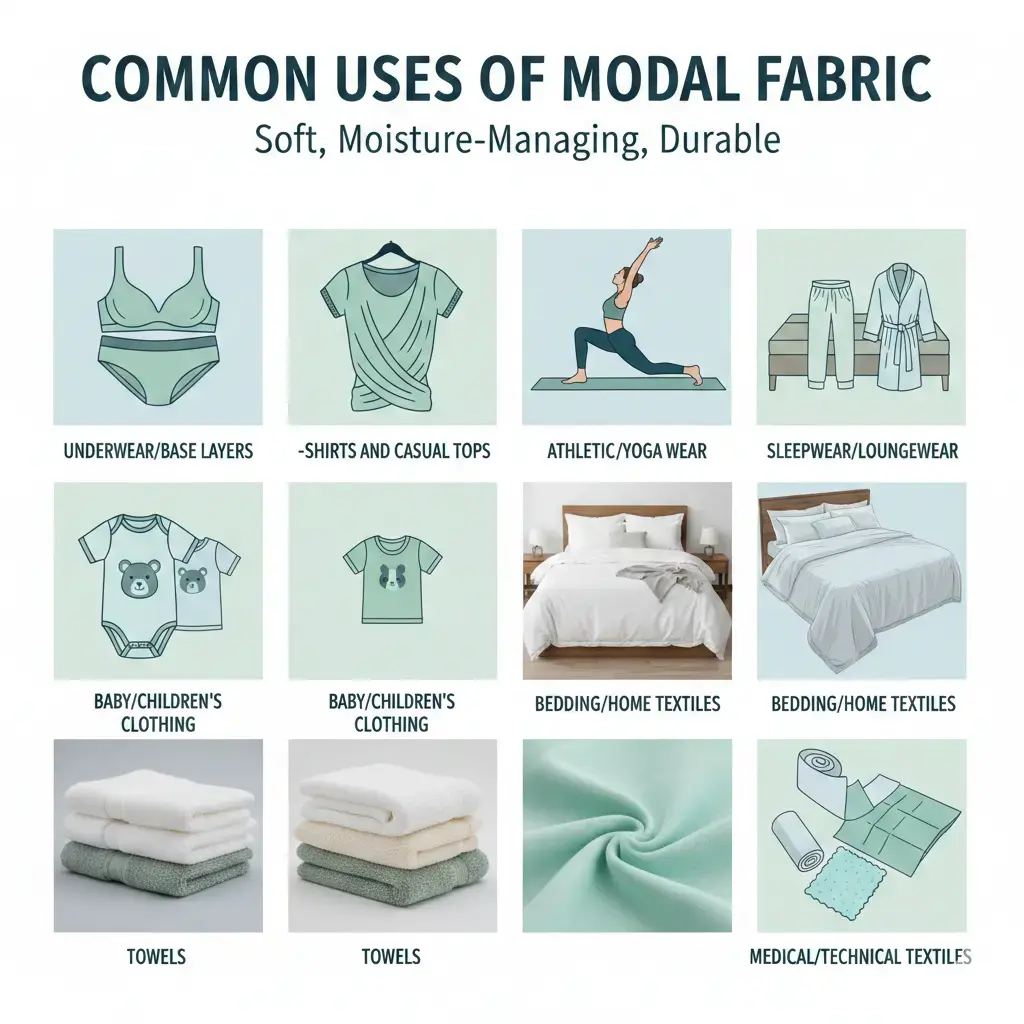
Baby/ children’s clothing – The soft feel of modal and breathability of the fabric makes it a good option for baby clothing, especially when it is sourced from chemical-free and certified suppliers.
Bedding/home textiles – Often, modal bedding will have a thread count of 300 or more, providing you with a softer sleep surface that is comparative to luxury cotton percale and much lighter in weight.
Towels – One of the most significant benefits of modal when used in towels is its high level of absorbency. Modal has long-term softness as compared to terry cotton for many washes.
Medical/technical textiles – Modal has had many uses due to its ability to absorb moisture and its non-allergenic properties, such as in wound dressings, surgical drapes, and industrial cleaning cloths.
Is Modal Fabric Actually Eco-Friendly?
This is the question that comes up most often when modal enters a conversation about sustainable fashion—and it deserves a careful answer rather than a yes/no.
The Case for Modal as an Eco-Friendly Fiber
The traditions surrounding the manufacture of modal definitely contribute to its green reputation. Beech trees are cut down in Central Europe, which is not irrigated and has no use of pesticides and have an FSC or PEFC compliant replant cycle. The source material from which certified modal is produced comes from a much lower-impact material source compared to traditional cotton which uses a large amount of chemicals and water (the world’s most “chemical intensive” and “water thirsty” food crop). Finally, modal fiber will decompose in an industrial composting environment and is therefore less likely than polyester will remain in a landfill.
How to Tell If a Modal Product Is Actually Eco-Friendly
- TENCEL brand or similar — This means the fibre is made by Lenzing and has a verified chain of custody and environmental standard.
- FSC certified or PEFC certified wood pulps — This confirms the wood pulp comes from responsibly managed forests and must be replanted.
- Oeko-Tex Standard 100 Certification — This means that the finished garment has been tested for harmful chemical residue, including those from processing and construction. This is particularly important for garments worn against one’s skin.
- Brand Transparency — Brands that have publicly available lists of suppliers and perform environmentally responsible supplier audits are likely to provide actual evidence behind their claims of being ‘sustainable modal’.
- Blends — If the garment contains significant amounts of synthetic fibres, the sustainability aspect of the garment is weakened greatly.
Final Verdict: Is Modal Worth Choosing?
Modal has an established reputation for being a great material for everyday clothing due to the fact that it is very soft, it manages moisture much better than cotton, and it has been tested as being durable.
Modal out-excels standard viscose on almost every category and can go toe-to-toe with cotton in categories where comfort and longevity are more important than price or full naturalness.
In summary: if you care about wearing something that feels good and lasts, modal is worth the money. If you care about sustainable materials, choose a certified modal, and check what is blended with it.