What Is Viscose Fabric: Uses Sustainability and How It’s Made
Introduction
Rayon is a type of fiber known as viscose. It comes from purifying cellulose (usually from wood pulp) and dissolving it to make a new fiber. Viscose has become popular because of the feel and performance of the fabric: soft, flowing drape, breathable, and great absorption of color in both patterns and solids. In this article you will learn what viscose is, how it’s manufactured, how it performs, how to care for it, and what to consider when buying it. This information is directed toward American consumers, sewers, and small clothing manufacturers who need clear, easy to understand information without a lot of technical jargon.
What is viscose fabric
Rayon family and naming
Rayon is the general product family that includes many different kinds of products. Viscose is also one of the most widely used types of rayon globally. All of these products are categorized as man-made cellulosic fibers (MMCF’s). Modal, Lyocell and Acetate and Cupro are also considered to be man-made cellulosic fibers. A basic outline of viscose will show that it is the main type of rayon, and how it is produced via the wet-spinning method, which involves dissolving cellulose, to creating new fibers, as shown in the neutral overview of Rayon (viscose) on the overview page. Washington, DC, the Council of Fashion Designers of America has a materials database with an overview of materials, as well as an overview of the terminology for each of the types of rayon fibers.
Core characteristics and feel
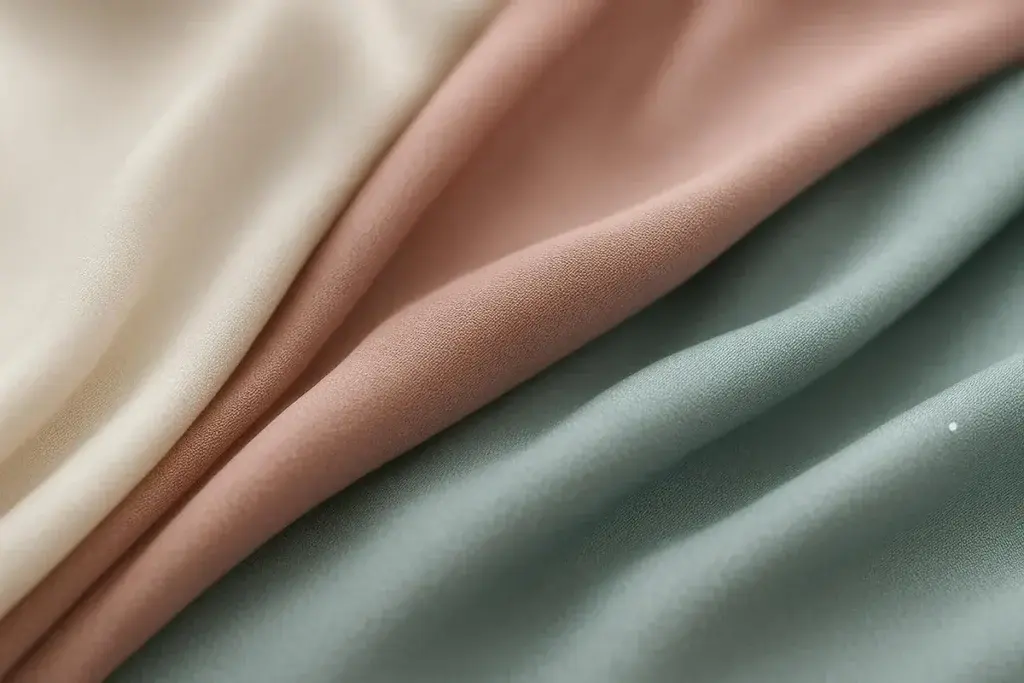
If you have worked with viscose challis or viscose sateen, it’s easy to see why it’s so appealing: it flows like water, feels cool against the skin, is breathable due to its hydrophilic cellulose content, and accepts dye brilliantly for vibrant colors. Because of its cellulose structure, it also wicks moisture from the body better than many synthetic fabrics, helping to keep you comfortable for long periods during hot days. However, because of the fiber structure and the way it is manufactured, the care required for each type will depend on the end use. More information will be provided below.
When viscose shines (and when it doesn’t)
Where it shines: flowy dresses, blouses, skirts, airy pants, scarves, and soft knits that are enhanced by motion and rich coloration. In the home, it is usually found in linings, blends with drapery fabrics, and bedding blends, where a cool/smooth feel is desirable.
Where it struggles: situations requiring high wet strength, heavy abrasion resistance, and/or crisp wrinkle recovery from washing. If you expect to be frequent washing and hot wash, aggressive tumble-drying, and hard wear, you would ideally prefer blends of other fibers (for example, polyester or nylon) or alternative fibers that are designed specifically for those conditions.
How it’s made and key properties
From pulp to fiber (step-by-step)
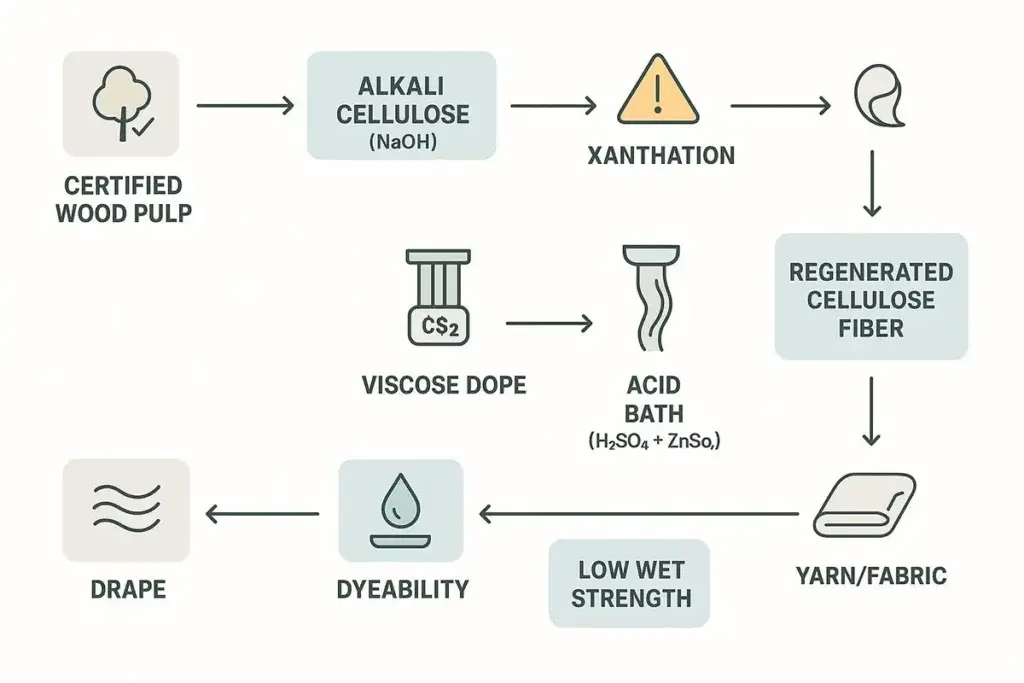
The classic viscose process uses a series of chemical and mechanical steps to dissolve cellulose and regenerate it as new fibers:
- Steeping and shredding: Purified wood pulp is steeped in a strong base, sodium hydroxide (NaOH). This forms alkali cellulose. The sheets are pressed and shredded into “white crumb,” then aged so the polymer chains reach a workable length.
- Xanthation: The crumb reacts with carbon disulfide (CS₂), creating cellulose xanthate—this is what makes the cellulose soluble in a dilute caustic solution. CS₂ is a toxic solvent used in this derivatization step.
- The viscose solution: The xanthated cellulose dissolves into a thick, honey‑like solution (“viscose”). It’s filtered and degassed to remove gels and air.
- Wet spinning and regeneration: The viscose is pushed through spinnerets (fine nozzles) into an acid bath, typically sulfuric acid (H₂SO₄) with other salts (like zinc sulfate). The chemistry reverses, regenerating nearly pure cellulose filaments.
- Wash, draw, and finish: Filaments are stretched to align molecules, then washed and finished before being cut into staple fibers or left as filaments and turned into yarn and fabric.
Good neutral explainers of these steps, including the wet‑spinning and acid regeneration, can be found in the Rayon (viscose) overview.
Performance in use (drape, breathability, color)
Process drives properties:
- Drape and softness: Fine, wet‑spun cellulose filaments with relatively low crystallinity yield the famous fluid drape and silky hand.
- Breathability and moisture: Regenerated cellulose is hydrophilic, so it takes up and releases moisture readily, supporting comfort in warm conditions.
- Color and print: Abundant dye sites in cellulose let viscose accept direct, reactive, and vat dyes for vivid shades and crisp prints, something highlighted in general rayon materials explainers like the Rayon overview.
Limits to watch (wet strength, wrinkling, shrinkage)
- Low wet strength: Hydrogen bonds that hold cellulose chains together weaken when wet; compared with dry strength, viscose loses a notable share of tenacity in water. That’s why gentle handling during washing matters.
- Wrinkling: The pliable structure that creates flowing drape also creases under pressure and moisture. Finishes and blends can help, but pure viscose typically wrinkles more than many synthetics.
- Dimensional change: Heat and agitation can drive shrinkage, especially in unstable constructions or loosely finished fabrics. Cold water, mild cycles, reshaping, and air drying counter this tendency.
Uses, care, and buying tips
Common apparel and home uses
You will find a range of viscose fabric in clothing from very light airy challis wovens for dresses and blouses to butter smooth jerseys for T-shirts and knit dresses; polished sateens or satins for special occasion clothing; and beautifully smooth linings.
In Home, you may see viscose blended with other fibres in drapery blends and sometimes in bedding or towels. Common combination partners for viscose are; polyester or nylon for wrinkle resistance and durability, linen for great breezy texture with even softer drape, cotton for a familiar hand with good colour retention and a little bit of elastane/spandex for recovery in knitwear and stretch wovens.
When looking for weight guidance use the usual practice base, but always check with your suppliers specific requirements for weight: usually light wovens such as challis range approximately 100 – 150 g/m², while single jersey knits (used for T-shirts) usually range 150 – 220 g/m². Because there are so many mills and types of finishes, treat these weights as guidelines and always check before cutting or ordering fabric.
Care essentials to extend lifespan
Always follow the care label to ensure that you are washing and drying your garments correctly. The GINETEX Global Table of Textile Care Symbols is a good reference for the meanings of the symbols on the care label and can help answer questions about washing temperature, tumble drying, bleaching, ironing, or having an outfit dry cleaned professionally.
- Washing: Use cold to warm water on the gentle or delicate cycle and wash only small loads that you can fully spin. To wash very delicate items, hand wash with a mild detergent and do not twist. If the care label says “dry clean” only, then it needs to be dry cleaned, noting that dry cleaning uses solvents, so weigh how often a garment needs to be dry cleaned against its needs.
- Drying: While damp, reshape garment and air dry. Knit garments should be positioned to dry flat to avoid pulling. Woven garments should be hung to dry as directed by the care label. Never tumble dry a garment unless the care label states it can be dried in the dryer; heat and agitation commonly cause shrinkage and wear.
- Ironing: Use a low or medium heat iron to press out the wrinkles on the back side of the garment, and place a thin cloth in between the iron and garment to prevent scorching. A great way to get out many of the wrinkles from a garment is to use a hand held steamer.
Why this works: Because Viscose has low wet strength when the fibres are soaked; they are weak, therefore gentle treatment and low temperature will protect the structure and help the garment keep its shape and finish.
Troubleshooting quick hits
- Shrinkage after wash? Soak in lukewarm water with a fabric conditioner, gently stretch along seams to original dimensions, then lay flat to dry. Severe shrinkage may be irreversible.
- Creasing set in? Use steam and a press cloth; avoid dragging the iron, which can create shine.
- Color bleeding on first wash? Pre‑soak with a dye catcher sheet in cold water and wash separately next time; vivid shades and prints can release excess dye initially due to viscose’s strong dye uptake.
Smarter buying: blends, labels, certifications
Blends can be your friend. Choose viscose‑polyester or viscose‑nylon when you need wrinkle resistance and durability; viscose‑linen for breathable summer pieces; viscose‑elastane for stretch recovery. Beyond the hang‑test and hand‑feel, labels and credible certifications help you judge sourcing and chemistry practices.
- Forest sourcing: Look for wood‑based inputs certified by programs like the Forest Stewardship Council. FSC explains what different labels (100%, Mix, Recycled) actually mean in its guide to labels and Chain of Custody. The Programme for the Endorsement of Forest Certification provides parallel assurances and regulatory context in its PEFC resources.
- Chemicals and emissions management: The EU Ecolabel for textiles defines manufacturing‑stage requirements, including emission thresholds relevant to viscose production (e.g., sulfur compounds to air, zinc and sulfate to water). See the European Commission’s EU Ecolabel product groups and criteria for the current framework.
- Harmful‑substance limits in finished goods: OEKO‑TEX Standard 100 indicates a finished textile meets strict limits for substances of concern by product class. It doesn’t certify how the fiber itself was produced; that is assessed by other OEKO‑TEX programs and facility audits.
- Deforestation risk screening: Many brands reference Canopy’s program to avoid sourcing from Ancient and Endangered Forests. The Canopy Hot Button resources summarize how MMCF producers are evaluated and where progress is happening.
Sustainability and better alternatives
Key impacts and improvements
Classic viscose uses carbon disulfide during xanthation, a step associated with worker‑health hazards if not well controlled. ATSDR summarizes human epidemiology linking CS₂ exposure to neurological and cardiovascular effects in its Carbon Disulfide Toxicological Profile (CDC, technical monograph). Beyond workplace exposures, viscose production can emit sulfur compounds to air and zinc/sulfate/COD to water if controls aren’t robust. The EU Ecolabel criteria for textiles outline emissions thresholds and control expectations at the manufacturing stage in the EU Ecolabel criteria documentation.
Forest sourcing is another hotspot: unless mills use recycled or credibly certified inputs, pulp can be linked to habitat loss. Forest‑certification systems such as FSC and PEFC aim to reduce this risk, and Canopy’s market tools encourage producers to shift toward low‑risk feedstocks and, increasingly, next‑gen alternatives like recycled cellulosics and agricultural‑residue inputs.
On the improvement side, leading viscose producers have implemented tighter chemical recovery, better emissions controls, and higher shares of certified wood inputs—a trajectory reflected in public frameworks like EU Ecolabel and in NGO tracking tools such as Canopy’s Hot Button assessments. While not uniform across the industry, these shifts signal that process choices and sourcing policies materially influence impacts.
What credible certifications signal
- Forest certifications (FSC, PEFC): They indicate responsible forest management and verified chains of custody for wood‑based inputs. They do not, by themselves, guarantee that 100% of the fiber in a mixed product is certified—pay attention to the specific label claim (e.g., “100%,” “Mix,” “Recycled”). See FSC’s labels explained and PEFC’s program resources for definitions.
- EU Ecolabel for textiles: Signals that the product meets lifecycle‑stage criteria, including restrictions and thresholds relevant to MMCF/viscose manufacturing. It is not a blanket “zero‑impact” claim but a standards‑based screen for better practices; the official EU Ecolabel criteria pages host the details.
- OEKO‑TEX Standard 100: Indicates the finished textile/article has passed strict harmful‑substance tests. It doesn’t replace facility‑level chemistry or environmental audits.
- CanopyStyle alignment: Indicates an MMCF producer has been evaluated for the risk of sourcing from Ancient and Endangered Forests and is making progress toward lower‑risk, next‑gen feedstocks. See Canopy’s Hot Button resources for methodology and producer standings.
Modal and lyocell: how they differ
Modal and lyocell are closely related to viscose but made differently.
- Modal: Often described as a modified viscose route tuned for higher strength and dimensional stability, modal is prized for softness that lasts through washes. Process improvements at leading producers typically include better chemical recovery and resource efficiency than generic viscose, though specifics vary by mill and certification. A concise manufacturer‑authored overview is provided on the TENCEL fibers page; treat branded claims as directional and verify with independent data where available.
- Lyocell: Uses direct dissolution of cellulose in N‑methylmorpholine N‑oxide (NMMO), skipping carbon disulfide derivatization. The process is widely recognized as “closed‑loop” because most solvent is recovered and reused; industry literature cites very high NMMO recovery rates. As with modal, performance depends on producer and finish, but lyocell commonly shows higher tenacity and good moisture management compared with generic viscose. For a plain‑language summary of lyocell’s process and properties, see overviews like TENCEL’s fiber explainer and neutral encyclopedic entries.
If you are interested in the softness and drape that viscose offers, but want a fiber that has more durable wet properties and is usually made with much stricter processing controls—then lyocell may be something to consider. If you desire something that feels silkier, resists stretching or bagging, and retains shape better than traditional viscose, then fabrics with modal as a major component may be for you. Whatever your needs, be sure to always examine the label and specifications (fabric type, blend(s), finishing, and certifications) when purchasing these products, as the method of construction and finishing will change performance of each of these fibers.