What Is Tencel Fabric? The Complete Guide to This Sustainable Textile
Check any clothing label these days and you will likely spot the word “Tencel” printed alongside cotton or polyester. It shows up on bed sheets, activewear, denim, and underwear. Yet most shoppers have no real idea what it is — a brand? A fiber? A sustainability claim?
Tencel is a branded name owned by Austrian textile company Lenzing AG, covering a family of semi-synthetic fibers made primarily from wood pulp. Over the past decade it has moved from a niche sustainable option to a mainstream fabric choice, thanks to its unusually soft feel, moisture management, and a production process that recycles nearly all its solvents.
This guide covers everything you need to know — what Tencel actually is, how it is made, the different types available, its strengths and weaknesses, how it stacks up against other fabrics, and how to care for it once you own it.
What Is Tencel Fabric?
Tencel is not a type of fiber in the way cotton or polyester is. It is a registered trademark owned by Lenzing AG, a company founded in Austria before World War II that has spent decades specializing in wood-based fibers.
Under that trademark, Lenzing produces two main fiber types: Lyocell and Modal. Both are derived from plant cellulose — usually eucalyptus, beech, or spruce trees — and both sit in the category of semi-synthetic fibers. “Semi-synthetic” means the raw material is natural, but the conversion into a usable fiber involves industrial chemistry.
A useful analogy: calling something “Tencel” is like calling a bandage a “Band-Aid.” Band-Aid is a brand; the product is an adhesive bandage. Tencel is a brand; the products are Lyocell and Modal fibers. Not all Lyocell is Tencel, but all Tencel-branded fiber is made to Lenzing’s specific standards.
A Brief Timeline
- 1972 — Courtaulds develops the earliest Lyocell-style process
- 1992 — Tencel brand launched by Courtaulds
- 2004 — Lenzing AG acquires the Tencel brand
- 2018 — Lenzing consolidates all branded fiber marketing under the Tencel name
How Is Tencel Fabric Made?
The manufacturing process is where Tencel separates itself most clearly from conventional semi-synthetic fibers like viscose/rayon. The key difference is the solvent system.
Step-by-Step
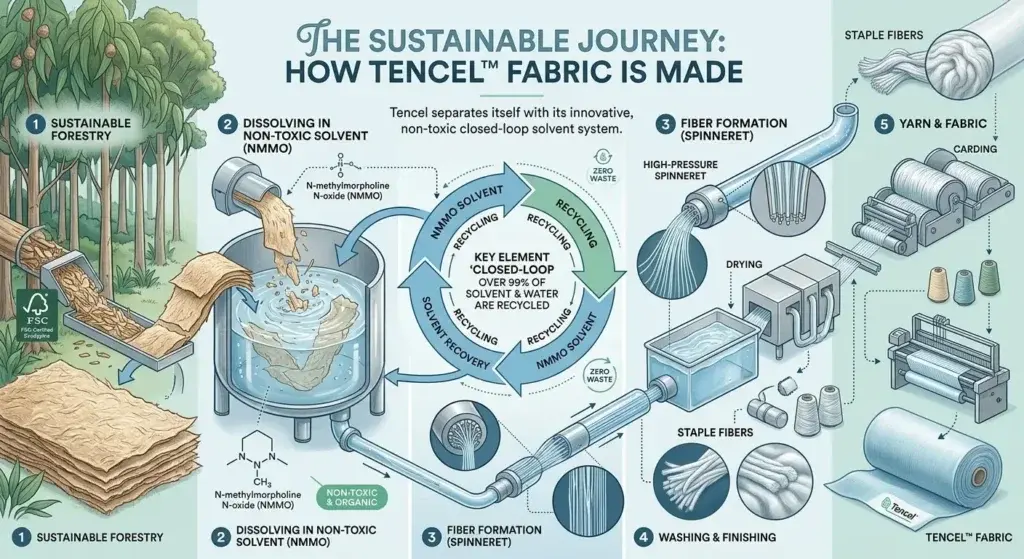
- Sustainably sourced wood (FSC-certified eucalyptus is most common) is chipped and processed into a dry wood pulp.
- The pulp is dissolved in a non-toxic organic solvent called NMMO (N-methylmorpholine N-oxide), creating a thick, viscous solution.
- That solution is pushed through fine spinnerets — essentially tiny nozzles — to form continuous fiber filaments.
- The filaments are washed, dried, and cut into the length needed for spinning into yarn.
- The yarn is then woven or knitted into fabric.
The Closed-Loop System
The defining environmental feature of the Tencel Lyocell process is solvent recovery. More than 99% of the NMMO solvent used in production is captured, purified, and re-used in subsequent batches. This near-zero discharge system is why Tencel holds the EU Ecolabel and has earned a platinum rating from EcoVadis.
Lenzing also operates its REFIBRA technology, which incorporates a proportion of recycled cotton scraps (at least 30%) alongside virgin wood pulp, further reducing waste.
Types of Tencel Fabric
1. Tencel Lyocell
Lyocell is the more widely known of the two Tencel fiber types. It is made primarily from eucalyptus wood pulp, which grows quickly, requires no irrigation in its native habitat, and needs no pesticides. The fiber has a slightly structured surface that gives it a subtle sheen and a crisp feel when dry, while remaining very soft against skin.
Best known for: bed sheets, casual shirts, light denim, activewear
Standout properties: high wet strength (does not go limp when damp), excellent moisture transport, biodegradable
2. Tencel Modal
Modal uses beech tree pulp and goes through a slightly different spinning process that produces a noticeably silkier, stretchier fiber. It is often compared to a middle ground between cotton and silk.
Best known for: underwear, loungewear, T-shirts, soft bedding
Standout properties: extreme softness, high resistance to shrinkage, retains color well after repeated washing
3. Specialty Variants
- Tencel Lyocell Micro — ultra-fine filaments that create a lightweight, almost gossamer-like fabric
- Tencel LUXE — a continuous filament version marketed as a plant-based alternative to silk; carries vegan certification
- Tencel with REFIBRA Technology — blends virgin Lyocell with recycled cotton waste, making it the most circular option in the Tencel lineup
4. Tencel Blends
You will frequently find Tencel blended with other fibers:
- Tencel + organic cotton — softens the texture of cotton, reduces the overall environmental footprint, and lowers the price compared to pure Tencel
- Tencel + elastane/spandex — adds stretch for fitted garments; note that this blend is not fully biodegradable
- Tencel + polyester — cheaper to produce but significantly reduces the sustainability credentials
Key Properties & Benefits
Tencel’s commercial success comes down to a combination of performance attributes that are difficult to find together in a single fabric.
| Property | What It Means in Practice |
| Exceptionally soft | Fiber diameter is finer than most cotton varieties; feels smooth directly against skin from the first wear |
| High moisture absorption | Absorbs moisture roughly 50% faster than cotton and wicks it away from the body, helping regulate temperature during sleep or exercise |
| Antibacterial | The fiber structure limits the moisture that bacteria need to multiply, reducing odor between washes |
| Hypoallergenic | Smooth fiber surface creates less friction; suitable for sensitive or eczema-prone skin |
| Pill-resistant | Longer fiber length and tighter fiber bonding means less surface fuzz compared to lower-quality cotton or acrylic |
| Drape and wrinkle resistance | Fabric hangs well and resists creasing better than linen or standard cotton |
| Biodegradable | Both Lyocell and Modal break down completely in soil — no microplastic residue |
| Excellent dye uptake | Cellulosic structure accepts pigments evenly, producing vibrant, long-lasting color |
Tencel vs Other Fabrics
Understanding how Tencel compares to the fabrics you already know makes it easier to decide when it is the right choice — and when it is not.
Tencel vs Cotton
Cotton will be the control fabric for most of you, so this is the most informative comparison.
- Softness: Out of the package Tencel is smoother, cotton takes a while to wear in, then makes less initial slip.
- Moisture management: Tencel absorbs and releases moisture faster. On the other hand, cotton can feel heavy and damp during intense sweating.
- Environmental footprint: Regular cotton uses 10-20x more water per kilo of fiber, and is more pesticideintensive. Tencel’s internal closed-loop process creates finitely less wastewater, uses certified-sustainable wood sources.
- Care: Cotton tolerates hotter wash cycles and tumble-drying, making home laundry less of a headache with this fabric.
- Price: Cotton has a larger breadth of pricepoints and is more widely available at “budget” pricepoints.
Verdict: On comfort and “sustainable practice”, Tencel wins. For ease of care and access, cotton wins.
Tencel vs Bamboo
Pieces of bamboo fabric are often marketed as a sustainable alternative to Tencel, but the comparisons are more complicated than marketing would have you believe.
- Raw material: Bamboo naturally grows quickly and does not need pesticides, giving it a strong base credential. However, nearly all “bamboo fabric” actually sold is bamboo viscose / rayon — the bamboo is chemically processed in much the same way as conventional rayon (meaning toxic solvents which are not always fully recovered).
- Softness: Both can feel v soft. Bamboo viscose is often a little silkier; Tencel a little crisper.
- Transparency: Tencel’s production credentials (FSC certification, closed-loop solvent, EU Ecolabel) are well documented, and independently verified. Bamboo fabric’s environmental claims are much harder to verify, and the FTC is investigating.
- Antibacterial claims: Bamboo’s natural antibacterial properties largely do not survive the viscose conversion process, making those claims on finished fabric dubious at best.
Verdict: Tencel has a more transparent and verifiable sustainability story. Both fabrics feel nice; it’s down to what you can actually confirm about how they were made”.
Tencel vs Polyester
Polyester and Tencel occupy opposite ends of the sustainability spectrum.
- Source: Tencel comes from certified-sustainable forestry. Polyester is derived from petroleum — a finite, non-renewable resource.
- Breathability: Pure polyester garments can feel pretty stifling, because polyester traps heat and doesn’t absorb moisture very well. Tencel breathes freely.
- Durability: Polyester is very abrasion resistant and retains its shape. Tencel is durable but less so in high-friction applications.
- End of life: Tencel is fully biodegradable. Polyester takes a few hundred years to break down, and it sheds microplastics with every wash.
- Price: Cheap-to-produce polyester now dominates the fast fashion landscape. There’s a price premium for Tencel.
Verdict: For most everyday clothing and bedding, Tencel is the winner on comfort and environmental impact. Polyester is still valid for certain high-performance technical applications where durability and water resistance are key.
Tencel vs Viscose / Rayon
This comparison isn’t entirely fair, but it’s worth making because Tencel Lyocell and viscose are both derived from wood-pulp and classified as semi-synthetic. They start literally at the same place, but then sharply diverge in terms of how they are processed.
- Solvent system: Viscose uses carbon disulfide — a hazardous chemical — and often doesn’t recover it very well so has a lot of chemical waste produced. Tencel uses NMMO with a >99% recovery.
- Wet strength: Viscose is weaker when wet and can even start to distort. Tencel holds its shape.
- Environmental compliance: Viscose production is always facing increasing scrutiny from environmental watchdogs. Tencel recently received EU Ecolabel status.
- Feel: Both are soft and drapey to the hand, but Tencel usually has a little more body; viscose can be slippery too.
Verdict: If you are buying viscose/rayon for its softness and drapiness, Tencel is the cleaner option — better wet performance and several points lower on the environmental cost spectrum.
Summary Comparison Table
| Dimension | Tencel | Cotton | Bamboo | Polyester | Viscose |
| Softness | ★★★★★ | ★★★★ | ★★★★ | ★★ | ★★★★ |
| Breathability | ★★★★★ | ★★★★ | ★★★★ | ★★ | ★★★ |
| Eco credentials | ★★★★★ | ★★★ | ★★★ | ★ | ★★ |
| Durability | ★★★★ | ★★★★ | ★★★ | ★★★★★ | ★★★ |
| Care ease | Medium | Easy | Medium | Easy | Difficult |
| Price | Higher | Mid | Mid | Low | Low–Mid |
Disadvantages of Tencel
So, is Tencel perfect? Not quite. A few things to bear in mind (possibly for a photograph):
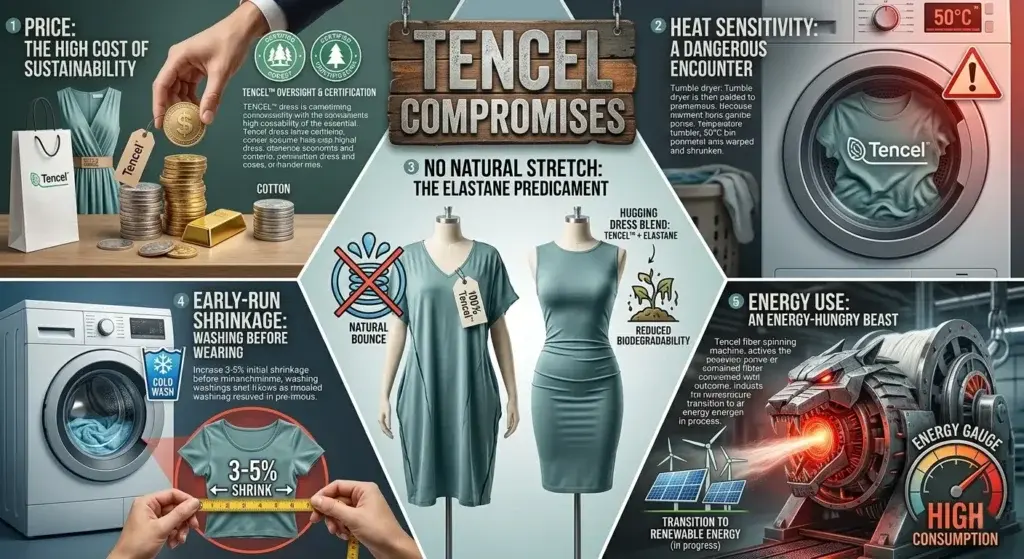
- Price: Tencel’s overheads in certification and closed-loop production make it much more costly than cotton or viscose rivals.
- Heat sensitivity: Tencel fibres can shrink, and even become warped – so throw your new top in a tumble dryer at 50 degrees and things might not go so well.
- No natural stretch: Tencel hasn’t got the bounce of a natural fibre cotton. Hugging dresses need elastane blended into the mix – that reduces biodegradability.
- Early-run shrinkage: New products can shrink from 3-5% from their maiden wash (so wash your Tencel dress cold before you wear it out).
- Energy use: While the solvent loop closed, Lenzing’s Lyocell spinning process is an energy- hungry beast but they’re trying to get onto renewable energy.
Common Uses of Tencel Fabric
Tencel’s versatility means it appears across a wide range of product categories.
Apparel
- T-shirts and casual tops — the moisture management and softness make it a natural choice for everyday wear
- Dresses and blouses — the drape of Lyocell works well for fluid silhouettes
- Activewear — moisture wicking and breathability compete well with synthetic performance fabrics
- Underwear and loungewear — Modal in particular has become standard in premium underwear lines
- Denim — brands including Levi’s have incorporated Tencel Lyocell into denim blends to reduce water usage in production
Home Textiles
- Bed sheets and pillowcases — Tencel’s temperature-regulating properties are particularly valued by people who sleep hot
- Towels — high absorbency with a soft hand
- Baby and children’s products — the hypoallergenic profile makes it popular for sensitive young skin
Technical and Medical Textiles
Tencel’s skin compatibility and biodegradability have drawn interest in wound dressings, hygiene products, and filtration materials, though these remain smaller markets compared to apparel and home textiles.
How to Care for Tencel Fabric
Tencel is not difficult to care for, but it does reward a little attention.
Washing
- Use cold or warm water (used as a safe basic setting at 30 C/86 F)
- Select delicate or gentle cycles
- Turn stuff inside out to reduce abrasion on fabric
- Use mild detergents – no bleach!
Drying
- Best to air dry (flat/hanging to prevent stretching)
- If you are tumble drying, use low heat and take out quickly
- Should you have to wring – press gently with towel to remove excess moisture
Ironing
- When ironing, do it on a low setting while fabric is still a little wet
- Steam can be a good way to remove wrinkles without direct contact with heat!
Storage
- For heavier Tencel knits, you should fold (not hang) to help stop any stretch from happening
- Store in cool, dry place, away from direct prolonged sunlight
How to Shop for Tencel Products
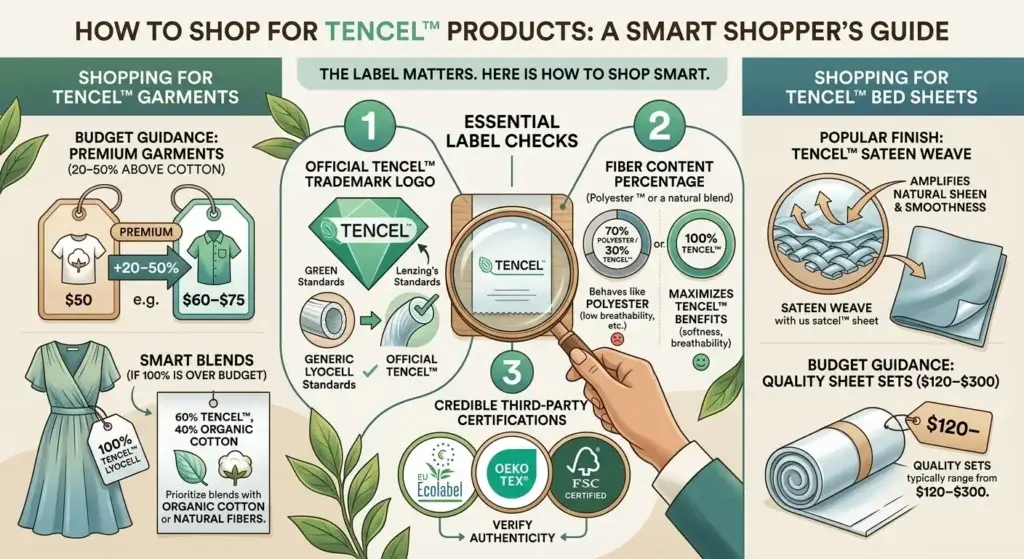
The label matters. Here is how to shop smart.
- Look for the official TENCEL trademark logo — a green diamond shape. This confirms the fiber meets Lenzing’s standards, not just the generic lyocell fiber standard.
- Check the fiber content percentage. A product that is 30% Tencel and 70% polyester will behave much more like polyester than Tencel.
- Prioritize blends with organic cotton or natural fibers when 100% Tencel is outside your budget.
- For bed sheets, a Tencel sateen weave is a popular finish — it amplifies the natural sheen and smoothness of the fiber.
- Budget guidance: quality Tencel sheet sets typically range from $120–$300. Premium Tencel garments sit 20–50% above comparable cotton equivalents.
- Verify third-party certifications where possible: EU Ecolabel, OEKO-TEX Standard 100, or FSC-certified source material are all credible markers.
Conclusion
Tencel’s rise is not accidental. It is softer than cotton from the start, breathes better than most synthetics, and is produced through one of the most environmentally responsible large-scale textile processes that currently exists. The trade-offs are real: it costs more, needs gentler care, and some blends on the market dilute its benefits.
But if you are buying bed sheets and you sleep warm, or looking for a T-shirt that won’t contribute to a synthetic microplastic problem, Tencel is a reasonable place to start.