Lace Trim by the Yard: A Smarter Sourcing Checklist
Why “by the yard” still needs factory-level specifications
Buying lace trim by the yard sounds simple: choose a pattern, confirm the width, and order the quantity. In real production, that is rarely enough. A trim that looks beautiful on a sample card can create problems when it is cut into lingerie, sleepwear, dresses, children’s garments, home textiles, or accessories. The issue is not usually the lace itself. The issue is that the purchase order does not describe how the lace must behave during cutting, sewing, dyeing, packing, and repeat orders.
Many online guides explain lace types, decorative styles, and common sewing tips. Fewer explain how a buyer should brief a knitting lace trim factory before bulk production. This guide focuses on that practical gap. It is written for brands, wholesalers, sample rooms, garment factories, and sourcing teams that need lace trim by the yard but want fewer surprises after the first shipment arrives.
Start with the final garment, not the trim card
The best trim selection begins with the place where the trim will be used. A soft eyelash edge on a neckline has different requirements from a firm lace insert on a dress panel. A narrow stretch trim for underwear must recover cleanly after tension, while a decorative non-stretch border for craft or home textile use may need a flatter, more stable hand.
- Contact area: Will the lace touch skin directly, sit over lining, or decorate an outer seam?
- Sewing method: Will it be overlocked, coverstitched, bonded, topstitched, or hand applied?
- Cutting method: Will the trim be cut manually, by laser, by straight knife, or by automatic cutting?
- Wash expectation: Is the garment dry-clean only, hand wash, machine wash, or swim/active use?
- Repeat order risk: Will the same article be reordered every season?
These answers decide whether the factory should prioritize softness, edge stability, stretch recovery, color consistency, width control, or pattern clarity.
The six specifications buyers often miss
Most purchase orders include width, color, quantity, and price. That covers only the surface of the order. For reliable wholesale lace trim, add the following details before sampling.
| Specification | Why it matters | What to confirm |
|---|---|---|
| Pattern repeat | Controls cutting yield and motif placement | Repeat length, scallop direction, usable repeat after tension |
| Edge behavior | Affects sewing speed and garment comfort | Eyelash edge, scallop firmness, fray risk, curl after dyeing |
| Width tolerance | Small changes create visible mismatch on paired garment parts | Nominal width and accepted tolerance after finishing |
| Stretch and recovery | Critical for intimate apparel and fitted garments | Stretch direction, recovery after extension, elastic yarn content |
| Dye lot control | Prevents shade difference across production batches | Lab dip, bulk approval, roll-to-roll shade limit |
| Roll packing | Protects trim shape and improves cutting efficiency | Yards per roll, tension, joins, labeling, polybag method |
How to judge lace edge quality
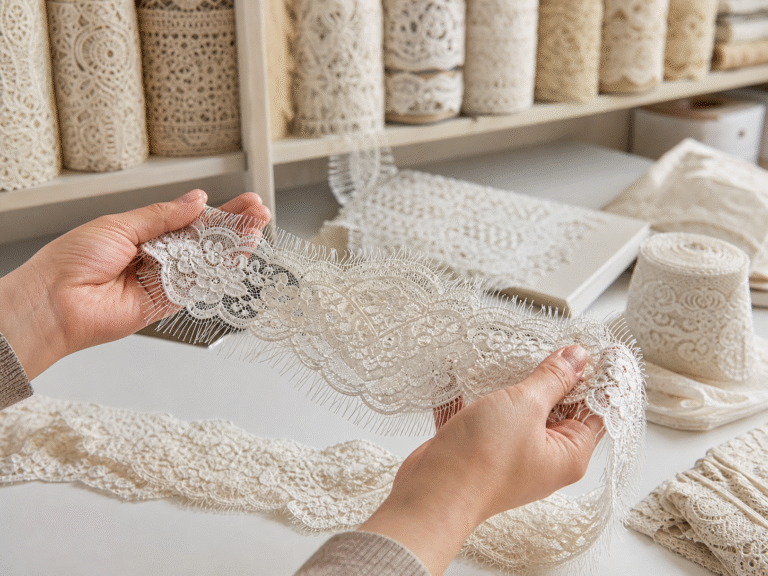
The edge is where many trim problems show up first. For eyelash lace, check whether the fine threads are even, clean, and secure. For scalloped lace, check whether each scallop keeps its shape after light stretching and steaming. For narrow lace trim, check whether both sides sit flat enough for the intended sewing method.
A practical test is simple: cut a 30 cm piece, stretch it gently if it contains elastic, release it, then place it flat beside the unhandled sample. If the edge curls, twists, or narrows too much, the trim may still work, but it should not be approved without a sewing trial. A trim that fails only after stitching is more expensive than a trim that is rejected at sample stage.
Repeat length affects cost more than buyers expect
When lace trim has a clear flower, scallop, or geometric motif, the repeat length affects marker planning. A longer repeat may look more premium, but it can increase waste when the garment needs mirrored pieces or exact motif placement. For example, a bra cup edge, sleeve hem, neckline, or dress insert may need the motif centered. If the repeat is not planned, the cutting team may lose more material than expected.
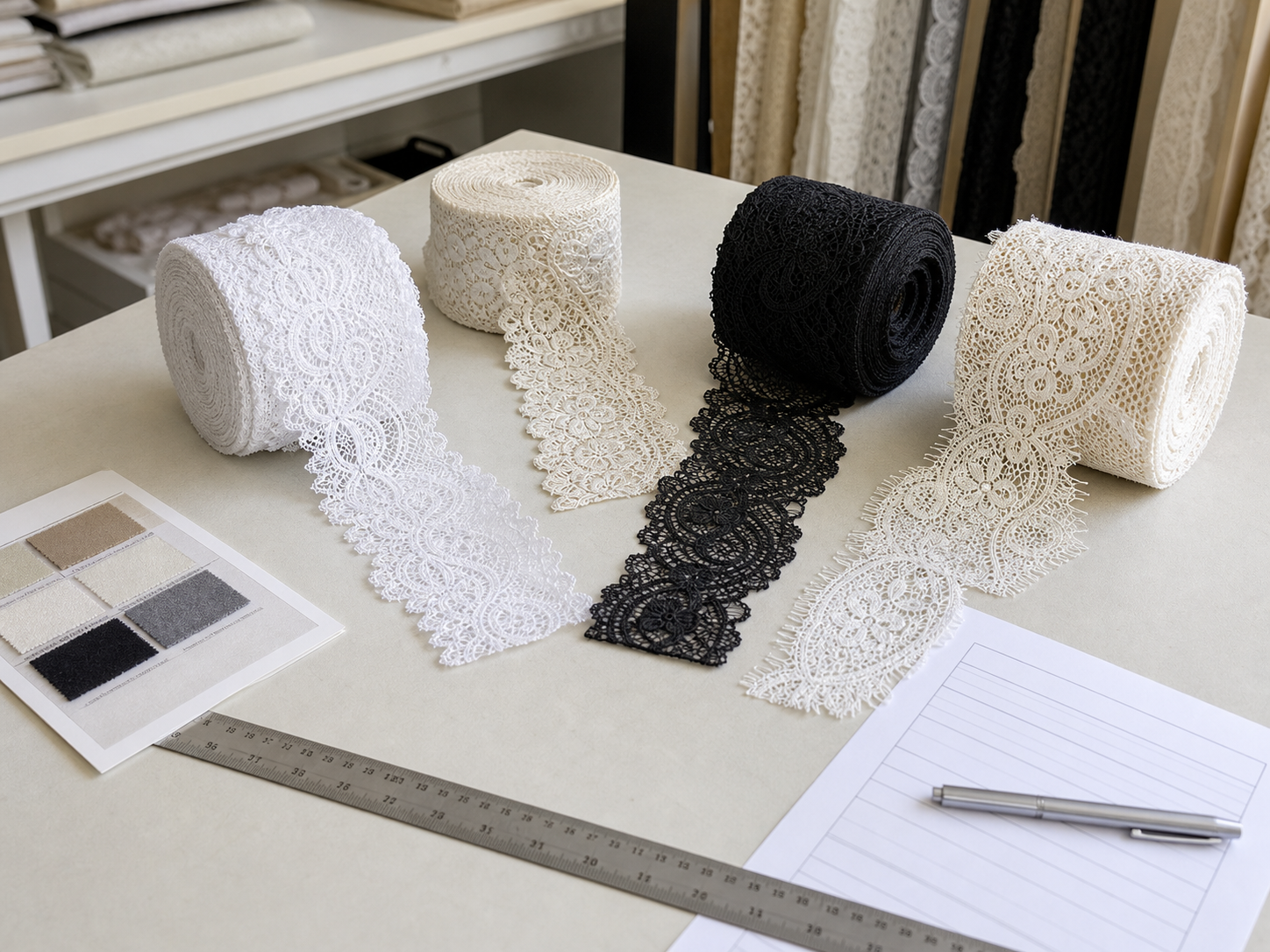
Ask the factory for the repeat length in centimeters and request a photo with a ruler. If the trim will be used on paired garment parts, ask for mirrored layout advice. This is especially useful for custom lace trim, where the repeat can sometimes be adjusted before production tooling or knitting setup is finalized.
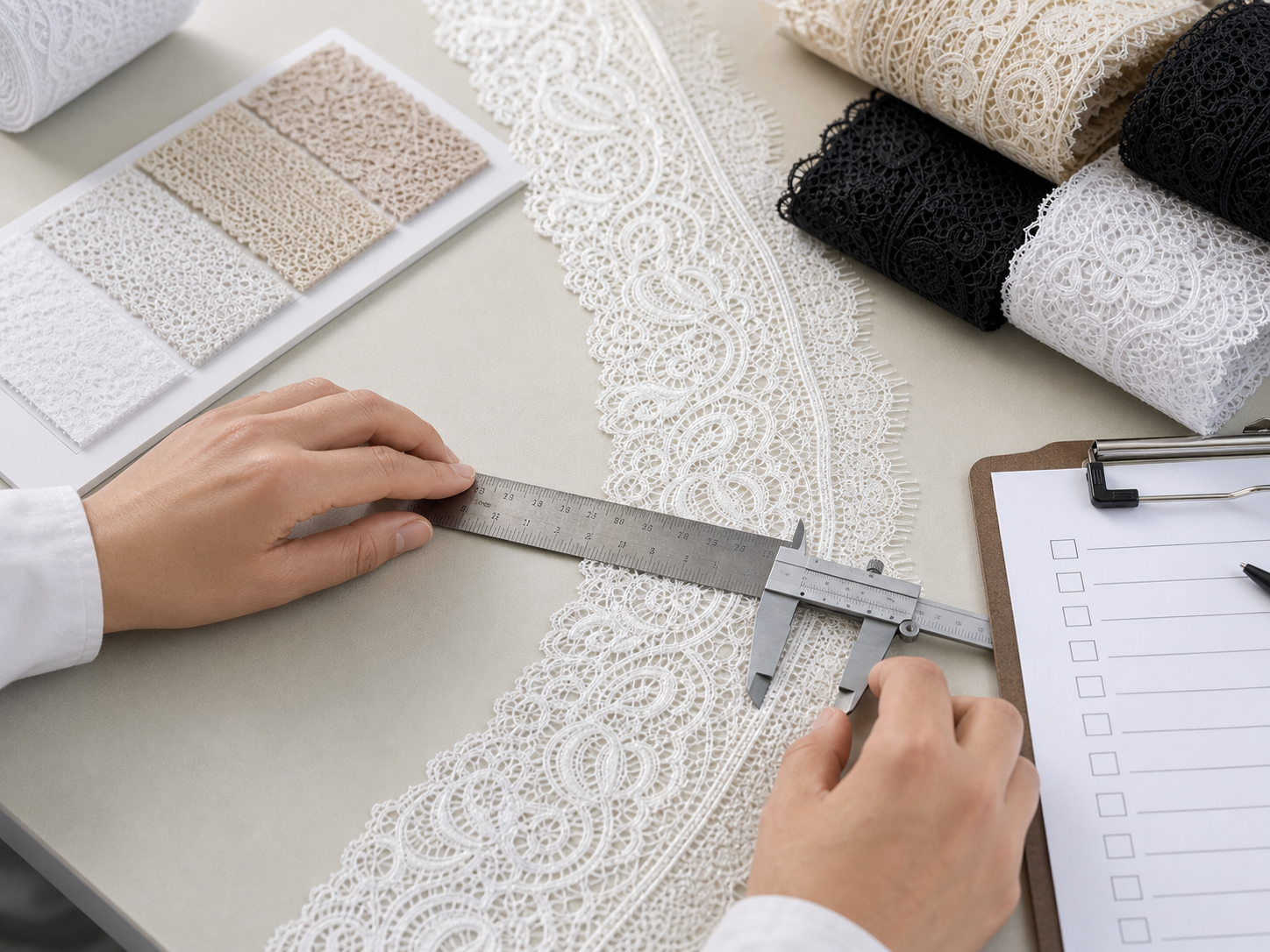
Color approval should include the base fabric
Approving lace color in isolation is risky. Lace is open, textured, and affected by the color beneath it. A beige lace trim may appear warmer on nude lining, cooler on white fabric, and deeper on black mesh. If the lace will be combined with mesh fabric, satin, jersey, or a printed base, review the lab dip on top of the actual base material whenever possible.
For repeat orders, keep a physical approved swatch from the bulk lot. Digital photos are helpful for communication, but they cannot replace a controlled swatch for shade comparison. If the style is likely to reorder, confirm whether the factory can keep the yarn, dye recipe, or production notes for the next batch.
A simple sampling workflow
- Send the use case: garment type, sewing method, target price, color, and expected order quantity.
- Request closest available trims: this saves time before custom development.
- Confirm technical details: width, repeat, stretch, composition, and MOQ.
- Run a sewing trial: test tension, seam appearance, edge comfort, and cutting waste.
- Approve lab dip and pre-production sample: review under consistent light.
- Lock packing requirements: roll length, labels, joins, and inspection standard.
Common mistakes in wholesale lace trim orders
The first mistake is choosing only by photo. Lace is tactile. Hand feel, stretch, weight, and edge firmness cannot be judged from a picture alone. The second mistake is ignoring trim direction. Some scalloped trims look symmetrical online but have a clear top and bottom in garment use. The third mistake is treating all white, ivory, or black shades as interchangeable. For lace, even small shade differences become visible when the trim sits over a contrasting base.
The fourth mistake is not discussing roll joins. For low-value craft use, occasional joins may be acceptable. For automated garment cutting, too many joins interrupt production. Put the expected standard in writing before bulk packing.
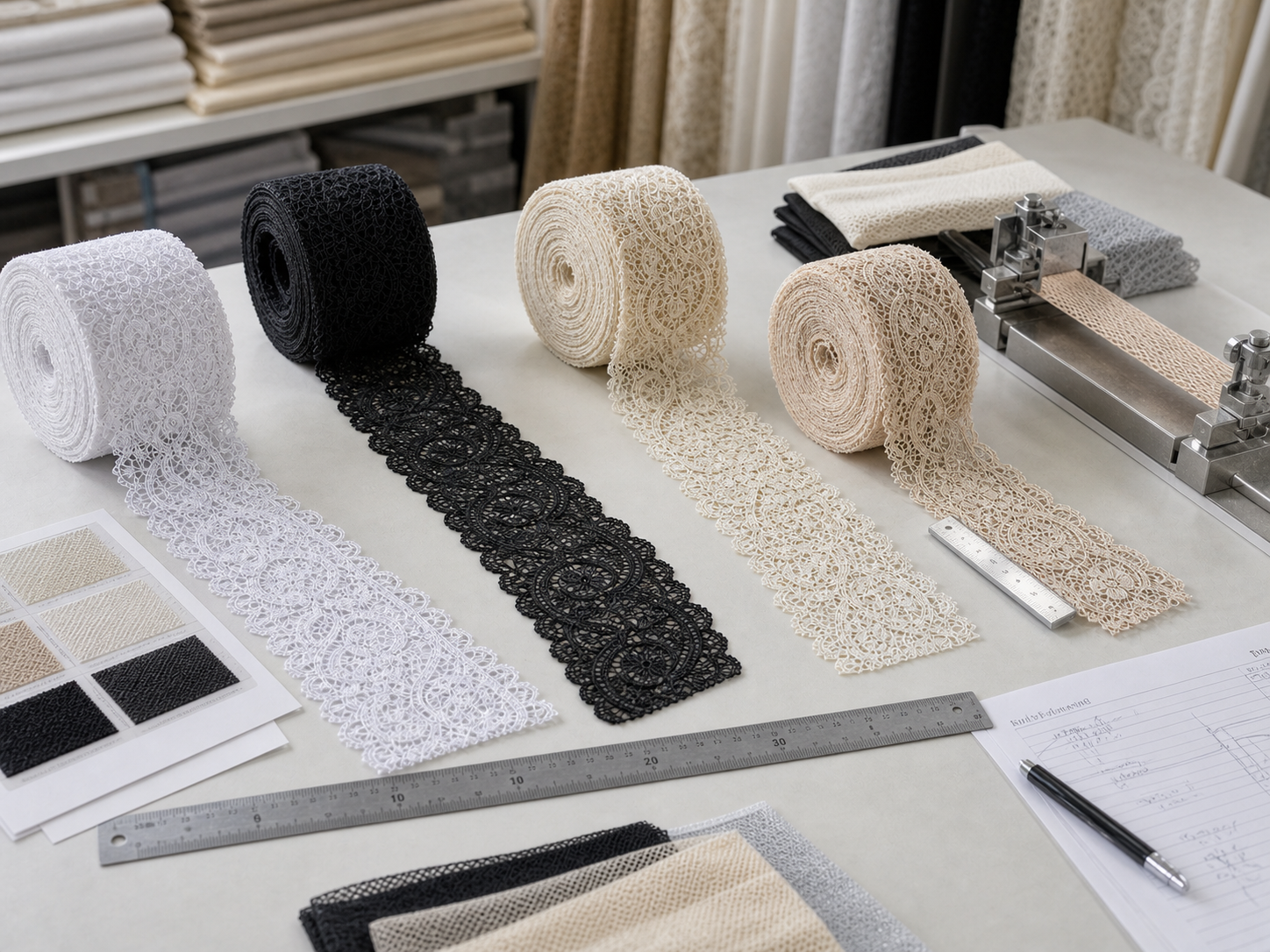
What to ask before a repeat order
The first bulk order is only part of the sourcing job. If the trim will become a carryover item, ask the factory how repeat orders are controlled. A small lace trim can change slightly when yarn lots, dye lots, machine settings, or finishing tension change. These changes may be acceptable for loose decorative use, but they can be visible on garments that require left-right matching or exact shade continuity.
For repeat programs, keep the approved bulk swatch, record the production date, and save the exact article number. If the trim has elastic yarn, ask whether the factory can keep the same yarn specification for later orders. If the trim is dyed to match a main fabric, confirm whether the next order should be matched to the old trim, the new base fabric, or a brand color standard. That decision should be written clearly, because each option can produce a different result.
It is also useful to ask for a small retained sample from the factory side. When both buyer and supplier hold the same approved reference, later color or hand-feel discussions become much easier. This is a simple habit, but it prevents many disputes that otherwise appear only after cutting has started.
For private-label or wholesale programs, ask one more question before approval: who owns the risk if the garment factory changes the sewing method after trim approval? If the approved sample was tested with one stitch type and production later uses another, the trim may be blamed for a problem caused by process change. Record the tested sewing method, needle size, thread type, and seam placement with the approved trim sample. This small record gives the sourcing team a practical reference when production moves from sample room to bulk line.
Final checklist before you order
Before placing a lace trim by the yard order, confirm more than the pattern and price. Confirm the final use, repeat length, edge behavior, width tolerance, stretch recovery, dye approval, packing method, and reorder plan. A good lace trim factory can help translate design ideas into production-ready details, but the brief must be specific. The more clearly the trim is defined before sampling, the easier it is to keep beauty, cost, and delivery under control.