How to Source Lace Fabric from China: A Designer’s Complete Guide
Published by Fuyuan Knitting | Estimated read time: 9 minutes
For fashion designers, bridal couturiers, and independent labels around the world, China is the undisputed capital of lace fabric manufacturing. Whether you’re looking for delicate eyelash lace for a bridal collection, stretch lace for a lingerie line, or embroidered mesh for an evening wear range, Chinese manufacturers offer a combination of quality, variety, and price that is difficult to match anywhere else.
But sourcing from China — especially for the first time — can feel overwhelming. How do you identify a real manufacturer versus a trading company? What should you ask about MOQ and lead times? How do you protect yourself from quality issues?
This guide answers all of those questions. Written from the perspective of a manufacturer with direct experience serving international designers, it gives you the practical knowledge you need to source lace fabric from China with confidence.
Why Designers Source Lace Fabric from China
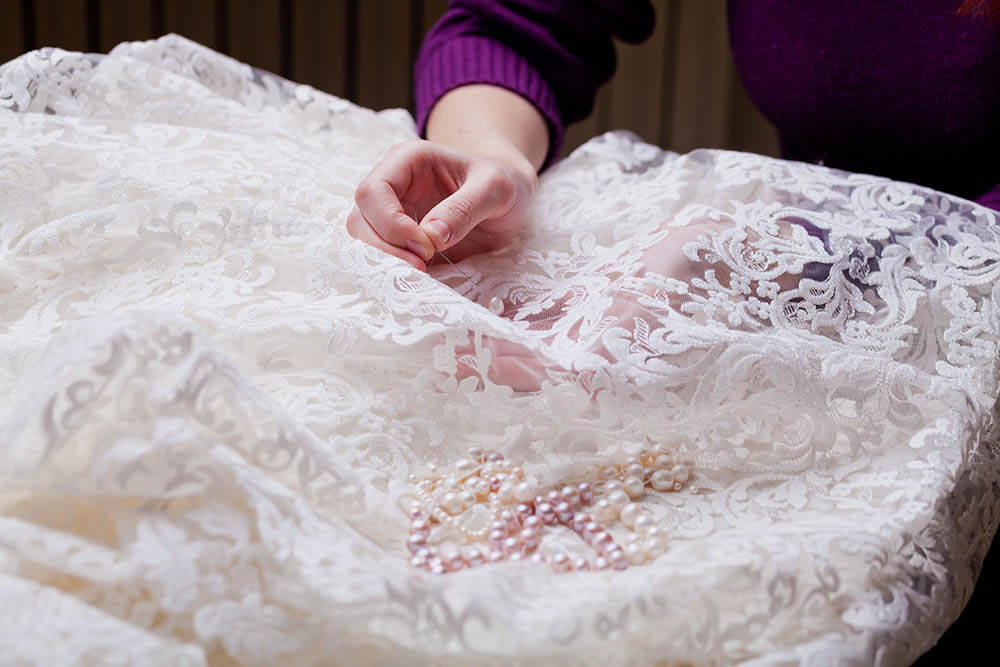
China produces over 60% of the world’s lace fabric, concentrated in key manufacturing clusters:
- Chaozhou (Guangdong) — the world’s largest bridal lace cluster, specializing in embroidery and Chantilly-style lace
- Fuzhou / Fujian Province — strong in Raschel warp-knitted lace, eyelash lace, and stretch lace
- Hangzhou (Zhejiang) — known for jacquard and embroidery lace
- Changshu (Jiangsu) — major center for lace trim and narrow fabrics
This geographic concentration means that the entire supply chain — yarn, machinery, dyeing, finishing — exists within a small area, keeping costs competitive and enabling rapid design turnaround.
For international designers, the key advantages are:
- Price — factory-direct pricing can be 40–70% lower than comparable quality sourced from Europe
- Variety — Chinese manufacturers offer thousands of patterns; custom pattern development is common
- Speed — major clusters can turn around sample development in 2–3 weeks
- Certifications — OEKO-TEX, GRS, and ISO-certified factories are widely available for brands with sustainability requirements
Step 1: Understand What Type of Lace You Need
Before approaching any supplier, be precise about what you’re looking for. Chinese manufacturers specialize in different lace construction methods, and not every factory produces every type.
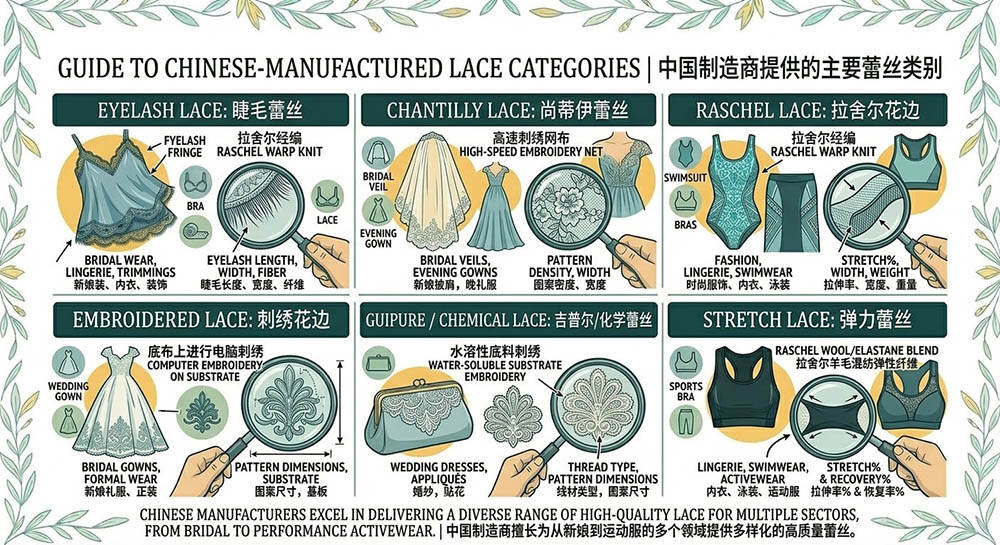
Main Lace Categories Available from Chinese Manufacturers
| Lace Type | Construction Method | Common Uses | Key Specs to Know |
|---|---|---|---|
| Eyelash Lace | Raschel warp knitting | Bridal, lingerie, trim | Lash length, width, fiber |
| Chantilly-style Lace | High-speed embroidery on mesh | Bridal overlays, evening wear | Pattern density, width |
| Raschel Lace | Raschel warp knitting | Fashion, lingerie, swimwear | Stretch %, width, weight |
| Embroidery Lace | Computerized embroidery on base fabric | Bridal, formal wear | Pattern size, substrate |
| Guipure / Chemical Lace | Water-soluble base embroidery | Wedding gowns, appliqués | Thread type, motif size |
| Stretch Lace | Raschel with elastane | Lingerie, swimwear, activewear | Stretch %, recovery % |
Be ready to communicate:
- Lace type and construction method
- Width requirement (trim vs. full fabric width)
- Fiber content preference (nylon, polyester, spandex blend)
- Stretch or non-stretch
- Color(s) required (Pantone code or physical swatch)
- Intended end use (this affects fiber and certification requirements)
Step 2: Finding the Right Supplier — Factory vs. Trading Company
This is the most important distinction for designers sourcing from China, and it’s often misunderstood.
What Is a Lace Factory?
A factory (manufacturer) owns the production machinery and directly produces the fabric. They:
- Can customize patterns, fiber content, colors, and width
- Have defined minimum order quantities (MOQ) for custom work
- Can provide machinery certifications and factory audit reports
- Will have consistent technical knowledge about what they make
What Is a Trading Company?
A trading company acts as an intermediary, sourcing from multiple factories. They:
- Often have lower MOQ thresholds (because they aggregate orders)
- Carry stock of standard patterns
- May offer faster shipping on in-stock items
- Have limited ability to customize or provide detailed technical specifications
Which is better for you?
| Situation | Best Choice |
|---|---|
| You need custom colors, patterns, or specifications | Factory |
| You’re ordering a small trial quantity of a standard style | Trading company |
| You need OEKO-TEX or GRS documentation | Factory |
| You’re building a long-term supplier relationship | Factory |
| You’re testing multiple fabric types quickly | Trading company |
How to Tell the Difference
Ask these questions:
- “Can you show me your production machinery?” — A real factory can send photos or video of their knitting or embroidery machines
- “What is your MOQ for custom dyeing?” — Factories have specific, consistent answers; trading companies often give vague responses
- “Can you provide a factory audit report or OEKO-TEX certificate?” — Real factories can provide these documents
- “What is your technical team’s experience with Raschel knitting?” — A real lace factory will engage with technical questions confidently
Step 3: MOQ, Pricing & Lead Times — What to Expect
Understanding realistic expectations prevents disappointment and helps you plan production timelines.
Minimum Order Quantities (MOQ)
MOQ varies significantly depending on whether you’re ordering stock patterns or custom work:
| Order Type | Typical MOQ Range |
|---|---|
| In-stock standard patterns | 10–50 meters (some factories) / 1 roll (~50–100 meters) |
| Custom color (stock pattern) | 100–300 meters per color |
| Fully custom pattern + color | 300–1,000 meters |
| Small batch programs (some factories) | 30–50 meters with design fee |
For independent designers and small bridal labels, ask specifically about sample programs — many quality manufacturers offer free or low-cost fabric samples (typically 1–2 meters) for designers evaluating materials before committing to bulk orders.
Pricing Factors
Lace fabric pricing from Chinese manufacturers is influenced by:
- Construction complexity — Raschel eyelash lace is generally more affordable than heavily embroidered Chantilly-style lace
- Fiber content — Nylon costs more than polyester; adding spandex increases price
- Width — Wider fabrics cost more per meter to produce
- Color — Standard white/ivory/black is cheapest; custom Pantone matching incurs a dye fee
- Order volume — Price per meter decreases significantly with larger orders
General price ranges (FOB China, indicative):
| Type | Price Range (USD/meter) |
|---|---|
| Standard eyelash lace trim (10cm wide) | $0.30 – $1.50 |
| Eyelash lace fabric (130cm wide) | $2.00 – $6.00 |
| Stretch Raschel lace (150cm) | $3.00 – $8.00 |
| Embroidery/Chantilly-style (140cm) | $4.00 – $15.00+ |
Prices vary by order size, specifications, and market conditions. Request a formal quotation from your supplier.
Lead Times
| Stage | Typical Timeline |
|---|---|
| Sample development (new pattern) | 2–4 weeks |
| Sample production (existing pattern, custom color) | 1–2 weeks |
| Bulk production (after sample approval) | 3–6 weeks |
| Sea freight (China → Europe / USA) | 25–35 days |
| Air freight (China → Europe / USA) | 5–7 days |
Plan for a total lead time of 8–12 weeks from first contact to receiving bulk goods if you’re developing a custom specification. For in-stock or standard orders, this can compress to 3–5 weeks.
Step 4: Customization — What You Can Specify
One of China’s strongest advantages is the depth of customization available. For designers building a signature aesthetic, this matters enormously.
Color
Most quality lace manufacturers offer Pantone color matching. Provide your Pantone number (or a physical fabric swatch to match) and the factory will produce a lab dip for your approval before bulk dyeing. Expect 1–2 rounds of approval.
Pattern
For true custom pattern development, factories use CAD design software to create new patterns on their knitting or embroidery machines. This involves a design fee (typically $200–$800 depending on complexity) and extended development time. For established labels working with a factory long-term, this is standard practice.
Fiber & Construction
You can specify:
- Fiber content ratios (e.g., 88% nylon / 12% spandex)
- Yarn weight (affects fabric hand and drape)
- Pattern density (more open vs. denser base)
- Lash length (for eyelash lace)
- Width (within machine capacity)
Private Labeling
Many factories can attach your brand’s woven or printed care labels to finished fabric rolls. For wholesale clients, this is a useful way to maintain brand consistency across your supply chain.
Step 5: Quality Control — What to Check Before Ordering Bulk
Quality issues are the most common source of frustration in China sourcing. Establishing clear expectations upfront is essential.
Request and Evaluate Samples Rigorously
Before approving bulk production:
- Check colorfastness — wet and dry rub the fabric against white cotton
- Check dimensional consistency — measure lash length and pattern repeat across the sample
- Check hand-feel — does it match your expectations for the end use?
- Check stretch and recovery (for stretch lace) — stretch to 150% and release; does it fully recover?
- Check for defects — holes, skipped stitches, uneven fringe density
Define Your Quality Standards in Writing
Provide your supplier with a written specification sheet before bulk production begins. Include:
- Acceptable color variance (Delta E ≤ 1.0 is a common standard)
- Width tolerance (typically ±2%)
- Allowable defect rate per roll
- Roll length requirements
Consider Third-Party Inspection
For orders over $5,000–10,000 USD, a third-party inspection (SGS, Bureau Veritas, or equivalent) conducted at the factory before shipment is a worthwhile investment. A pre-shipment inspection typically costs $200–$400 and can save you from receiving an entire shipment of substandard goods.
Step 6: Certifications — What Bridal and Fashion Designers Need to Know
If you are selling into European, North American, or Australian markets, certifications are increasingly important — both for regulatory compliance and for brand credibility.
OEKO-TEX Standard 100
This certification verifies that the fabric has been tested for harmful substances and is safe for human skin contact. It is essential for:
- Bridal wear (worn against skin for 12+ hours)
- Lingerie
- Children’s wear
- Any garment sold to retailers with sustainable sourcing requirements
Always request the actual certificate (not just a claim) and verify it on the OEKO-TEX database at oeko-tex.com.
GRS (Global Recycled Standard)
Relevant if your brand uses or claims recycled fiber content. GRS-certified factories can produce lace with certified recycled nylon or polyester.
ISO 9001
A quality management system certification. While not fabric-specific, it indicates the factory has documented quality processes — a positive signal when evaluating new suppliers.
Red Flags to Avoid
Even experienced buyers encounter issues when sourcing from China. Watch for:
❌ Prices that seem too good to be true — extremely low pricing often signals fiber substitution (polyester passed off as nylon) or poor quality control
❌ Reluctance to provide factory photos or video — legitimate factories are proud to show their facilities
❌ Vague answers about certifications — a factory with real OEKO-TEX certification will give you the certificate number immediately
❌ Requests for full payment before sample approval — standard practice is to pay a sample fee, then approve before placing bulk orders
❌ No written quality standards or specification agreement — professional manufacturers expect and welcome written specs
❌ Unable to provide a production timeline — quality factories manage their scheduling and can give realistic timelines
Why Work with an Established Manufacturer Like Fuyuan Knitting
At Fuyuan Knitting, we’ve spent years refining our process for working with international bridal and fashion designers. Here’s what that means in practice:
Factory-direct manufacturing — no trading company markup. You work directly with the team that produces your fabric.
OEKO-TEX Standard 100 certified — all our lace and knit fabrics meet international safety standards, with certificate documentation provided on request.
Flexible MOQ — we support small batch sampling programs for independent designers and small labels, as well as large-volume production for established brands.
Pantone color matching — custom color development available for both standard and custom patterns.
English-speaking customer service — clear communication throughout the sampling, approval, and production process.
Product range includes: eyelash lace fabric, stretch lace, mesh fabric, lace trim, performance fabric — all produced in our own facilities.
Frequently Asked Questions
What is the minimum order quantity for lace fabric from China? MOQ varies by factory and order type. For standard in-stock patterns, some suppliers offer as little as 1 roll (approximately 50–100 meters). For custom color or custom pattern development, MOQ is typically 100–500 meters per specification. At Fuyuan Knitting, we offer a sample program that allows you to evaluate materials before committing to bulk.
How long does shipping take from China? Sea freight from China to major ports in Europe, the USA, or Australia takes approximately 25–35 days. Air freight typically takes 5–7 days. For time-sensitive sample orders, most manufacturers can arrange air express delivery (DHL, FedEx) within 3–5 days.
Can I get samples before placing a bulk order? Yes — reputable manufacturers offer samples. Some provide free samples for evaluation; others charge a small sample fee (typically $10–$30 per sample) that is credited against your first bulk order. Always insist on evaluating a physical sample before approving production.
How do I verify that a Chinese lace manufacturer is legitimate? Request their business registration documents, factory location, and OEKO-TEX or ISO certificates. Ask for a video call or factory video tour. Check whether their website and communication is consistent and professional. Be cautious of suppliers whose only presence is on marketplace platforms without a direct website.
Do Chinese lace manufacturers accept PayPal or credit card? Most manufacturers work on bank transfer (T/T) or trade finance terms. A typical payment structure is 30% deposit upon order confirmation and 70% balance before shipment. PayPal is occasionally available for sample fees but is rarely used for bulk orders due to transaction costs.
Can I request exclusive patterns or designs? Yes. Many factories offer design exclusivity arrangements for clients who commit to minimum annual volumes. For custom-developed patterns, the design belongs to the client by agreement; confirm ownership in writing before paying any design fees.
Ready to Start Sourcing?
Sourcing lace fabric from China doesn’t have to be complicated. With the right preparation — clear specifications, a reliable manufacturing partner, and a solid understanding of MOQ and quality expectations — you can access world-class lace at a fraction of what you’d pay closer to home.
At Fuyuan Knitting, we work with bridal designers, fashion labels, and lingerie brands from the initial sample stage through to ongoing bulk supply. We’re happy to answer technical questions, provide samples for evaluation, and help you develop custom specifications for your collection.
[Request a Free Sample] | [Browse Our Lace Catalog] | [Contact Our Sourcing Team]
Fuyuan Knitting is a professional lace and knitted fabric manufacturer based in China, serving international fashion designers, bridal manufacturers, and apparel brands. OEKO-TEX Standard 100 and GRS certified. Contact us to discuss your sourcing requirements.