Types of Lace Materials: Friendly Guide to What They Are and How to Choose
If you’ve ever ordered “lace” and received something that looks right in a product photo but behaves totally differently in production—too stiff, too fragile, too scratchy, too stretchy—you’ve already learned the hard lesson:
“Lace material” isn’t one thing. It’s a mix of how the lace is constructed (woven, knitted, embroidered, or dissolved-out) and what fibers it’s made from (nylon, polyester, cotton, rayon, silk, blends).
This guide breaks down the most common lace types you’ll see in apparel and trims, plus a practical way to pick the right one for bridal, lingerie, fashion, and more.
What “lace material” actually means
In sourcing conversations, “lace material” usually refers to two layers of choices:
- Construction (how the lace is made) — this drives look, stability, stretch, and price.
- Fiber content (what it’s made from) — this drives hand feel, dyeing behavior, durability, and care requirements.
Two laces can share the same floral motif and still perform very differently if one is knitted nylon and the other is woven cotton.
Quick comparison: common lace types at a glance
| Lace type (common name) | How to recognize it | Typical stretch | Typical hand/feel | Best for | Watch for |
|---|---|---|---|---|---|
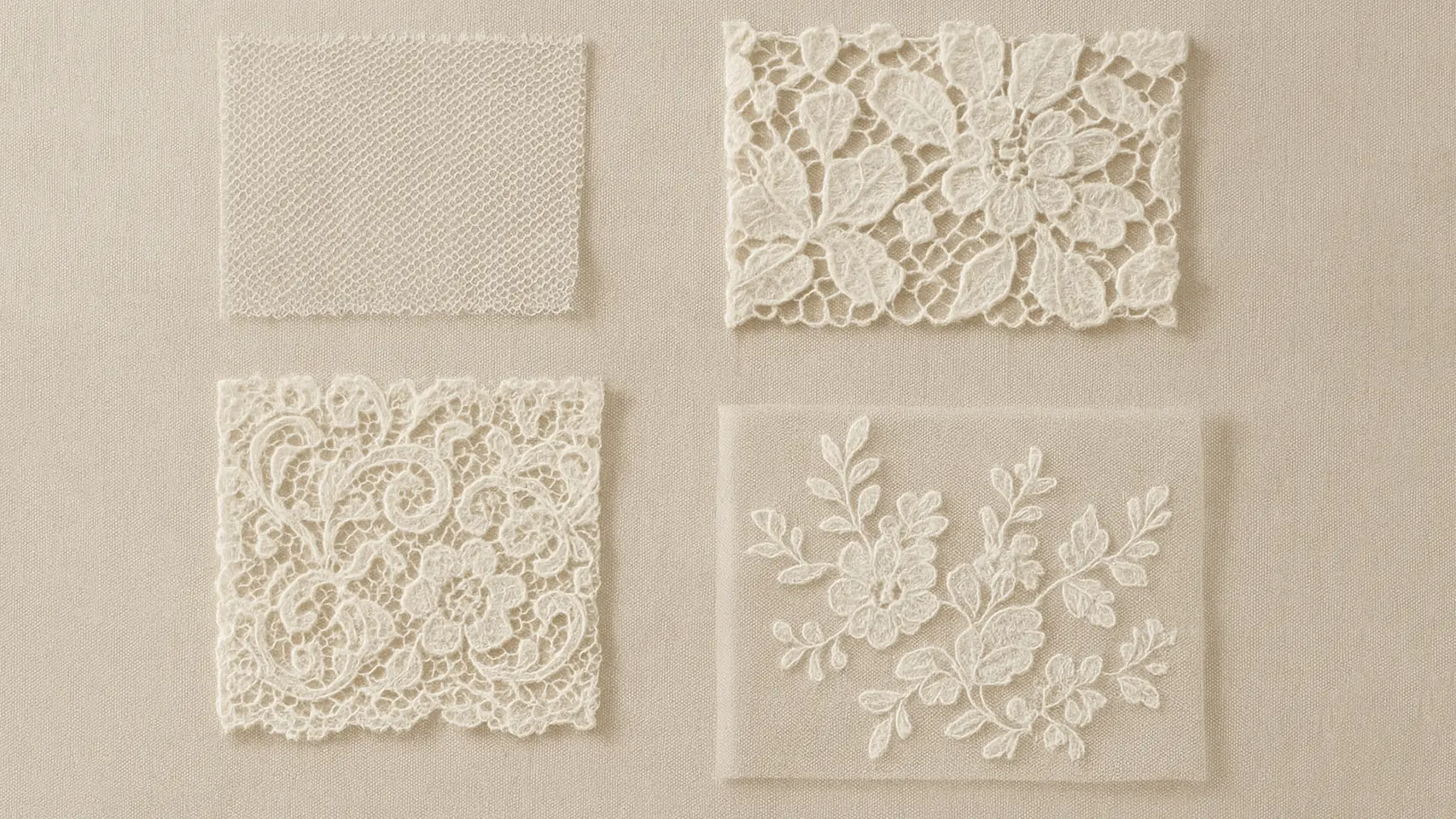
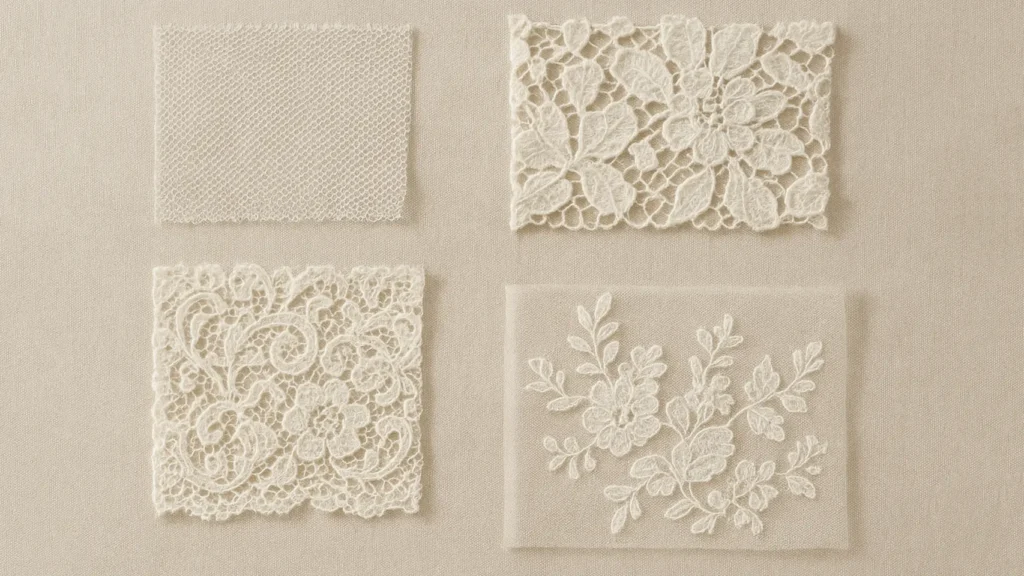
| Chantilly lace | Fine motifs on a delicate net; often scalloped edges | Low | Soft, airy, drapey | Bridal overlays, veils, sleeves; refined lingerie | Snagging; needs careful handling |
| Leavers lace | Very intricate, “classic” look; often associated with premium woven lace | Low | Refined, stable, detailed | High-end bridal and fashion where detail matters | Higher cost; longer lead times |
| Raschel lace | Machine-made motifs; can range from delicate to bold; widely used in lingerie | Medium to high (varies) | Often soft with good drape | Lingerie, fashion lace yardage, affordable bridal | Quality varies widely; check recovery |
| Guipure lace (Venise) | No net background; motifs connected by bars/bridges | Low | Heavier, more structured | Statement panels, bridal motifs, bold trims | Bulk at seams; less drape |
| Embroidered lace | Motifs stitched onto tulle/mesh base; may include beads/sequins | Base depends on ground | Textured, dimensional | Bridal, occasionwear, decorative overlays | Embellishment weight; scratchiness; care |
| Chemical lace | Clean motifs with no visible ground (base dissolved away) | Low | Can be crisp or soft | Motifs, patches, trims | Can feel stiff; test fray/edge stability |
Pro Tip: When you’re comparing “types of lace materials,” ask for both construction and fiber content on the spec sheet. “Raschel lace” + “nylon/spandex” tells you far more than “lace fabric.”
Types of lace materials by construction
1) Woven lace (Leavers-style lace)
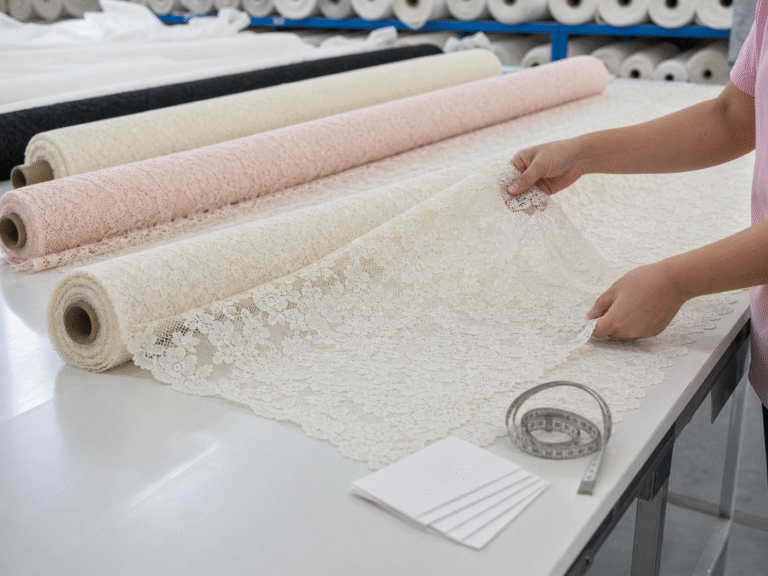
Woven lace is built on a weaving-style machine that can create very intricate patterns. In the bridal world, Chantilly lace is commonly described as being made on Leavers machines, and it’s known for its fine net ground and delicate motifs.
Buyer-relevant behavior:
- Stable (doesn’t grow much on the bias compared with many knits)
- High visual detail (fine outlines, subtle pattern density)
- Often more expensive than faster machine alternatives
If you’re comparing Leavers lace vs Raschel lace, one practical shortcut is: woven lace tends to look more “drawn” and refined; Raschel can be excellent, but it’s more variable and often optimized for speed.
2) Knitted lace (Raschel lace)
Raschel lace is produced on warp knitting machines. It’s widely used because it can deliver lace-like motifs efficiently and at scale.
Buyer-relevant behavior:
- Often more available and cost-effective
- Can be engineered for stretch (especially when paired with elastic fibers)
- The quality range is huge—two Raschel laces can feel nothing alike
What to check before you buy:
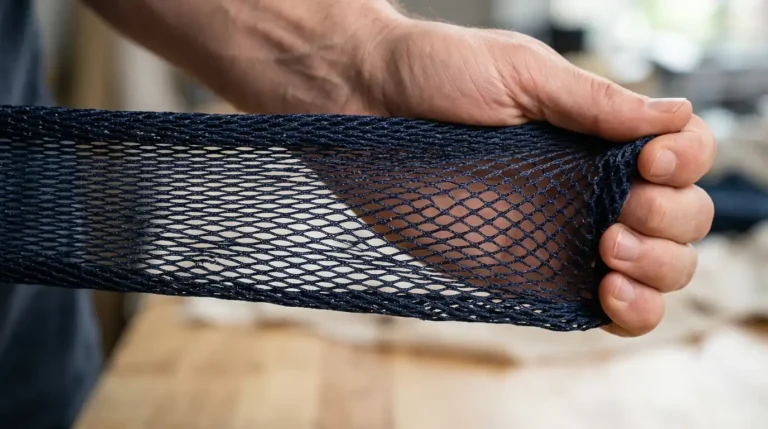
- Stretch % and recovery (does it snap back, or does it bag out?)
- Snag resistance (especially for lingerie)
- Edge stability (does it curl, ladder, or distort?)
3) Embroidered lace
Embroidered lace is created by stitching decorative motifs onto a base (often tulle or mesh). The “lace” look is coming from the embroidery—so the base fabric matters a lot.
Buyer-relevant behavior:
- Great for dimensional, decorative effects
- Easy to add beads, sequins, corded outlines
- Performance depends on the ground: tulle vs power mesh vs stable net
If you need a dramatic motif placement (necklines, hem borders, illusion yokes), embroidered lace is often the most controllable route.
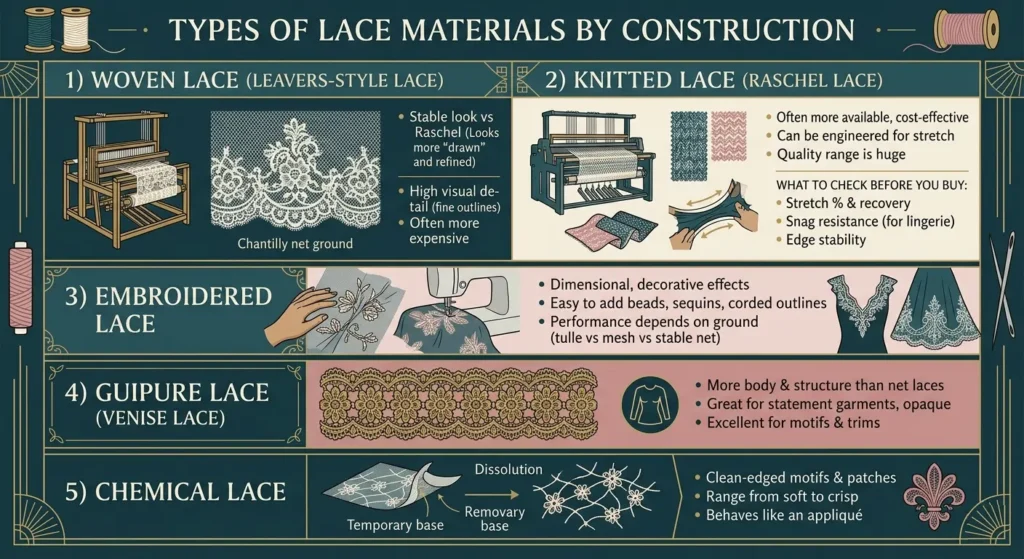
4) Guipure lace (Venise lace)
Guipure (often called Venise) is a heavier lace with no net background. Motifs are connected by bars or bridges, giving it a bold, structured look.
Buyer-relevant behavior:
- More body and structure than net-ground laces
- Great for statement garments or applications where you don’t want transparency
- Can be excellent for motifs and trims
5) Chemical lace
Chemical lace is made by creating lace on a temporary base and then dissolving/removing that base, leaving the motif network behind (the result often resembles guipure-like motifs).
Buyer-relevant behavior:
- Often clean-edged motifs and patches
- Can range from soft to crisp depending on yarn + finishing
- Useful when you want lace that behaves more like an applique than a drapey fabric
Types of lace materials by fiber content
Once you know the construction, fiber content helps you predict comfort, dyeing behavior, and durability.
Nylon (polyamide) lace
Common in lingerie and trims.
- Strength-to-weight is good
- Often soft when finished well
- Pairs well with spandex for stretch lace
Best for: lingerie, fashion lace that needs resilience.
Polyester lace
Often used for cost efficiency and durability.
- Generally durable and stable in care
- Can feel stiffer unless finished for softness
Best for: budget-friendly lace yardage, trims, applications needing easy care.
Cotton lace
Common in eyelet-style looks and casual apparel.
- Breathable and natural hand
- Less “sheer glamour,” more textural and casual
Best for: casual dresses, blouses, kidswear accents.
Rayon/viscose lace
Used to achieve a softer drape and a more “matte-lux” hand.
- Often drapier than polyester
- Strength and dimensional stability depend on construction and finishing
Best for: fashion lace where softness and drape matter.
Silk lace
Premium niche; often chosen for luxury bridal and high-end lingerie.
- Elegant drape and refined hand
- Typically higher cost and more delicate care needs
Best for: luxury applications where feel is the priority.
Blends (and stretch blends)
Many of the best-performing laces are blends:
- Nylon/spandex for stretch lace
- Poly/rayon blends for balanced drape + durability
If the lace must stretch, don’t just ask “is it stretch lace?” Ask for:
- stretch in warp and weft directions
- recovery after 5–10 stretch cycles
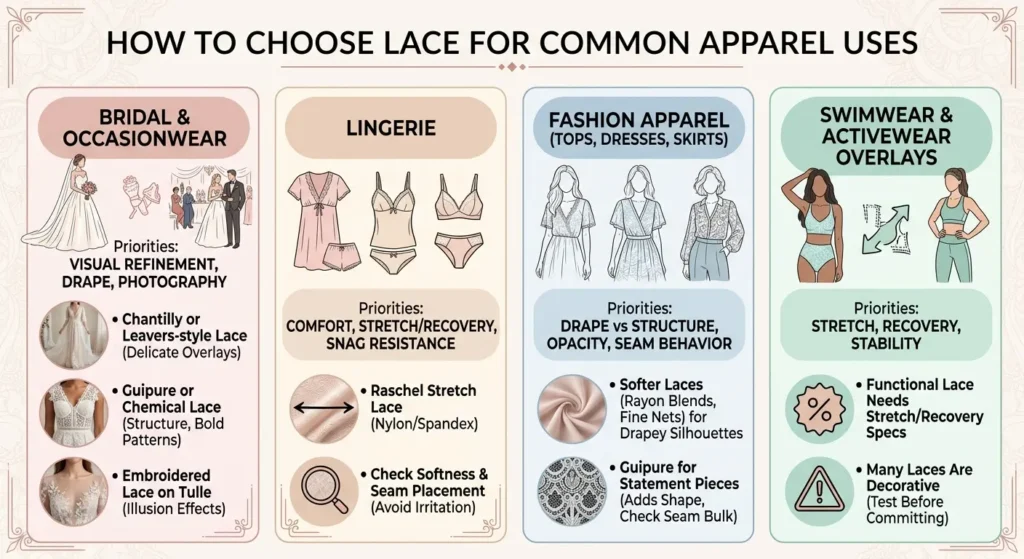
How to choose lace for common apparel uses
Bridal and occasionwear
Priorities: visual refinement, drape, and how it photographs.
- Choose Chantilly or fine woven/Leavers-style lace for delicate overlays.
- Choose guipure or chemical lace motifs when you want structure and bold pattern definition.
- For illusion effects, embroidered lace on tulle gives control over motif placement.
Lingerie
Priorities: comfort, stretch/recovery, snag resistance.
- Raschel stretch lace (often nylon/spandex) is common for a reason.
- Check softness at the edges and seam placement—the prettiest lace can still irritate.
Fashion apparel (tops, dresses, skirts)
Priorities: drape vs structure, opacity, and seam behavior.
- For drapey silhouettes, look for softer constructions and fibers (rayon blends, fine nets).
- For statement pieces, guipure brings shape but may add bulk at seams.
Swimwear and activewear overlays
Priorities: stretch, recovery, and stability.
- If the lace is functional (not just decorative), you’ll need clear specs on stretch and recovery.
- Many laces are decorative and won’t behave like performance knits—test before committing.
Common questions to ask a supplier
Use this as a quick checklist when comparing types of lace fabric:
- Construction: Is it Raschel/warp knit, woven (Leavers-style), embroidered, chemical, or guipure?
- Fiber content: What’s the exact composition (including elastane %) ?
- Width and usable width: Does the pattern repeat reduce usable width?
- Stretch % and recovery: In both directions (warp/weft). Any lab data?
- Hand feel: Softened finish? Any stiffening?
- Snagging: What’s the snag resistance expectation for end-use?
- Dyeing/finish: Any known shade limitations? (Especially for bright whites, deep blacks, or saturated fashion colors.)
- Shrinkage and dimensional stability: What’s expected after care cycles?
FAQ
Is lace defined by the fiber or by how it’s made?
Mostly by how it’s made (construction). Fiber content still matters a lot for comfort, care, and durability—but lace “type” names usually refer to structure.
What’s the difference between Chantilly lace vs guipure lace?
Chantilly is typically fine and airy on a net ground with delicate motifs. Guipure is heavier and more structured with no net background, often connected by bars.
What’s the difference between embroidered lace vs chemical lace?
Embroidered lace is stitched onto a base (like tulle or mesh), so you’ll still see (and feel) that ground fabric. Chemical lace is made on a temporary base that’s dissolved away, leaving a freestanding motif network with no ground.
What’s the difference between Leavers lace vs Raschel lace?
In many buyer conversations, “Leavers” points to a traditional woven approach associated with very fine detail, while “Raschel” is warp-knitted and often faster and more variable in look/price. For a bridal-oriented comparison, see Bridalfabrics’ wedding lace guide (2022).
Is embroidered lace always stiff?
Not always. The base fabric (tulle/mesh) and the thread density/finishing make a big difference. Embellishments (beads/sequins) can add weight and stiffness quickly.