Double-Sided Eyelash Lace: What It Is, Why It’s Made That Way, and How to Buy It
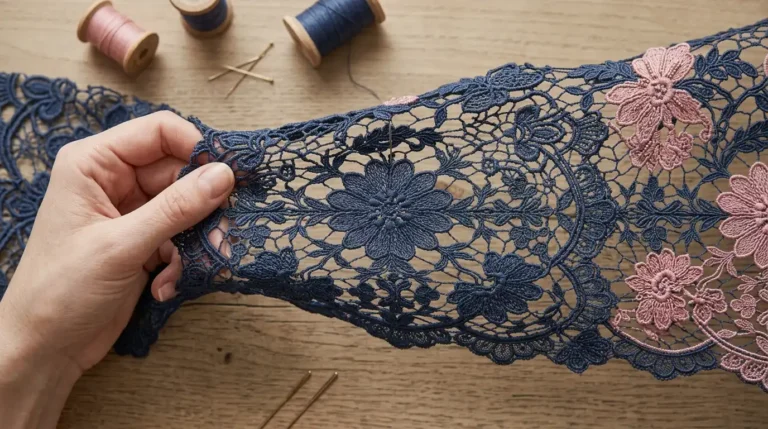
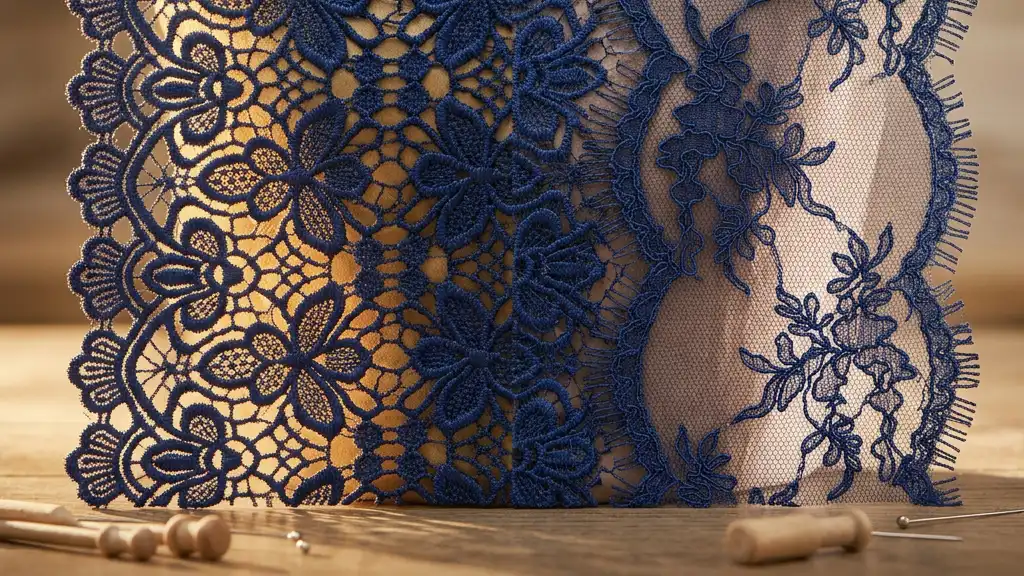
A buyer looks at two lace panels side by side. Both have the same floral pattern. Only one has fringe on both long edges instead of just one.
That single difference changes how the fabric gets cut and where it can be used. It also changes something most buyers never hear about: how much of it actually ends up as usable trim.
This guide is for fashion and evening-wear brand buyers and small-batch designers. It’s meant to help you decide whether a project actually calls for double-sided eyelash lace, or just looks like it should.
What Double-Sided Actually Changes
Three things shift once both edges get finished instead of one.
- Cutting. A double-sided panel can often be split down the middle into two usable trims. A one-side panel can’t.
- Application. Double-sided lace belongs wherever both raw edges will show — a one-side panel belongs at a hem.
- Cost math. Yield per yard is different, and so is the price you should expect to pay.
Get this distinction right before you spec a project, not after the fabric arrives.
The Industry Term You Should Actually Use: Galloon
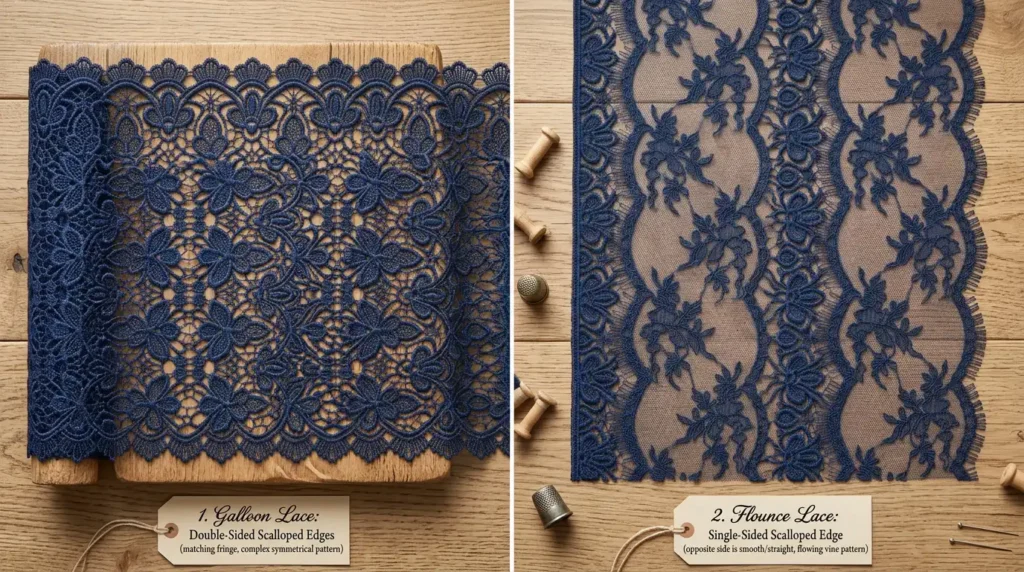
“Double-sided eyelash lace” is the descriptive name. The trade term is galloon.
A galloon is lace finished with a scalloped or fringed edge on both sides — the definition has been stable in textile trade language for centuries. Ask a supplier for “galloon” instead of “double-sided,” and you’ll usually get a faster, more accurate quote.
It’s worth knowing the neighboring term too: a flounce has a scalloped edge on one side and a plain edge on the other. Our complete guide to eyelash lace fabric covers this distinction, plus the other eyelash lace variants worth knowing before you write a spec sheet.
💡 Pro Tip: Put “galloon” in your PO alongside “double-sided” the first time you order from a new supplier. It removes any ambiguity about which edge configuration you mean.
Why Manufacturers Knit It This Way
Double-sided isn’t purely an aesthetic choice. It’s partly a production decision.
On a knitting machine, motifs pull against the surrounding structure as they form. When both edges carry a matching floral pattern, the pull from each side tends to balance the other out. A single finished edge doesn’t get that counter-tension, which is one reason mills favor the double-sided build for dense, heavily corded patterns.
Corded construction adds another layer to this. A corded motif — outlined in a thicker, twisted yarn — already pulls harder against the base structure than a flat embroidered one. Pairing that with two finished edges gives the machine tension something to balance against on both sides at once.
Where Double-Sided Lace Actually Belongs
Match the edge configuration to what the garment will show, not to which one looks nicer on a hanger.
Overlays and accent panels where both raw edges sit inside the visible garment — not tucked into a hem or seam — need both sides finished. A cape, a shawl, or a center-front panel are typical cases.
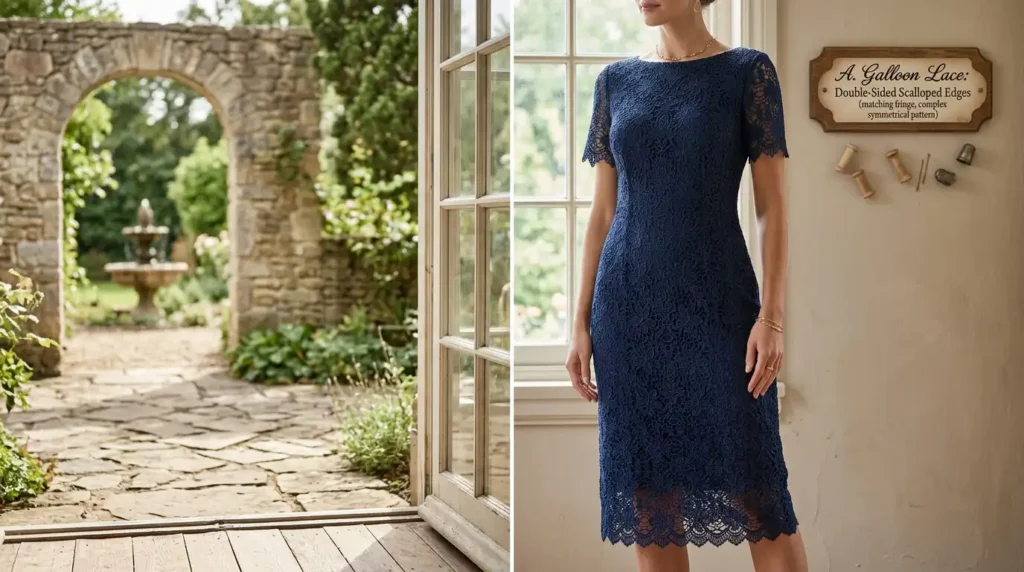
Fitted dresses and sheaths built entirely from the panel — rather than a separate lining plus a lace trim — often use this construction too. The double-sided pattern edge frames the hemline on both the front and back cut pieces.
Hems and single-edge trim, by contrast, only need one side finished. Buying double-sided for a pure hem application means paying for — and wasting — a second edge nobody will ever see.
The Yield Math Nobody Explains
Here’s the part that actually affects your budget.
The scallops on each edge are usually offset from each other. That means a double-sided panel can often be cut carefully down the center — motif by motif — into two separate trims. One yard of double-sided lace can become roughly two yards of usable single-edge trim this way.
That math only works if you’re buying the panel specifically to split it. If you need a full-width double-sided panel intact — for the overlay and dress applications above — cutting it in half defeats the purpose.
⚠️ Warning: Confirm with your supplier whether the two edges are offset or mirrored before you plan a center cut. A mirrored, symmetrical layout won’t split into two clean trims the way an offset one will.
Sourcing Checklist: What to Confirm Before You Order
A few specs are worth locking down before yardage gets quoted, not after.
- Width, measured edge to edge including both fringe borders, not just the printed pattern width.
- Fringe length and density on each side — the two edges don’t always match exactly, and that’s worth knowing up front.
- Fiber content, especially for corded versions, since the cord yarn is sometimes a different fiber than the base lace.
- Weight (GSM), which climbs fast on corded double-sided constructions compared to flat single-sided lace.
- MOQ, which is typically higher for custom colorways than for stock patterns.
Our guide to sourcing eyelash border lace walks through how to request and read a fringe and dye-lot review before placing a wholesale order. For general MOQ ranges by order type, our guide to sourcing lace fabric from China breaks down what to expect from stock versus custom development.
Case Study: G143 Double-Sided Eyelash Corded Lace
G143 is where all of this comes together in one real product.
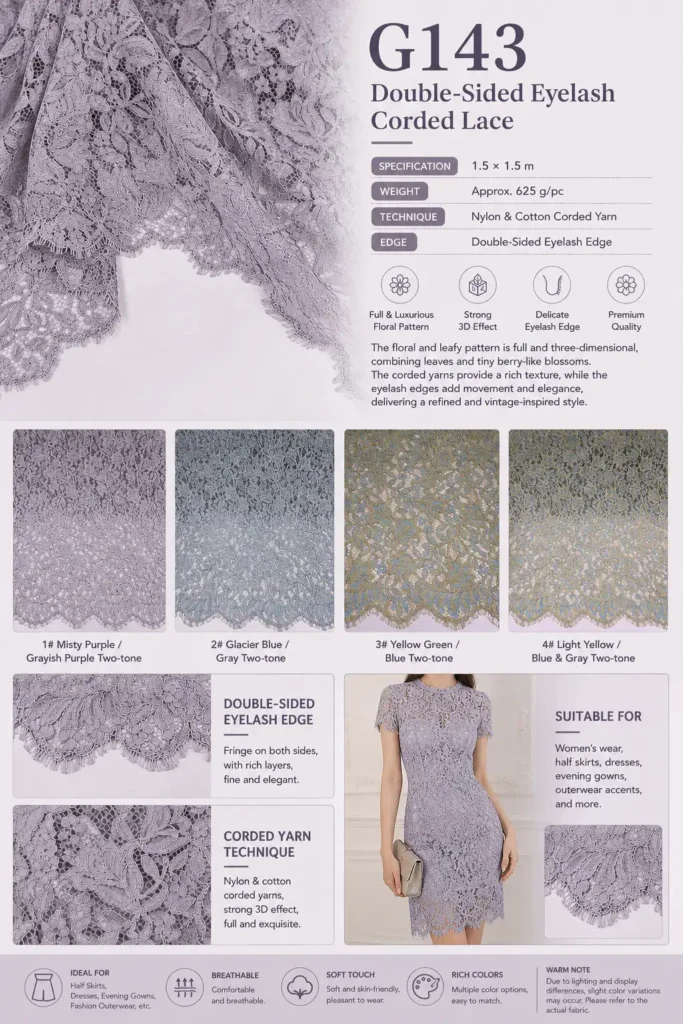
It’s a corded lace with 625 g/pc — noticeably heavier than a typical flat lace, which tracks with the corded-plus-double-sided construction described above. The pattern combines dense florals and leaves with small berry-like motifs, finished with fringe on both long edges.
The application photo shows it cut as a full sheath dress, not trimmed as a hem accent. That’s the overlay/fitted-garment use case from earlier in this guide. The panel is built into the dress itself, with the double-sided scalloped edge doing double duty as the finished hemline, front and back.
It ships as a 1.5m × 1.5m panel in four two-tone colorways — misty purple, glacier blue, yellow-green, and light yellow. Each one blends two shades across the pattern rather than a single flat color.
If a corded, double-sided eyelash lace fits your next collection, our lace fabric collection is a good place to start. From there, we can talk through custom colorways directly.
One Edge or Two: Say Which One You Need
Sourcing eyelash lace? The pattern is only half the spec. Which edges are finished — one or both — decides how the fabric gets cut, where it belongs on a garment, and what it should cost.
Fuyuan Knitting produces both one-side and double-sided eyelash and corded lace, with in-house dyeing that keeps colorways like G143’s consistent across a full production run.
Reach out for swatches and tell us the edge configuration you actually need. We’ll help you avoid paying for an edge your design doesn’t use.