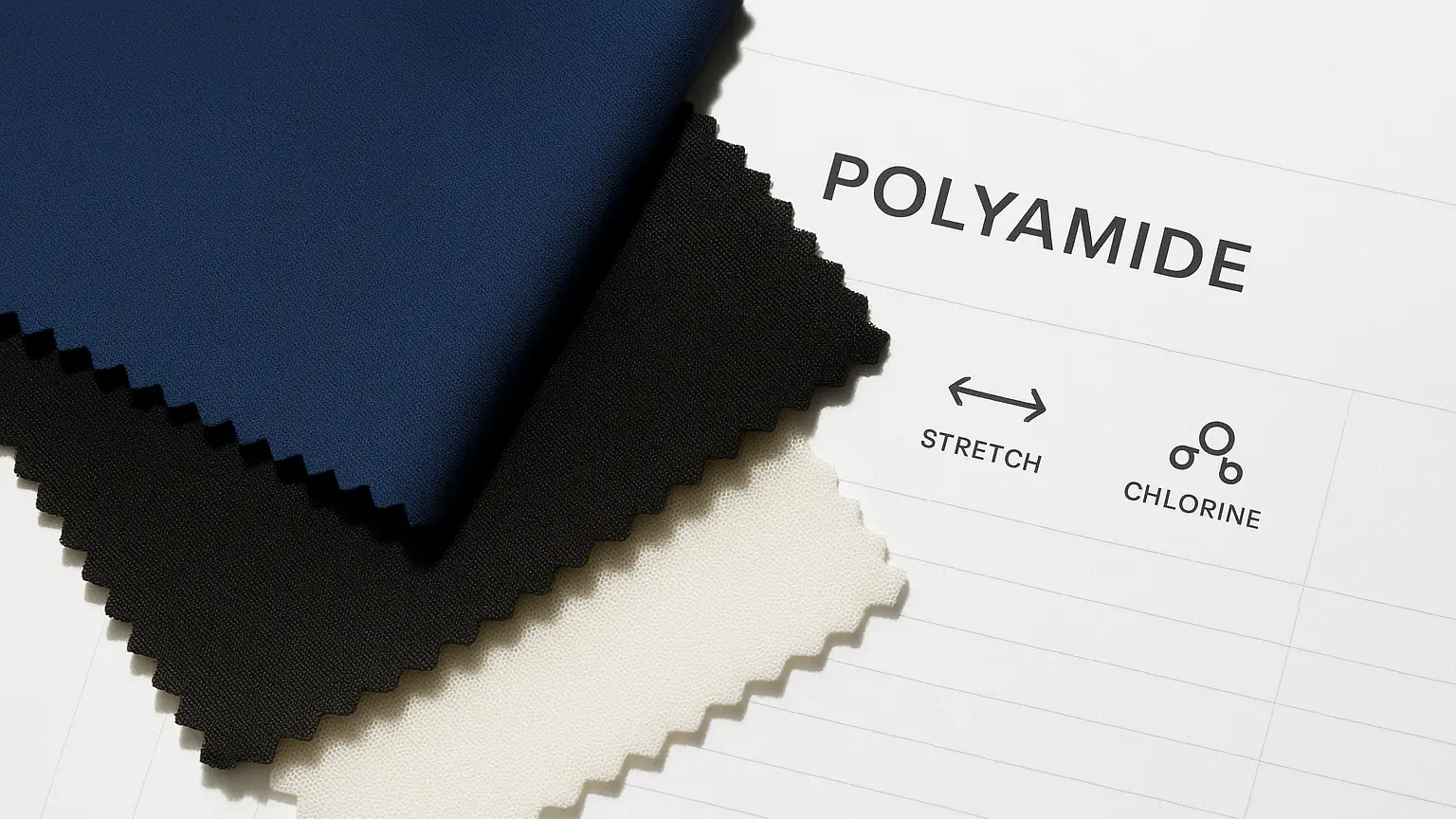
Polyamide Fabric: A Procurement Guide for Swimwear and Lingerie
If you’re sourcing for swimwear or intimate apparel, “polyamide” can feel like a vague term—until you’re the one who has to sign off on performance, color consistency, and returns risk.
This guide translates polyamide (nylon) into procurement language: what it is, how it behaves vs. polyester/cotton/viscose, where it wins, where it’s the wrong choice, and what to ask suppliers so you don’t discover problems after production.
First, what is polyamide fabric (and is it just nylon?)
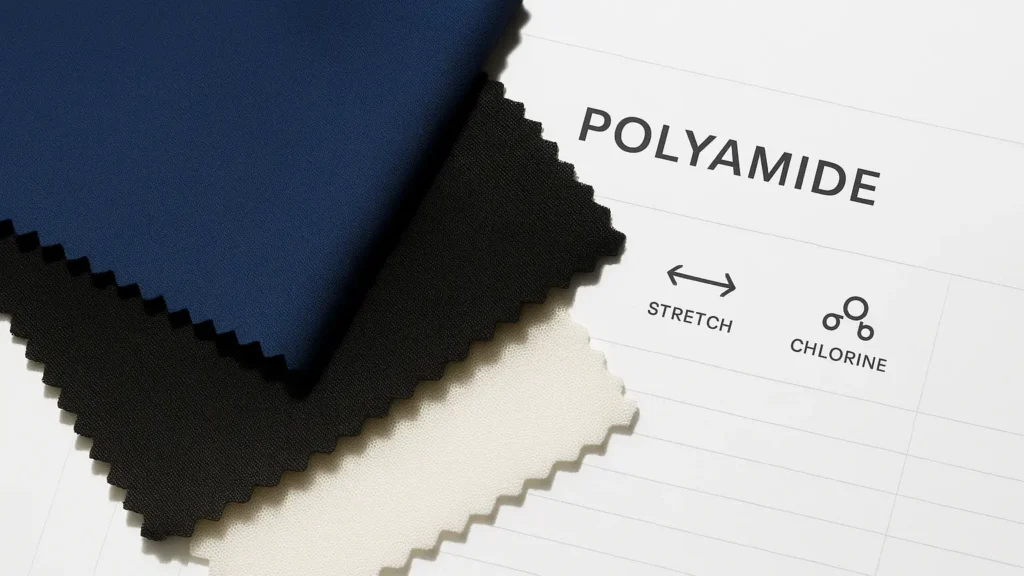
In apparel, polyamide fabric almost always means nylon fabric—a family of synthetic fibers made from long-chain polyamide polymers.
In the U.S., fiber names on labels are governed by the FTC’s textile rules. The practical takeaway is: you’ll commonly see “nylon” on U.S.-market labels, while “polyamide” also appears (especially in globally-sourced trims or materials) as an ISO-aligned naming convention. The compliance anchor for generic fiber naming and definitions is the FTC’s textile rules under 16 CFR Part 303.
- Reference: FTC’s Textile Fiber Products Identification Act rules (16 CFR Part 303) (linked later in the FAQ)
- Helpful overview: FTC guidance on textile labeling requirements (linked later in the FAQ)
Procurement implication: Treat “polyamide” and “nylon” as the same starting point for performance discussions—but still confirm the exact type (e.g., nylon 6 vs nylon 6,6), yarn type, and construction because that’s where your real outcomes come from.
Quick comparison table: polyamide vs polyester and other common fibers
Use this as a first-pass filter when you’re aligning Product Development, Sourcing, and Quality on what matters most for the line.
| Criteria (what you’re really buying) | Polyamide (Nylon) | Polyester (incl. PBT variants for swim) | Cotton | Modal / Viscose | Silk |
|---|---|---|---|---|---|
| Handfeel against skin | Smooth, “cool,” often premium-feeling in knits | Can be smooth, often slightly firmer/stiffer depending on yarn/finish | Soft, familiar, can feel bulky when wet | Very soft, drapey, comfort-forward | Luxurious, delicate |
| Stretch & recovery (with elastane) | Excellent fit/contour and recovery in quality knits | Good recovery; often used when shape retention + durability are priorities | Limited without elastics/blends | Comfortable stretch but less supportive alone | Limited |
| Chlorine & UV durability (swimwear) | Good but not typically the top performer for heavy chlorine | Often preferred for chlorine/UV durability; PBT is frequently positioned for high-chlorine use | Not suitable for swim performance | Not suitable for swim performance | Not suitable |
| Moisture management & drying | Quick-dry vs naturals; can hold more water than polyester | Low absorbency and fast drying | Absorbs and stays wet longer | Absorbent; can feel clammy in high-sweat use | Absorbent, slow care |
| Abrasion/snags/pilling | Generally strong; real outcome depends on knit + denier + finish | Often strong abrasion resistance; pilling varies with quality | Can abrade and lose shape over time | More delicate | Delicate |
| Best use cases | Fashion swim, lingerie/bras, mesh, trims, supportive knits | High-chlorine swim, performance swim, longevity-driven lines | Cotton gussets, comfort underwear, liners | Comfort-first underwear/loungewear | Luxury lingerie accents |
Pro Tip: Treat “fiber content” as only the first line item. Your wearer experience is just as influenced by construction (tricot, jersey, power mesh) and finishes (heat setting, anti-pilling, chlorine-resistant treatments).
Evaluation criterion 1: Stretch and recovery (what happens after 20 wears)
For swimwear and lingerie, your real enemy isn’t stretch—it’s stretch that doesn’t recover. Poor recovery shows up as:
- bagging at seat/knee or bust band
- curling edges on lingerie elastics
- distorted prints/stripes after laundering
- “fits great in fitting, fails in wear testing” returns
Where polyamide helps
Nylon is commonly chosen because it can feel supple and body-conforming in knit constructions—especially when blended with elastane.
Where the blend can betray you
Elastane/spandex delivers the snap-back, but it’s also the component that tends to degrade fastest in aggressive conditions (chlorine, heat, body oils). A practical industry rule of thumb is to keep elastane in a moderate band for swimwear.
One consumer-facing but specific reference point is SwimZip’s swimwear fabric guide, which notes typical swimwear blend ranges and cautions against very high spandex percentages for durability.
Procurement checklist for stretch/recovery
- What is the elastane % and what elastane type is being used?
- Is the fabric heat set (and at what conditions) to lock in dimensional stability?
- What are the supplier’s stretch and recovery test results after laundering and (for swim) chlorine exposure?
Evaluation criterion 2: Chlorine, UV, and colorfastness (swimwear reality check)
Swimwear is an exposure product: pool chemicals, sunscreen oils, heat, UV, abrasion from decks, and repeated washing.
Nylon vs polyester in swim
The market reality is:
- Nylon blends are often selected for handfeel and fit.
- Polyester (and especially chlorine-focused polyester variants like PBT) is frequently selected when chlorine durability and longevity are the priority.
SwimZip summarizes practical tradeoffs (drying, feel, UV considerations, and blend percentages) in a way that’s easy to map to your own test plan.
What to specify (not just “good color”)
Instead of asking for “good colorfastness,” make it procurement-verifiable:
- chlorine exposure color change protocol (your lab or supplier’s)
- lightfastness / UV testing approach for the intended market use
- shade banding tolerance and lab dip approval workflow
⚠️ Warning: If the supplier can’t explain their test method or only provides a marketing claim, assume you’ll be the one paying for the learning curve.
Evaluation criterion 3: Handfeel and skin comfort (lingerie: comfort is not subjective)
In lingerie and intimate apparel, “soft” is table stakes. What you’re really balancing is:
- softness + low irritation at elastic edges
- support (for bras) without scratchy stiffness
- breathability where it matters (often the gusset and high-friction zones)
- pilling control in everyday wear
Where polyamide is a common choice
Nylon + elastane is widely used in bras and lingerie because it can deliver supportive stretch and recovery that pure cotton often can’t sustain in bands and cups.
A practical, brand-facing explanation of why cotton alone often lacks bounce-back compared with nylon/spandex appears in Q for Quinn’s bra material guide (2025).
Where cotton/modal win
Cotton and modal/viscose-based fabrics often win on:
- perceived breathability
- moisture absorption for comfort underwear
- “all-day wear” softness
But they often need design and material support (construction + elastics + lining strategy) to meet performance expectations in bras or shape-critical lingerie.
For a construction-oriented overview of lingerie fabric types and when to use them, see Seamwork’s lingerie fabric guide.
Procurement checklist for comfort (spec it)
- Request handfeel approval standards (your internal panel + supplier reference swatches)
- Specify pilling requirements appropriate to the garment zone
- Confirm shrinkage/dimensional change targets after laundering
Evaluation criterion 4: Moisture management and drying time
A common sourcing mistake is treating moisture management as a single attribute. It’s at least three:
- absorption (how much water the fiber holds)
- wicking (how the fabric moves moisture)
- drying rate (how quickly it releases moisture)
Procurement framing:
- Polyester is generally positioned as lower absorbency and faster drying.
- Nylon can still be quick-drying compared with natural fibers, but in many swim constructions it may hold more water than polyester.
So if your line includes performance swim or high-wear pool use, you should treat drying/weight-in-water as a real criterion in wear testing.
Evaluation criterion 5: Durability—abrasion, snags, and pilling
Durability for these categories shows up differently:
- Swimwear: abrasion vs pool decks, snagging, seam integrity, color stability.
- Lingerie: pilling in wash/wear, mesh snagging, elastic edge fatigue, hook/eye zone stress.
Because many web sources overclaim “nylon is always more durable,” keep your durability evaluation grounded in construction and testing. Nylon variants can behave differently based on polymer type and processing.
Evaluation criterion 6: Nylon 6 vs nylon 6,6 (when the numbers matter)
If you see “nylon 6” or “nylon 6,6” (sometimes written “nylon 66”) in a spec sheet, the numbers refer to the monomers used to make the polymer. In practical sourcing terms, these variants are often discussed in relation to:
- heat performance (e.g., higher melting point often associated with nylon 6,6)
- strength/abrasion tendencies
- dyeing behavior and process requirements
Two practical references that explain these differences for buyers (not just chemists):
Procurement implication: If you’re chasing a specific outcome (e.g., tighter heat tolerance in processing, or particular abrasion performance), ask for the nylon type explicitly—don’t let it stay implicit under “polyamide.”
What to ask suppliers: a spec-ready RFQ checklist
Use this to turn a vague request (“polyamide fabric for swim/lingerie”) into a quote that’s actually comparable across mills.
1) Composition and polymer type
- Fiber content (% nylon/polyamide, % elastane)
- Nylon type if known/available (nylon 6, nylon 6,6)
2) Construction and yarn details
- Construction (e.g., tricot, jersey, mesh, power mesh)
- Yarn type (filament vs textured) and denier range (supplier to confirm)
3) Performance and testing
- Stretch and recovery results (before/after wash)
- For swim: chlorine exposure testing approach and results (and whether results apply to the exact colorway)
- Lightfastness/UV approach (if relevant to your market requirements)
- Pilling / abrasion test method and threshold (define by garment zone)
4) Color and consistency controls
- Lab dip process and lead time
- Shade band tolerance and roll-to-roll consistency controls
- Minimum order and re-order matching expectations
5) Finishing and stability
- Heat setting details
- Dimensional change (shrinkage) after laundering
- Any functional finishes that affect handfeel or longevity (documented, not claimed)
Decision guide: which fiber strategy fits which use case?
Swimwear
Choose polyamide (nylon) blends when:
- fit and handfeel are primary (fashion swim, comfort-forward lines)
- you want a smooth, body-hugging knit that feels premium
Choose polyester/PBT-led options when:
- chlorine and UV durability are the top priority (frequent pool use, team/competition use)
- longevity and shape retention outweigh “softest handfeel”
Lingerie / intimate apparel
Choose polyamide (nylon) blends when:
- you need dependable stretch + recovery (bands, supportive zones)
- you’re working with mesh/lace constructions where strength matters
Choose cotton/modal-led strategies when:
- breathability and moisture absorption are central to the product promise
- you’re building comfort underwear and can engineer support via elastics/structure
FAQs for sourcing teams
Is polyamide the same as nylon?
In apparel sourcing, polyamide usually refers to nylon (an aliphatic polyamide). In the U.S., “nylon” is the common generic fiber name under FTC textile rules: FTC’s Textile Fiber Products Identification Act rules (16 CFR Part 303).
Why does polyamide sometimes show up on labels instead of nylon?
Global supply chains often use ISO-aligned naming conventions. U.S. compliance labeling still relies on FTC generic-name rules; this FTC overview is a useful reference: FTC guidance on textile labeling requirements.
What blend percentages are typical for swimwear?
Blend targets depend on the intended performance profile. For one practical summary of common spandex ranges and tradeoffs, see SwimZip’s guide to swimwear fabrics. Always validate with your own fit and wear testing.
Does nylon always beat polyester for durability?
Not automatically. Outcomes depend heavily on construction, yarn, finishing, and use conditions. Use fiber choice to narrow options, then rely on testing to choose.