What Is Crepe Fabric? A Complete Guide
Pick up a crepe dress and run your thumb across it, and you’ll notice something odd: it looks wrinkled, but it never actually creases. That contradiction is the whole point of crepe. It’s one of the few fabrics designed to look imperfect on purpose, and that “flaw” is exactly why it drapes so well on a body and hides a full day of wear without an iron in sight. But “crepe” isn’t one material — it’s a technique that can be applied to silk, wool, cotton, or plastic, and the fiber underneath changes almost everything about how it feels, costs, and performs. Here’s what’s actually going on under that crinkled surface.
What Is Crepe Fabric?
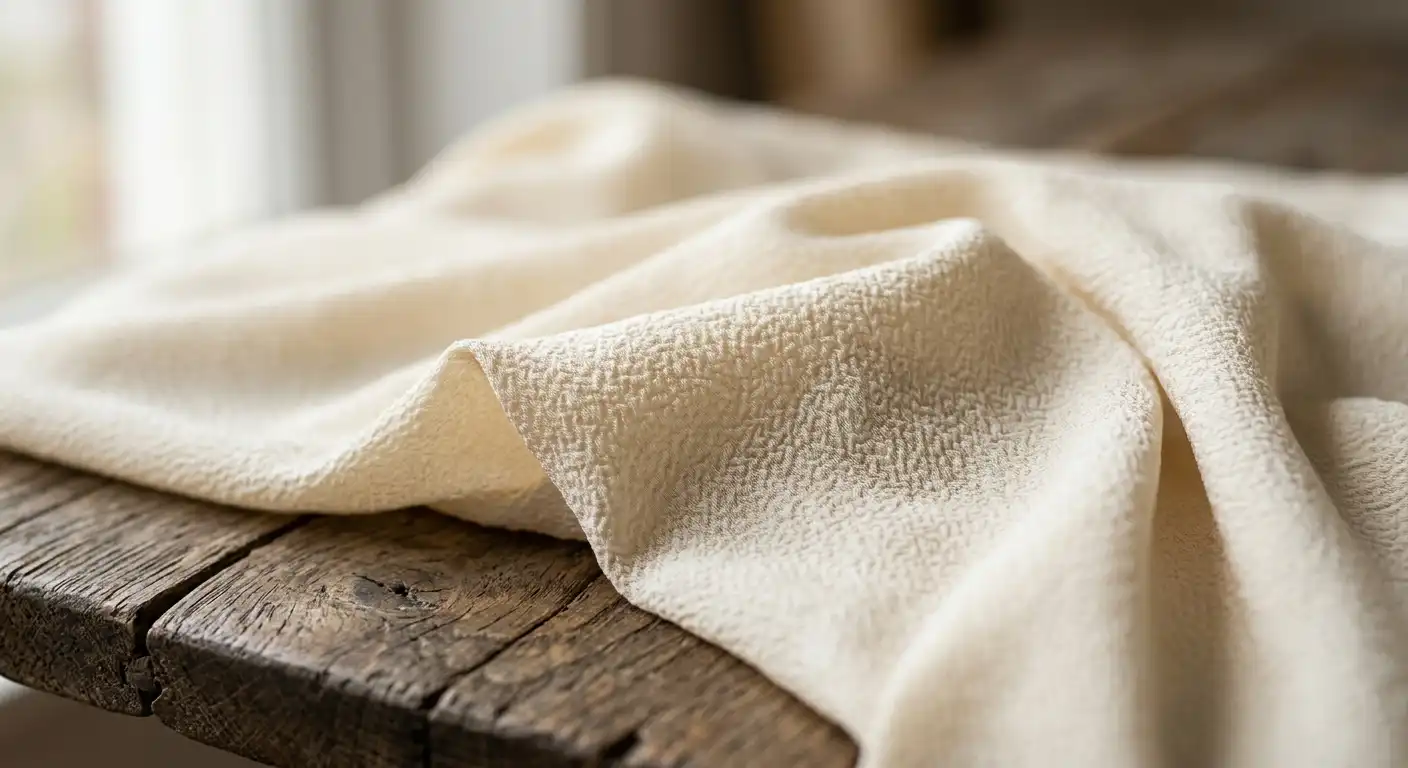
Crepe is a fabric — silk, wool, cotton, or a synthetic like polyester — finished with a tight, crimped surface that gives it a slightly rough, pebbly hand and a fluid, almost liquid drape. The name comes from the French word crêpe, itself borrowed from the Latin crispus, meaning “curled” or “crinkled.” Yes, it’s the same root as the French pancake — both share that thin, slightly rippled quality.
The key thing to understand is that crepe isn’t a fiber. It’s a construction method. You can make crepe from almost any yarn, which is why you’ll find silk crepe next to polyester crepe on the same shelf, looking similar but behaving very differently once you touch them.
A Brief History of Crepe Fabric
Crepe-style weaving goes back centuries, with early versions traced to East Asia, particularly China, where silk production and tight-twist yarn techniques developed early. The fabric traveled west along the Silk Road and found its way into European wardrobes by the 19th century.
In Victorian Europe, black silk crepe became closely tied to mourning dress — stiff, matte “mourning crape” was practically a uniform for widows for decades. That association faded through the 20th century as synthetic fibers like rayon and polyester made crepe cheaper and easier to produce. Once it wasn’t tied to funerals anymore, crepe moved into everyday fashion: blouses, suiting, evening wear, and eventually curtains and cushions.
How Crepe Fabric Is Manufactured
There are two basic routes to that crinkled surface: twisting the yarn before weaving, or treating the finished cloth with heat or chemicals afterward (this is how plissé crepe gets its pleated look). The classic method — and the one that gives crepe its name — is yarn twisting.
Hard Twisting
Crepe yarn starts as ordinary fiber, but it’s spun with far more twist per inch than standard yarn. That extra tension is what gives crepe its characteristic bounce and texture once the fabric relaxes after weaving.
S-Twist and Z-Twist Yarns
Manufacturers alternate two twist directions in the yarn — S-twist and Z-twist, named for the direction the fibers spiral (like the diagonal strokes in the letters S and Z). When yarns twisted in opposite directions are woven or knit together, they pull against each other unevenly as the fabric relaxes, which is what creates that random, three-dimensional pucker instead of a flat surface. It’s a simple mechanical trick, but it’s the reason crepe never looks perfectly smooth — and never needs to.
What Is Crepe Fabric Made From?
Natural Fibers
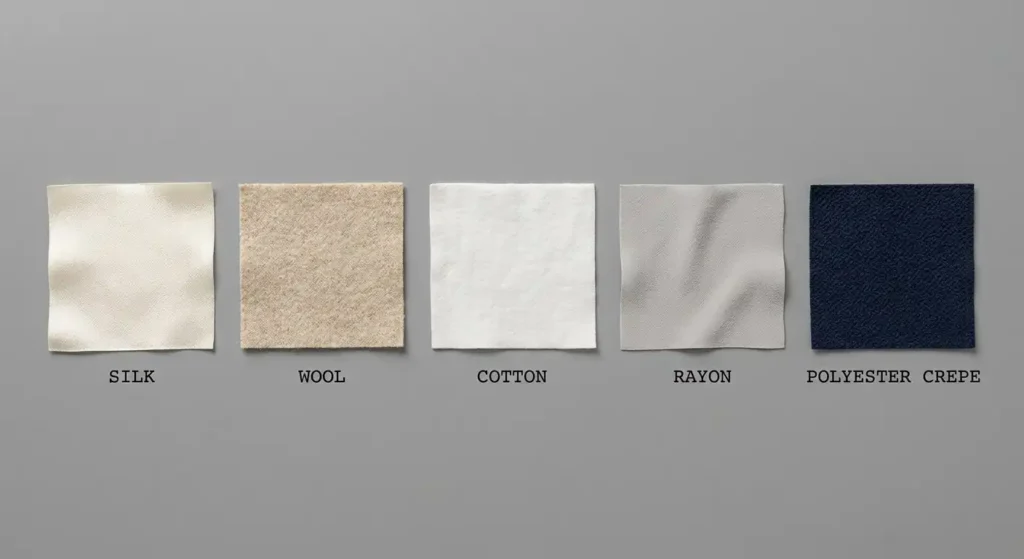
- Silk Crepe — The original and still the benchmark. Lightweight, glossy in a muted way, and famous for its drape. Crepe de Chine is the best-known example.
- Wool Crepe — Heavier and springier than silk crepe, with a dry, slightly rough hand. Common in tailored suits, skirts, and cooler-weather dresses because it holds shape well.
- Cotton Crepe — Softer and more casual, often chemically treated (as in seersucker-adjacent crepe cottons) rather than yarn-twisted. Easy to wash, less prone to the fragility of silk.
Synthetic and Regenerated Fibers
- Polyester Crepe — The most common crepe on the market today. It mimics silk’s look at a fraction of the price, resists wrinkling well, and machine-washes without drama, though it doesn’t breathe the same way natural fibers do.
- Rayon Crepe — Made from regenerated cellulose, rayon crepe splits the difference: a drape close to silk, a price closer to cotton. If you want the mechanics behind this fiber, our guide to viscose fabric covers how it’s produced and where it performs best. For buyers looking at a lower-impact cellulosic option, Tencel fabric is worth comparing against standard rayon.
Fiber Comparison Table
| Fiber | Hand Feel | Breathability | Typical Cost | Standard Moisture Regain* |
|---|---|---|---|---|
| Silk | Smooth, light, slightly grainy | High | High | 11.0% |
| Wool | Springy, dry, textured | Moderate–High | High | 16.0% |
| Cotton | Soft, matte | High | Moderate | 8.5% |
| Rayon/Viscose | Fluid, silk-like | Moderate–High | Moderate | 11.0% |
| Polyester | Slick, synthetic | Low | Low | 0.4% |
*Standard commercial moisture regain values as defined under ASTM D1909, a widely used textile industry reference for how much moisture a bone-dry fiber reabsorbs under standard conditions. Higher regain generally correlates with better breathability and moisture-wicking comfort.
Moisture regain isn’t the whole story on comfort, but it’s a useful, measurable stand-in: fibers with higher regain (wool, silk, cotton, rayon) tend to feel cooler and less clammy against skin than polyester, which barely absorbs moisture at all and relies on the weave to move sweat away from the body.
Properties of Crepe Fabric
Regardless of fiber, most crepe shares a few traits:
- Drape — Falls close to the body instead of standing away from it, which is why it’s a go-to for gowns and wrap dresses.
- Textured surface — The pebbled finish scatters light instead of reflecting it, so crepe reads as matte rather than shiny.
- Wrinkle resistance — The existing texture disguises new creases, so crepe travels better than flat-woven fabrics.
- Variable weight — Crepe ranges from sheer chiffon-weight to heavy double crepe, so “crepe” alone doesn’t tell you much about warmth or opacity — you have to check the specific type.
- Fraying — Many woven crepes fray at a cut edge more than a tightly woven cotton would, which matters at the sewing stage.
Pros and Cons of Crepe Fabric
Pros
- Elegant, fluid drape that flatters most body shapes
- Naturally hides light wrinkles and travels well
- Available across a wide price range depending on fiber
- Works year-round — lightweight versions suit summer, heavier wool crepe suits winter
Cons
- Natural-fiber crepe often needs hand washing or dry cleaning
- Slippery surface makes cutting and sewing more fiddly than with cotton
- Polyester versions trap heat and feel less breathable
- Frays more readily at raw edges, so seams need finishing
Crepe vs Other Fabrics
Crepe gets confused with a handful of similar-feeling fabrics, but the differences show up quickly once you compare them side by side.
| Fabric | Surface | Drape | Transparency | Typical Use |
|---|---|---|---|---|
| Crepe | Pebbled, matte | Fluid | Opaque to semi-sheer | Dresses, suiting, blouses |
| Chiffon | Smooth, sheer | Very flowy | Sheer | Overlays, scarves, evening wear |
| Satin | Smooth, glossy | Fluid | Opaque | Bridal wear, linings |
| Georgette | Fine crinkle, lightweight | Floaty | Semi-sheer | Sarees, layered dresses |
| Cotton (plain weave) | Smooth, matte | Structured | Opaque | Shirts, casual wear |
Comparison based on standard weave and finish characteristics as documented for these fabric categories.
Georgette is technically a lightweight subtype of crepe, which is why the two often get lumped together — the giveaway is that georgette is sheerer and floatier, while general-purpose crepe holds a bit more body. If you’re weighing crepe against a sheerer option for something like a lining or overlay, our full breakdown of chiffon fabric explains why two “chiffon” garments can feel completely different depending on fiber and weight — the same logic applies to crepe.
How to Tell Real Crepe From a Fake
Because crepe can be made from almost any fiber, “is this real silk crepe or polyester dressed up as silk?” is one of the most common questions buyers ask. Two low-tech checks get you most of the way there.
Hand Feel
Rub a corner of the fabric between your fingers. Silk crepe warms up quickly against skin and has a dry, slightly grainy texture with a soft (not slick) surface. Polyester crepe tends to feel cooler for longer and slightly slippery or “plasticky,” even when the crinkle pattern looks nearly identical. Crumple a section in your fist — silk creases and releases with a soft, organic wrinkle; polyester often springs back almost too perfectly.
The Burn Test
This is the more reliable method, and it only requires a small clipped thread and a lighter — never test on fabric still attached to a garment you care about, and always burn over a non-flammable dish with water nearby.
| Fiber | Flame Behavior | Smell | Residue |
|---|---|---|---|
| Silk | Curls away, self-extinguishes | Burnt hair | Fine, dark, crushes to powder easily |
| Wool | Burns slowly, self-extinguishes | Burnt hair | Coarser, dark ash |
| Cotton | Ignites quickly, keeps burning | Burning paper | Soft gray ash |
| Rayon/Viscose | Ignites quickly, like cotton | Burning paper | Soft gray ash, minimal |
| Polyester | Melts, shrinks from flame | Sweet/chemical | Hard, dark bead — won’t crush |
Source: Standard fiber burn-test behaviors as documented by textile testing references, including AATCC-based identification methods used by fabric testing labs.
A word of caution: blended fabrics won’t give you a clean result, and finishes or dyes can slightly change how a swatch burns. Treat the burn test as a strong indicator, not absolute proof — if the stakes are high (a wedding dress, a bulk order), pair it with a proper fiber content label check or lab test.
Summary
Crepe isn’t a single fabric — it’s a twisting technique that can be applied to silk, wool, cotton, polyester, or rayon, and the fiber you choose determines almost everything that matters in practice: how it breathes, what it costs, and how it needs to be cared for. What stays constant across all of them is the crinkled surface and fluid drape that make crepe a reliable choice for anything from a tailored blazer to a flowing evening gown. If you’re buying or sourcing crepe, don’t stop at the word on the label — check the fiber content, and if you’re unsure, a quick hand-feel check or burn test will tell you more than the swatch card ever will. For more fiber-by-fiber breakdowns like this one, FuYuan Knitting’s fabric blog covers everything from viscose to chiffon in the same practical format.
FAQs
Is crepe fabric good for hot weather?
Lightweight silk or rayon crepe breathes reasonably well and suits warm climates. Polyester crepe traps more heat, so it’s a better fit for air-conditioned settings or cooler seasons.轻薄的真丝或人造丝绉纱透气性较好,适合温暖气候。涤纶绉纱则更保暖,因此更适合空调环境或较冷的季节。
Does crepe fabric shrink when washed?
Natural-fiber crepe (silk, wool) can shrink noticeably in a washing machine, which is why dry cleaning or careful cold hand-washing is usually recommended. Polyester crepe is far more shrink-resistant and often machine-washable on a gentle cycle.
What’s the difference between crepe and crepe de chine?
Crepe de chine is a specific, lightweight type of silk (or silk-like) crepe with a smoother, more matte finish than heavier crepes — it’s essentially one style within the broader crepe family, not a separate fabric.
Can you tell real silk crepe from polyester crepe just by touch?
Often, yes — silk feels warmer, drier, and slightly grainy, while polyester feels cooler and a bit slick. But it’s not foolproof, especially with high-quality synthetics, so pairing touch with a burn test gives a more reliable answer.
Is crepe fabric expensive?
It depends entirely on the fiber. Polyester crepe is budget-friendly, rayon crepe sits in the middle, and silk or wool crepe carry a noticeably higher price tag due to raw material cost and more delicate processing.