What Is Jacquard Fabric? Types, Uses, and Everything You Need to Know
Pick up an expensive sofa cushion, an evening gown, or a set of hotel-quality bed sheets, and there’s a good chance you’re touching jacquard. The fabric shows up everywhere, yet most people couldn’t explain what makes it different from a printed or embroidered textile. The answer comes down to one idea: the pattern isn’t applied to jacquard — it’s built into it, thread by thread, during weaving. That single distinction explains why jacquard looks richer, wears longer, and costs more than most fabrics at a similar weight. This guide walks through everything worth knowing, from the loom behind the fabric to how it holds up on your couch.
What Is Jacquard Fabric?
Jacquard fabric is any woven textile whose pattern is formed during the weaving process rather than printed, dyed, or embroidered onto the surface afterward. The term refers to a method of production, not a single material — jacquard can be made from silk, cotton, wool, polyester, or blended fibers. What all jacquard fabrics share is a loom-controlled structure where individual warp threads are raised or lowered independently to create intricate, often three-dimensional designs.
Because the pattern is structurally part of the cloth, it won’t fade, crack, or peel the way surface prints can. Run a finger across a jacquard piece and you’ll often feel the design — a slight texture or relief that flat-printed fabrics simply can’t replicate.
Quick definition: Jacquard = woven pattern, not printed pattern. If the design is in the weave, it’s jacquard.
How the Technology Works
Understanding jacquard fabric starts with the machine that makes it possible.
Before 1804, weaving complex patterns required a second worker — called a “draw boy” — to manually lift specific warp threads on each pass of the shuttle. The process was slow, expensive, and error-prone. Joseph Marie Jacquard, a French textile worker, solved this by attaching a series of punched cards to the loom. Each card represented one row of the design: a hole meant “lift this thread,” no hole meant “leave it down.” By feeding cards in sequence, the loom could execute any pattern automatically and repeat it without mistakes.
The implications went far beyond textiles. The punched-card system directly inspired Charles Babbage’s early mechanical computer in the 1820s, and IBM used a version of the same principle for data processing well into the 20th century.
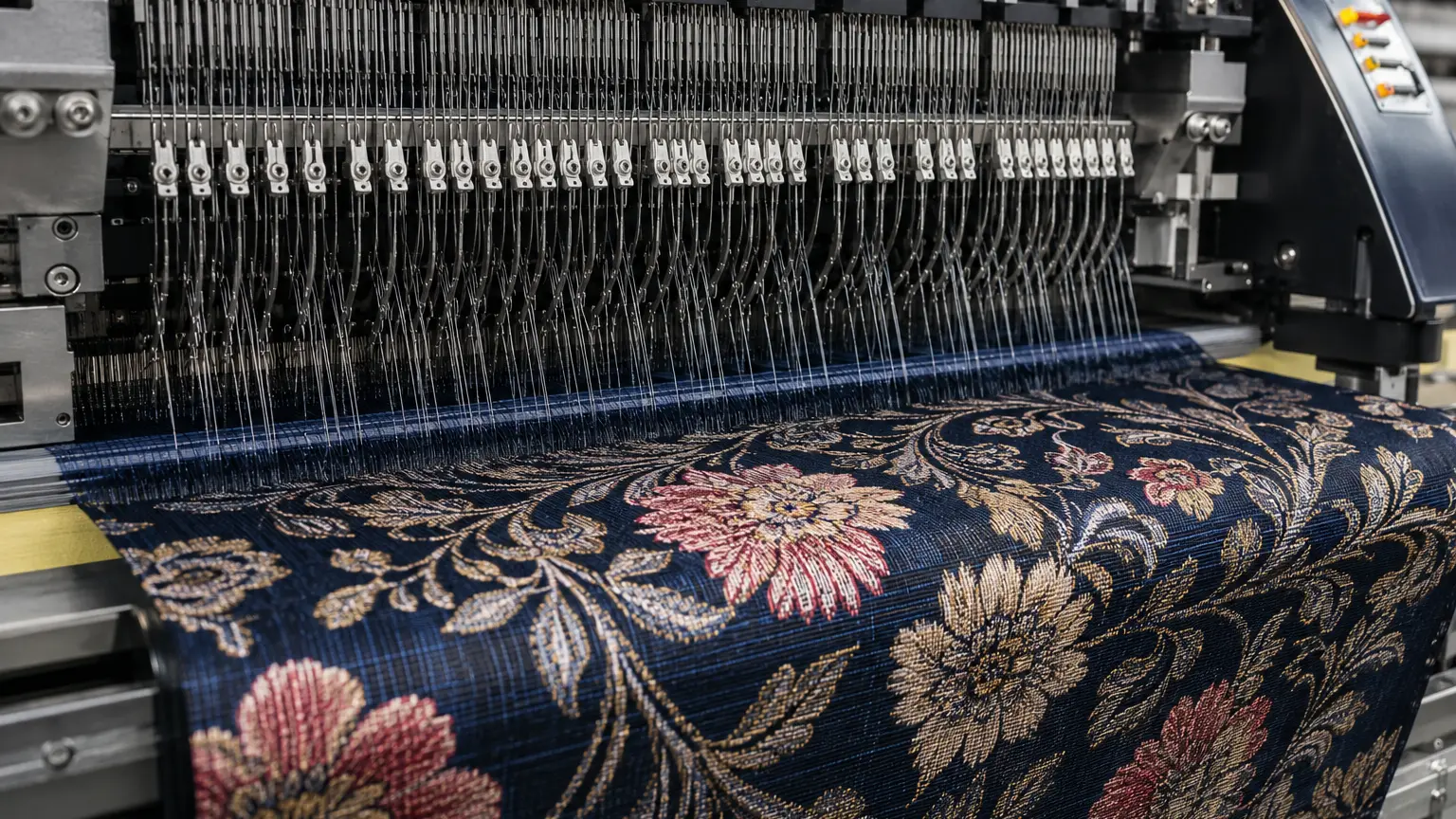
Modern Jacquard looms replace punched cards with digital files. A designer draws a pattern on screen, exports it as a weaving file, and the computerized loom reads it directly — controlling thousands of individual threads per second. The creative ceiling is essentially unlimited, and setup times that once took days now take hours.
How Jacquard Fabric Is Made
The production of jacquard fabric follows a logical sequence from raw fiber to finished cloth.
1. Fiber selection The manufacturer chooses a base fiber — silk, cotton, wool, polyester, or a blend — based on the intended end use. Fiber choice determines the final feel, weight, sheen, and durability of the fabric.
2. Spinning and yarn preparation Raw fibers are spun into yarn. For jacquard, yarn quality matters more than in plain weaving because fine, consistent yarn allows the loom to execute sharp pattern edges without distortion.
3. Pattern programming The design is created digitally (or, in traditional production, set up as a punch-card sequence). The program maps exactly which warp threads rise on each weft pass, translating the visual pattern into mechanical instructions.
4. Warping and dressing the loom Hundreds or thousands of warp threads are wound onto a beam and threaded through the loom’s heddles in a precise order. This setup step is time-intensive and is one reason jacquard production costs more than plain weaving.
5. Weaving The loom runs, lifting selected warp threads on each pass while the weft thread is passed through. The pattern builds row by row. Depending on complexity, a computerized loom might control 10,000 or more warp threads independently.
6. Finishing After weaving, the fabric is washed, heat-set, and sometimes treated with surface finishes. Some jacquards are brushed or sheared for texture; others receive a sheen finish that highlights the pattern contrast.
Types of Jacquard Fabric
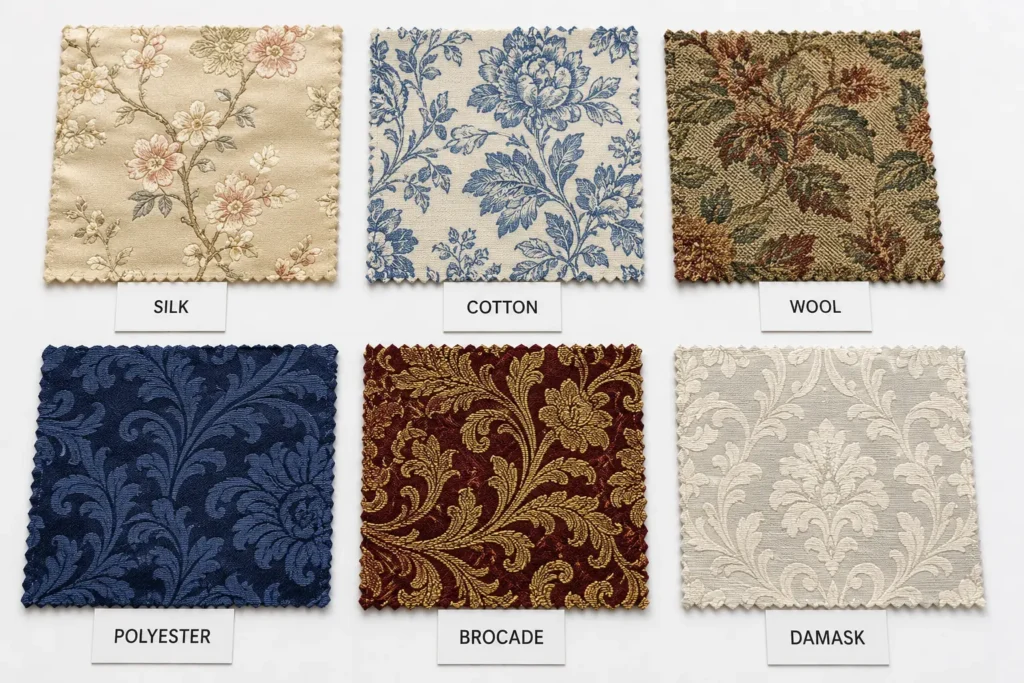
Jacquard is a weaving method, and it produces a wide family of distinct fabric types. The table below covers the most common ones.
| Type | Key Characteristics | Common Uses |
|---|---|---|
| Brocade | Raised, embossed patterns; often with metallic threads; not reversible | Formalwear, upholstery, evening bags |
| Damask | Reversible; pattern created through satin/matte weave contrast; flat surface | Curtains, table linens, bedding, apparel |
| Matelassé | Quilted or padded appearance; double-layer weave gives a blistered texture | Bedspreads, decorative pillows, luxury upholstery |
| Tapestry | Pictorial or scenic designs; heavy weight; multicolor | Wall hangings, bags, heavy upholstery |
| Silk Jacquard | Lustrous sheen; excellent drape; lightweight options available | Evening gowns, scarves, luxury bedding |
| Cotton Jacquard | Breathable; softer hand; machine washable in most cases | Casual apparel, bath towels, everyday bedding |
| Wool Jacquard | Structured; excellent warmth; natural elasticity holds pattern definition | Suiting, winter coats, premium throws |
| Polyester Jacquard | Durable; colorfast; lower cost; less breathable | Upholstery, curtains, budget apparel |
| Jacquard Knit | Stretchy; pattern knitted rather than woven; more flexible | Sweaters, leggings, knitwear |
The most important distinction to remember: brocade, damask, and matelassé are all types of jacquard. Calling something “jacquard” is like calling something “knitted” — it describes the construction method, not a single specific look.
Jacquard Fabric Patterns & Design Styles
Because the pattern is generated by controlling individual threads, jacquard can produce virtually any design — though certain motifs have become closely associated with the fabric.
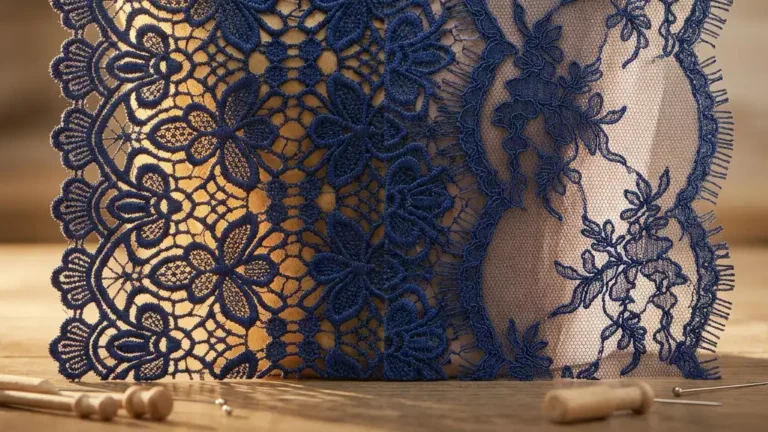
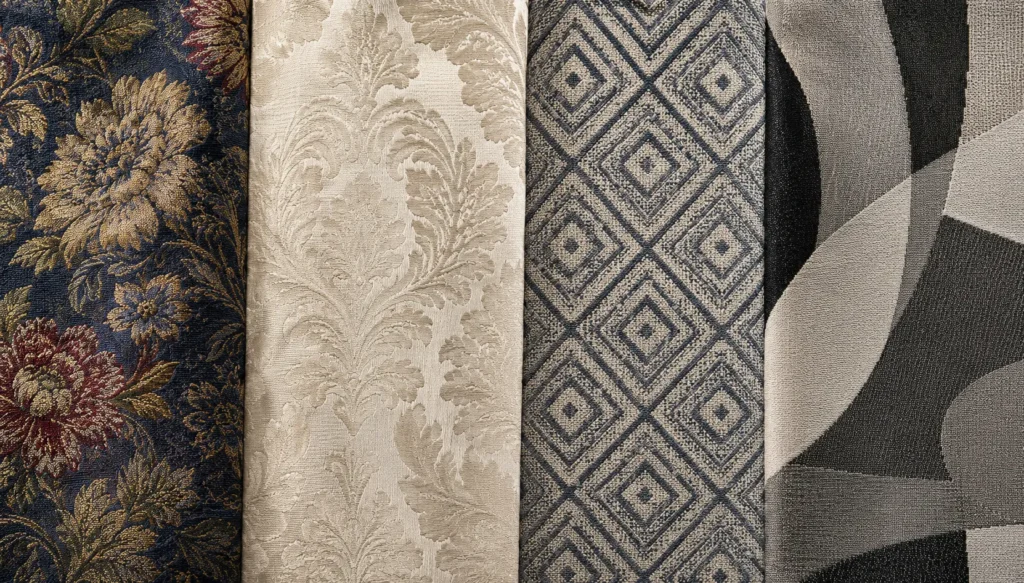
Floral and botanical patterns are the most traditional. Large-scale florals, vines, and leaf motifs appear frequently in upholstery jacquards and formal apparel. The density of the weave lets designers capture fine petal detail that printed fabrics struggle to match.
Geometric patterns — including diamonds, chevrons, houndstooth, and lattice designs — translate well into jacquard because the grid structure of the loom naturally lends itself to clean angles and repeating shapes.
Damask patterns are a subcategory of their own: symmetrical, medallion-centered designs with curving foliage, often rendered in tone-on-tone (one color, two weave structures) for a subtle, formal look.
Paisley — the teardrop-shaped motif with Persian origins — has been a staple of jacquard design for centuries and remains popular in scarves, ties, and upholstery.
Abstract and pictorial designs are more common in modern digital jacquard. Contemporary designers use the loom’s precision to create photographic-quality images, geometric color gradients, and patterns that would have been impossible to weave before computerized controls.
One thing that distinguishes jacquard patterns from printed equivalents: the design has physical texture. Light catches different weave structures differently, creating a contrast between matte and shiny areas even in a single-color fabric.
Properties & Characteristics of Jacquard Fabric
Jacquard’s properties vary considerably depending on the fiber used, but some characteristics apply broadly across the category.
| Property | Typical Range | Notes |
|---|---|---|
| Weight | Medium to heavy (150–400+ g/m²) | Lighter in silk jacquard; heavier in tapestry weaves |
| Durability | High | Tight interlocking weave resists wear better than loose weaves |
| Stretch | Low (woven jacquard) | Jacquard knit has moderate stretch |
| Breathability | Depends on fiber | Cotton/silk = breathable; polyester = less so |
| Sheen | Variable | Silk and satin-weave areas reflect light; matte areas absorb it |
| Pattern durability | Permanent | Pattern is structural; won’t fade, crack, or wash out |
| Pilling | Depends on fiber | Wool and some synthetics may pill over time |
| Thread count range | 100–300 | Higher counts tend toward finer, more detailed patterns |
The standout property is pattern permanence. A printed fabric can fade significantly after repeated washing; a jacquard fabric’s design, being woven into the structure, looks the same after 50 washes as it did on day one. This is one reason jacquard remains the go-to choice for high-use upholstery.
Jacquard vs Brocade vs Damask
This is the question that confuses almost everyone. Here’s the clearest way to think about it.
Jacquard is the weaving method — like “knitted” or “woven.” It describes how the fabric is made, not what it looks like.
Brocade is a specific style of jacquard characterized by raised, embossed patterns that stand out from the fabric surface. It often incorporates metallic or contrasting threads and has an almost embroidered appearance. Brocade is not reversible — the weft threads float loosely on the back.
Damask is another specific style of jacquard where the pattern is created through the contrast between satin-weave (shiny) and plain-weave (matte) areas. The surface is relatively flat, and — unlike brocade — damask is typically reversible, with the pattern appearing as a mirror image on the back.
| Jacquard | Brocade | Damask | |
|---|---|---|---|
| What it is | Weaving method | Fabric style | Fabric style |
| Surface | Varies | Raised/embossed | Flat |
| Reversible | Depends | No | Yes (usually) |
| Metallic threads | Sometimes | Often | Rarely |
| Pattern contrast | Weave structure | Raised texture + color | Sheen vs. matte |
| Typical weight | Light to heavy | Heavy | Medium |
| Best for | Broad range | Formalwear, upholstery | Linens, curtains, apparel |
The short version: all brocades and all damasks are jacquard, but not all jacquard is brocade or damask. It’s a hierarchy, not a competition.
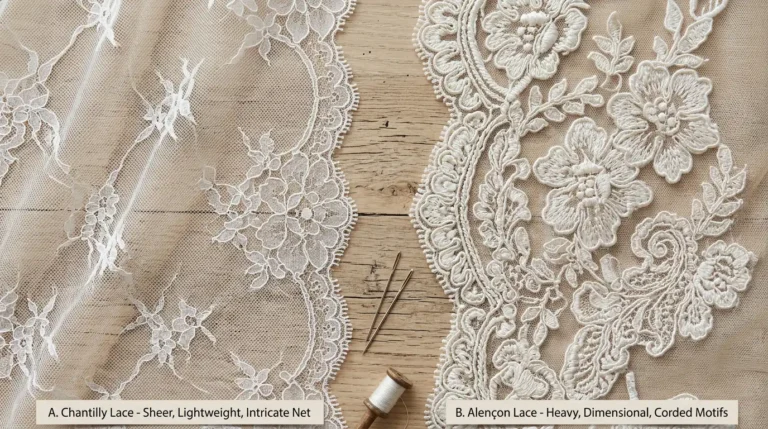
If you’re exploring other fabric comparisons, the FuYuan blog has a useful breakdown of lace vs mesh that applies similar structural thinking to two other commonly confused textile categories.
Pros & Cons of Jacquard Fabric
No fabric is perfect for every application. Here’s an honest look at both sides.
Advantages
- Pattern is permanent. The design is structural, not surface-applied. It won’t fade, peel, or crack with washing or age.
- Durable. The tight, complex weave holds up well under friction, which is why jacquard is a standard choice for upholstery.
- Visually rich. The interplay of weave structures creates depth and texture that printed fabrics can’t match at any price.
- Versatile fiber options. The same weaving method works with cotton, silk, wool, or synthetics, giving designers enormous flexibility.
- Reversible in some types. Damask jacquard can be used on either side, which is useful for curtains and table linens.
Disadvantages
- Higher cost. The setup and weaving time for complex jacquard patterns is significantly greater than for plain or printed fabrics. The cost difference is real, especially in silk and wool versions.
- Care requirements can be demanding. Many jacquard fabrics — particularly wool and silk — require dry cleaning or very gentle hand washing. Polyester and cotton jacquard are generally more forgiving.
- Heavy weight. Most woven jacquard is medium to heavy, making it unsuitable for lightweight, flowy garment styles.
- Limited stretch. Woven jacquard has very little give, which restricts its use in fitted activewear or stretch-dependent designs. (Jacquard knit addresses this, but with different pattern limitations.)
- Can feel stiff. Especially in brocade, the complex weave structure produces a fabric that holds its shape well but doesn’t drape as fluidly as plain-weave alternatives.
Jacquard Fabric for Home Decor
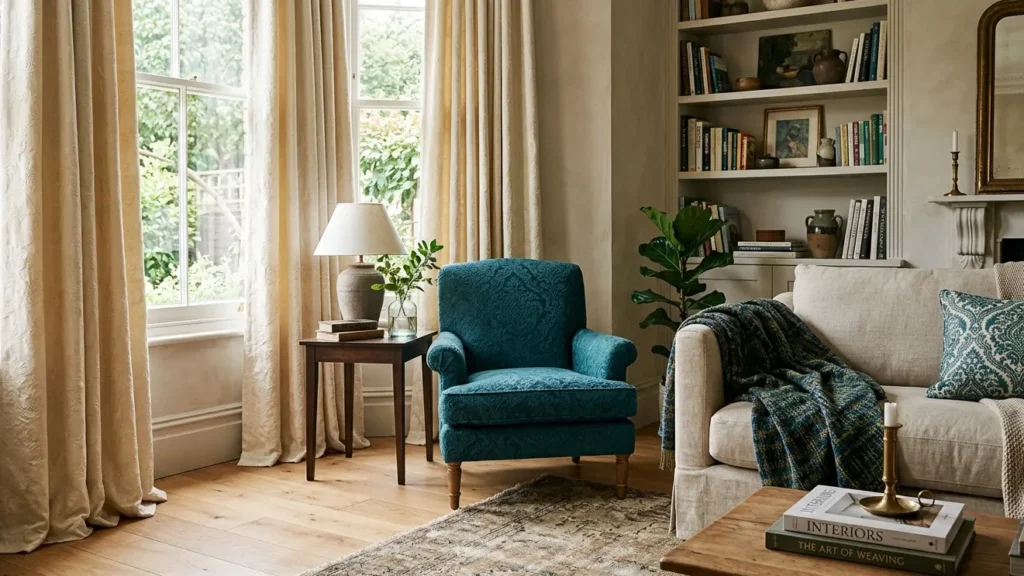
Jacquard’s combination of durability and visual complexity makes it particularly well suited to home furnishings, where a textile needs to look good and hold up over years of daily use.
Upholstery is perhaps jacquard’s strongest application. The dense weave resists abrasion — an important quality for sofas and chairs that see constant use. Patterns woven in provide an elegance that is difficult to achieve with plain fabrics, and because the design is in the structure, there’s no concern about the pattern rubbing or fading off the surface over time.
Curtains and drapery benefit from jacquard’s weight. Heavier fabrics hang better, block more light, and move more deliberately — qualities that suit formal living spaces. Damask jacquard is a classic choice for floor-to-ceiling drapes because its flat surface and reversible pattern work equally well from inside and outside the room.
Bedding and throws see frequent washing, which is exactly where jacquard’s pattern permanence pays off. A jacquard-woven duvet cover or throw maintains its design through dozens of laundry cycles without the pattern degrading.
Table linens — tablecloths, napkins, placemats — have used damask jacquard for centuries. The subtle tone-on-tone patterns read as formal without being flashy, which is why white damask tablecloths remain a staple in formal dining settings.
Accessories and fashion round out the application list. Ties, scarves, evening bags, and structured jackets all benefit from jacquard’s combination of visual detail and structural integrity.
Beyond woven textiles, jacquard-knit constructions extend the same pattern-in-structure principle to stretch fabrics — opening up applications in knitwear, sweaters, and performance apparel. If you’re sourcing for those applications, FuYuan’s range of performance fabrics covers stretch-knit options built for functional end uses.
For buyers comparing different luxury fabric options, the FuYuan guide to what is chiffon fabric is a useful companion read — chiffon and jacquard sit at opposite ends of the weight and structure spectrum, and understanding both helps clarify when each is the right call.
Summary
Jacquard fabric is defined by its construction method: the pattern is woven into the structure of the cloth rather than applied to the surface. This gives jacquard its primary advantages — pattern permanence, durability, and visual depth — but also its limitations in weight, flexibility, and cost. The term covers a broad family of fabrics including brocade, damask, and matelassé, each with its own surface character and best-fit applications. Whether the end use is a formal sofa, a set of luxury curtains, or a structured evening jacket, the right choice within the jacquard family comes down to fiber content, weave type, and the specific performance requirements of the project.
FAQ
Is jacquard fabric good for upholstery?
Yes — woven jacquard is one of the best choices for upholstery. The tight, interlocking weave structure resists abrasion better than looser weaves, and because the pattern is structural rather than printed, it won’t rub off or fade with regular use. Polyester and cotton jacquard are the most practical options for high-traffic furniture; silk jacquard is better suited to low-use decorative pieces.
What is the difference between jacquard fabric and brocade fabric?
Brocade is a type of jacquard, not a separate category. All brocade is jacquard, but not all jacquard is brocade. Brocade specifically refers to jacquard with raised, embossed patterns that stand above the fabric surface — often incorporating metallic threads. Plain jacquard may have a flat or subtly textured surface without the three-dimensional relief that defines brocade.
Can jacquard fabric be machine washed?
It depends entirely on the fiber content. Cotton and polyester jacquard fabrics can generally be machine washed on a gentle or delicate cycle in cold water. Silk and wool jacquard typically require dry cleaning or careful hand washing. Always check the care label first — the fiber determines the washing method, not the jacquard weave itself.
What does jacquard knit fabric mean?
Jacquard knit uses the same principle — pattern controlled by individual thread manipulation — but applied to a knitting machine rather than a weaving loom. The result is a stretchy fabric with a complex pattern built into the knit structure. Jacquard knit is used for sweaters, knitwear, and performance apparel where stretch is required alongside visual pattern complexity.
Is jacquard fabric suitable for curtains?
Jacquard is one of the most popular choices for curtains, particularly in formal or traditional interiors. Its weight helps the fabric hang well and maintain a full, structured drape. Damask jacquard is especially common for curtains because its relatively flat surface and reversible pattern look clean from both sides of the window. For lighter-weight applications, cotton or silk jacquard offers a less heavy option while retaining the woven pattern.