Best Lace Fabric for Wedding Dresses: A Buyer’s Framework for Choosing the Right One
Two bridal brands send the same line to a lace supplier: “Chantilly lace, ivory.” One gets a featherlight, barely-there overlay. The other gets something with real body and a visible corded outline.
Same name. Completely different fabric.
This guide is for bridal brands, small-batch dressmakers, and designers sourcing lace for wedding gowns. We’re building a framework for judging lace on what actually matters, not just on what it’s called.
What Actually Makes a Lace “Best” for a Wedding Dress
“Best” isn’t one property. It’s four, stacked together.
- Type — the pattern family (Chantilly, Alençon, Guipure) that sets the overall look.
- Fiber content — what the yarn is made of, which drives hand-feel and how it ages.
- Technical properties — weight, sheerness, drape, and stretch, which decide fit and function.
- Edge and motif layout — how the pattern finishes and repeats, which decides sewing time and waste.
Get all four right for your specific gown, and you’ve found the best lace. Get one wrong, and the other three won’t save it.
Next: each variable, one at a time. Then we’ll fold them into one table you can actually hold up against a quote sheet.
The Lace Types Every Bridal Buyer Should Know
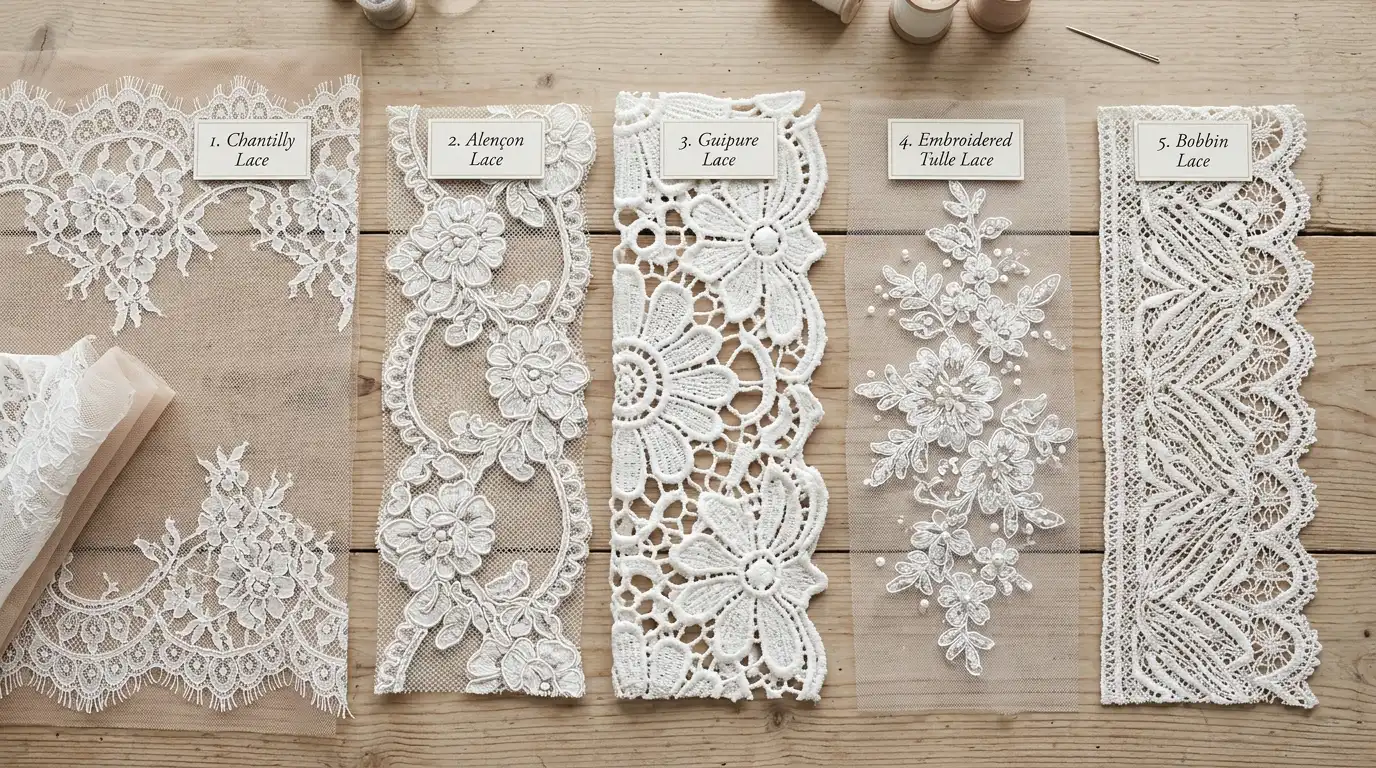
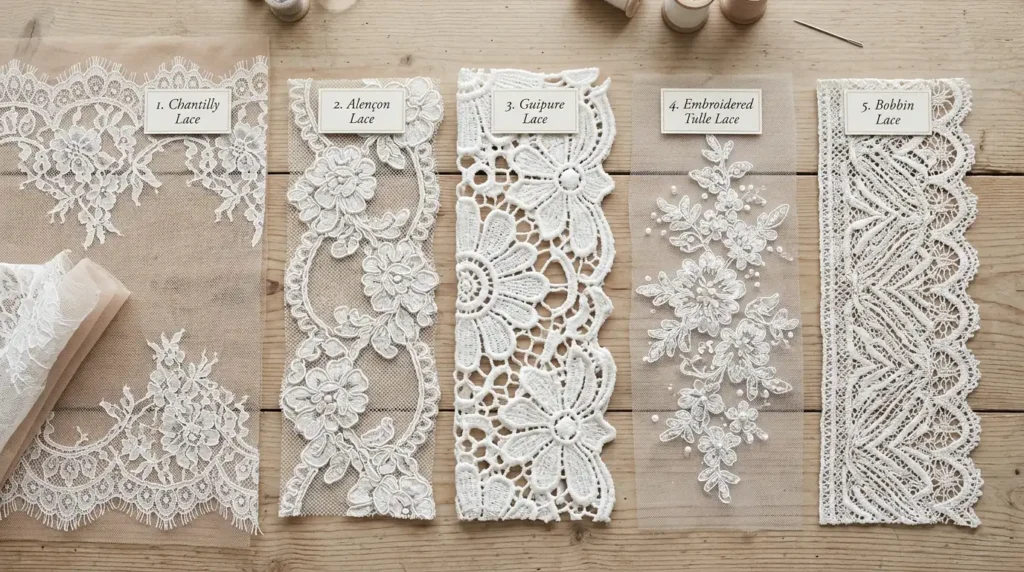
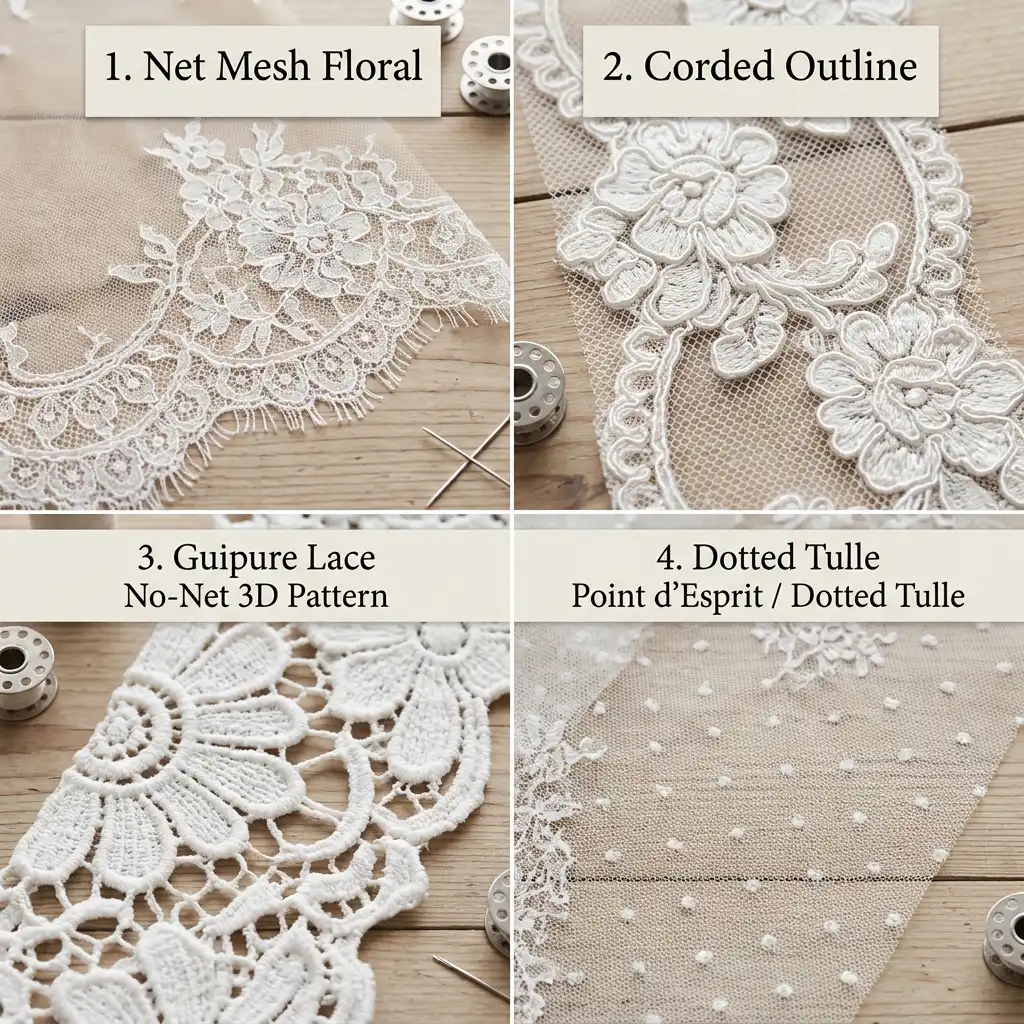
Chantilly lace carries fine floral and vine motifs over a sheer net ground. No cord outline, no heavy edge — just delicate, almost weightless pattern. It’s the lightest of the classic bridal laces, which is why it shows up so often on veils and overlays.
Our deep dive on Chantilly lace covers its French origins and what separates a fine version from a cheap imitation.
Alençon lace looks related to Chantilly but reads heavier. A corded outline traces every motif, giving the pattern a raised, sculptural edge. That structure is what makes Alençon feel formal even in a simple silhouette.
Guipure lace (sometimes labeled Venise or Venetian) skips the net ground entirely. Motifs connect to each other with small bars instead of floating on mesh. The result is stiff and dimensional — strong enough to stand on its own without lining.
Embroidered lace starts as a plain net or tulle base, then gets motifs stitched on top. It’s closer to appliqué than woven pattern, more structured than Chantilly but without Alençon’s corded edge.
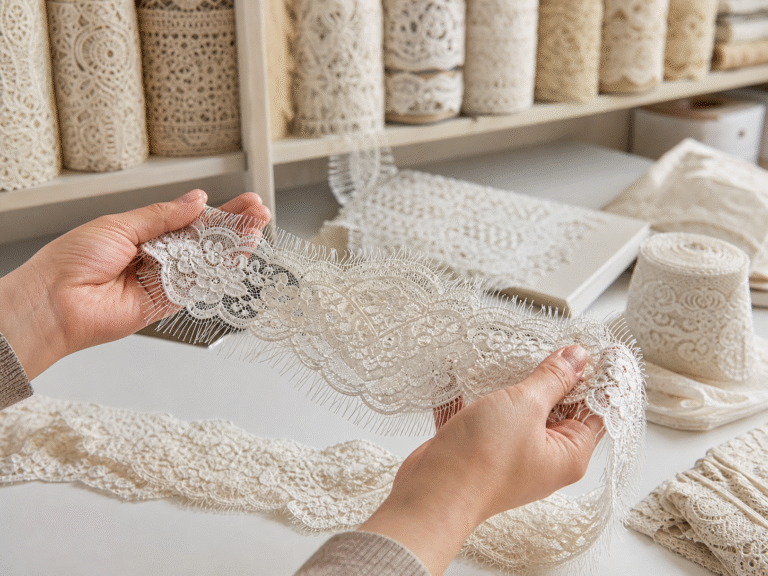
Eyelash lace ends every scallop in loose, fringe-like threads. It behaves less like a full-coverage fabric and more like a finishing detail — trim, hemlines, layered edges where you want texture without weight. Our complete guide to eyelash lace fabric covers the fiber and sewing specifics if you’re specifying it for the first time.
Point d’Esprit is the simplest of the group: tiny dots scattered across sheer net, no floral motif at all. Good for sleeves and veils where you want texture without competing with a bodice.
These pattern families trace back to specific construction methods and fibers. Our types of lace materials guide breaks down the full family tree.
Fiber Content: What the Lace Is Actually Made Of
Pattern name tells you the look. Fiber tells you how it behaves.
- Nylon — soft hand, drapes well, resists yellowing over time. The default for most mid-to-premium bridal lace today.
- Polyester — firmer and less expensive than nylon, with a slightly stiffer hand. Common in budget-tier and heavily structured laces.
- Silk — the historic bridal fiber. Soft and fluid, but expensive and less forgiving of humidity and storage than synthetics.
- Cotton — textured and matte rather than lustrous. Common in eyelet and vintage-style laces, and holds beading well.
- Elastane/spandex blends — added to a base fiber, usually nylon, to create stretch lace built for fitted and mermaid silhouettes.
💡 Pro Tip: Ask for the fiber percentage breakdown, not just “nylon lace.” A supplier can call it nylon lace at 60% nylon — the rest quietly changes how it drapes and dyes.
Fiber content isn’t cosmetic. It’s the reason two “Chantilly” swatches from two suppliers can feel completely different in your hand.
Technical Properties That Actually Decide Bridal Suitability
Fiber sets the raw material. These four properties decide whether the fabric actually works on a gown.
- Weight (GSM). Lighter laces, roughly 40–70 g/m², drape and layer well for overlays and sleeves. Heavier laces at 100 g/m² and up hold their shape without lining — useful for a structured bodice, less useful for a flowing skirt.
- Sheerness. Hold it to light. Chantilly and Point d’Esprit are meant to be sheer; Guipure and heavy embroidered lace are not. Sheerness isn’t a flaw. It’s a design choice, but only if you planned for it.
- Drape. How the fabric falls under its own weight. A stiff, heavily corded lace won’t drape into soft gathers no matter how the pattern is cut.
- Stretch. Most bridal lace has none. Stretch lace, built with elastane, exists specifically for fitted and mermaid silhouettes that need to move without straining seams.
⚠️ Warning: Don’t assume stretch from the pattern alone. A lace can look identical to a non-stretch version and still behave completely differently on the body. Always test-pull the actual swatch.
Width matters too, and it varies more than most buyers expect. Full-width bridal lace fabric commonly runs 75–150cm, while narrow trims and eyelash borders stay under 30cm. Confirm which one you’re quoting before you calculate yardage.
Edges, Finishing & Motif Layout
Two lace panels can share the exact same pattern and still behave completely differently at the sewing table. The difference is the edge, not the motif.
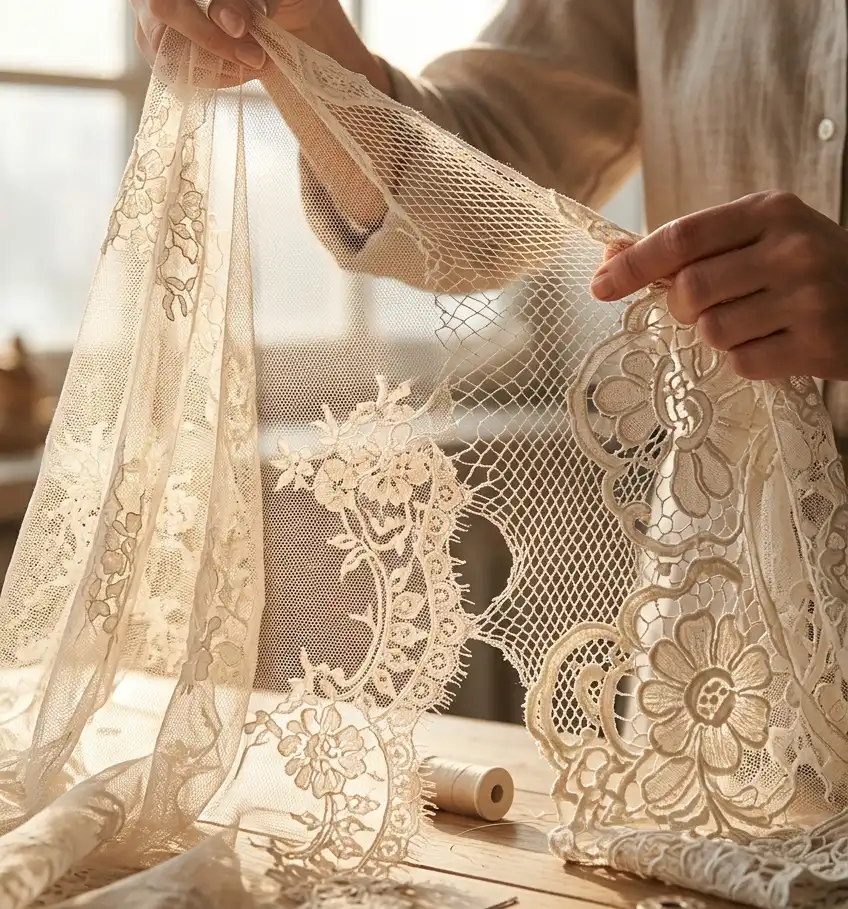
Scalloped edges are finished. The wave-shaped border doesn’t fray, so it can become the visible hem or neckline with zero extra work.
Eyelash fringe edges take that a step further, adding loose threads for texture along the scallop. Our guide to sourcing eyelash border lace covers how to check fringe density and repeat consistency before placing a bulk order.
Cut edges are the opposite: raw, unfinished, and prone to fraying unless you line, bind, or serge them. Most full-width lace fabric, as opposed to trim, ships with cut edges by default.
Then there’s pattern repeat — the distance before a motif repeats across the fabric. It sounds like a minor spec. It isn’t.
A long repeat means more fabric wasted when matching motifs across a seam. A short, dense repeat gives more flexibility for pattern layout but can look busy on a large panel. Ask your supplier for the repeat measurement before you calculate yardage, not after.
The Lace-vs-Lace Decision Matrix
Everything above compresses into one table you can hold up against a quote sheet.
| Lace Type | Typical Fiber | Weight & Drape | Stretch | Best For | Relative Cost |
|---|---|---|---|---|---|
| Chantilly | Nylon or silk blend | Light, fluid | None | Overlays, sleeves, veils | Mid–high |
| Alençon | Nylon/rayon on net | Medium, structured | None | Bodices, appliqué motifs | High |
| Guipure / Venise | Rayon or cotton, no net | Heavy, stiff | None | Statement panels, unlined use | Mid–high |
| Embroidered (on tulle) | Polyester/rayon on nylon tulle | Medium | None | Illusion necklines, sleeves | Mid |
| Eyelash lace | Nylon | Light–medium | Optional (with spandex) | Trim, hemlines, layered edges | Low–mid |
| Stretch lace | Nylon + spandex | Light, clingy | High | Fitted and mermaid bodices | Mid |
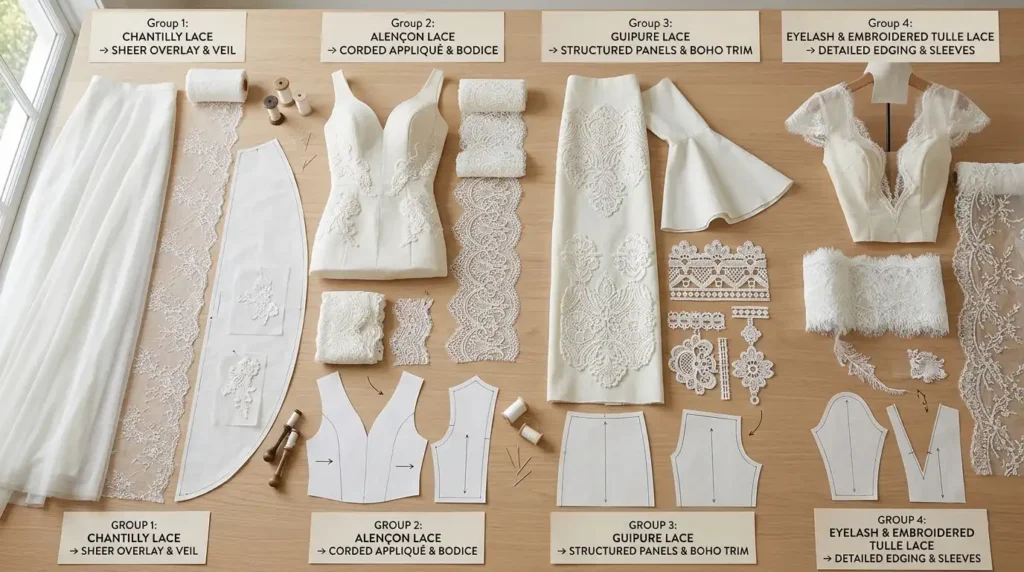
Read this by gown zone, not by name. A bodice usually wants weight and structure. A veil or overlay wants the opposite.
Still not sure which combination fits? Most manufacturers — ours included — will talk through swatches with you before you commit to yardage.
Where This Gets Tested: Illusion Lace on Skin-Tone Tulle
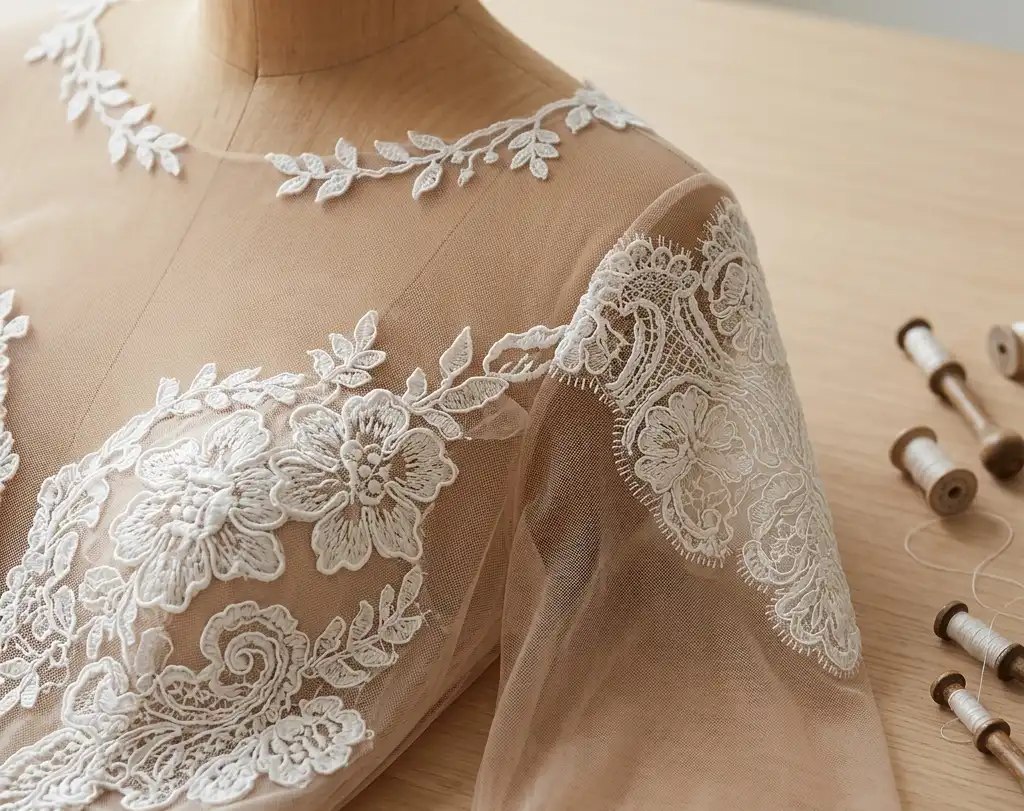
Take everything above and apply it to the trickiest bridal application: illusion necklines and “tattoo lace” sleeves, where motifs appear to float directly on skin.
The trick isn’t the lace. It’s the base underneath it.
Illusion tulle has to disappear. That means matching it to the wearer’s actual skin tone, not a generic “nude.” It also means choosing a mesh fine enough to read as bare skin, not fabric.
Our guide to tulle fabric explains why tulle’s clean, non-fraying edge makes it the standard base for this build. It also covers where nylon and polyester tulle diverge — the gap shows up more under studio lighting than daylight.
Get the fiber choice wrong and the tulle picks up a sheen that reads as fabric, not skin. Get the weight wrong and seam allowances show through in every photo. Get the edge finishing wrong and the transition between lace motif and bare tulle looks stitched-on instead of grown-in.
This is the section where the framework earns its keep. Every variable above shows up at once, and none of them forgive a shortcut.
Match the Fabric, Not Just the Name
Sourcing lace for a wedding gown? “Best” was never one fabric. It’s a match between four variables and one specific gown.
Fuyuan Knitting produces Chantilly-style, embroidered, and eyelash lace fabric for bridal and eveningwear brands. In-house dyeing keeps color consistent across a full production run.
Our wedding dress fabric sourcing guide covers the wider picture — tulle, organza, and linings — if lace is only part of what you’re sourcing. Reach out for swatches and we’ll help match the fabric to the gown, not just the name to the name.