
Mesh Fabric Edge Stability: Sew Before You Buy
Mesh fabric can look excellent as a swatch and still create problems at the sewing machine. The edge may curl, the holes may distort, the seam may wave, or the panel may grow after handling. These issues are often discovered after the buyer has already approved color, hand feel, and weight. By then, the material may be technically correct but difficult to produce.
This guide focuses on edge stability and sewing trials for buyers sourcing mesh fabric. It is different from a general breathability or openness checklist. The practical question is whether the mesh can be cut, handled, sewn, and inspected at the speed your garment factory needs.
Why edge stability matters in mesh fabric
Mesh is an open structure. That openness gives airflow and lightness, but it also means the cut edge has less support than a solid knit. Some mesh fabrics stay flat after cutting. Others curl, fray, stretch, or distort when handled. A small amount of movement may be acceptable for a hidden lining, but it can become a real defect on a visible panel, neckline insert, or contrast detail.
When buyers compare wholesale mesh fabric, they often ask for GSM, width, composition, and color. Those are useful, but they do not show whether the fabric will behave well during sewing. A better first sample request includes enough yardage for cutting and seam tests, not only a hand swatch.
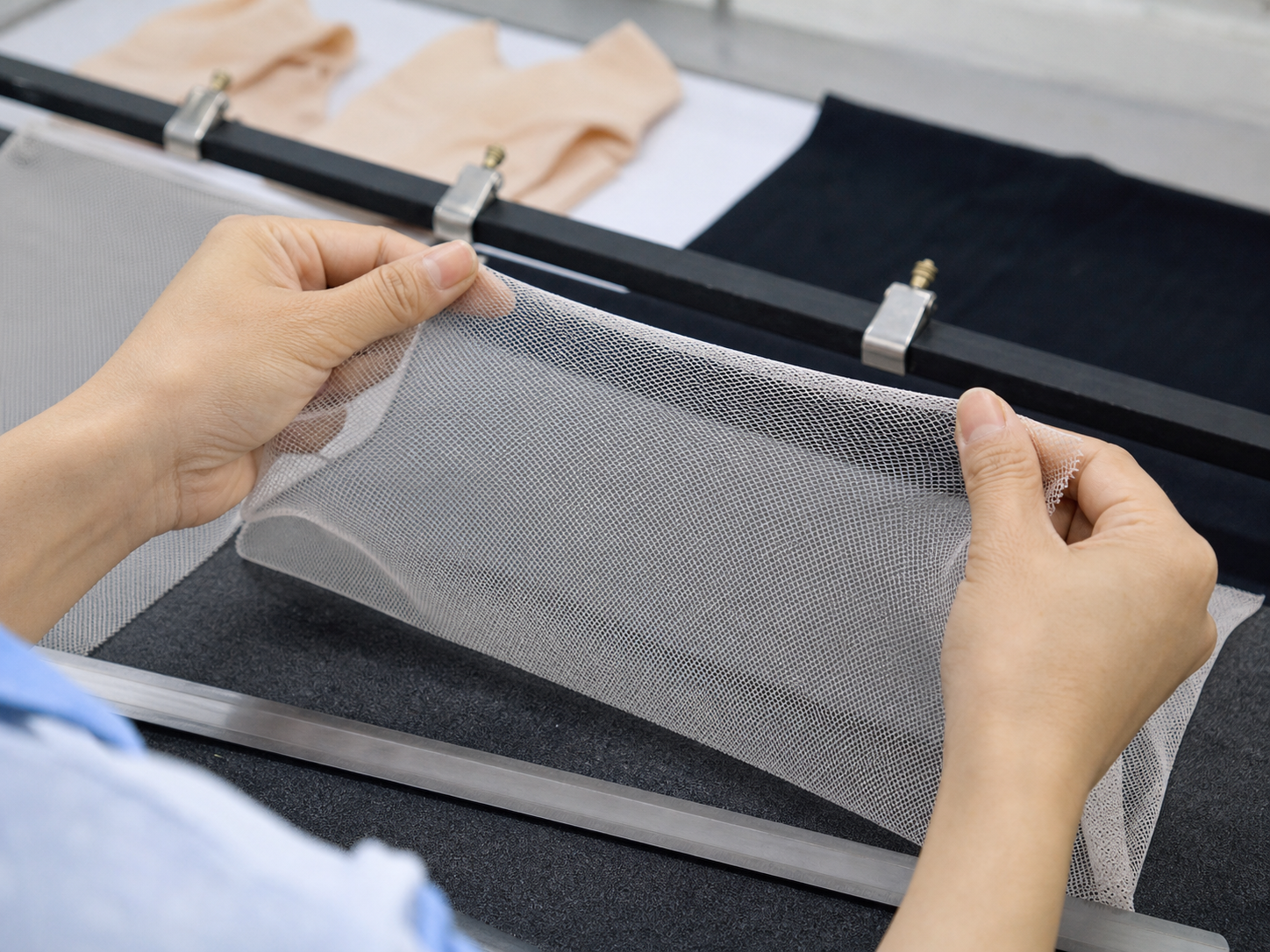
Separate hand feel from production behavior
A soft mesh may feel premium, but softness can come with lower stability. A firmer mesh may feel less delicate, but it may sew cleaner and hold panel shape better. Neither choice is automatically better. The right choice depends on placement. A body-facing lining may need softness first. A side panel may need recovery and edge control. A pocket bag may need durability and low distortion.
For custom mesh fabric, explain this placement clearly to the supplier. If the mesh will be used beside lace, elastic, or performance fabric, say so early. FuYuan’s performance fabric range includes materials with different stretch and recovery behavior, so matching the mesh to the neighboring fabric is part of the sourcing decision.
| Mesh behavior | What it looks like | Production risk |
|---|---|---|
| Edge curling | Cut edge rolls inward or outward after resting. | Slower sewing, uneven seam allowance, extra handling. |
| Hole distortion | Mesh openings elongate near seams or curves. | Visible panel looks uneven after stitching. |
| Growth after handling | Panel becomes longer or wider during sewing. | Fit changes and matching points drift. |
| Weak seam recovery | Seam stays stretched after pulling. | Garment may ripple or lose shape after wear. |
Run a small sewing trial before bulk approval
A sewing trial does not need to be complex. Cut a few panels in the intended direction, let them rest, sew them with the planned seam type, and check the result after light handling. If the fabric will be bound, bind it. If it will be overlocked, overlock it. If it will be joined to lace trim or elastic, test that exact join. The goal is to check the real construction, not a theoretical seam.
The trial should include the factory that will sew the garment whenever possible. A textile supplier can suggest a suitable mesh, but the garment factory controls sewing machines, needles, thread, seam tension, and operator handling. A mesh that works well in one sample room can behave differently in another if the setup changes.
Check direction before cutting panels
Mesh fabric may stretch more in one direction than another. Even when a supplier gives a clear width and composition, the buyer should confirm the practical stretch direction before pattern placement. If a panel is cut in the wrong direction, it may bag, twist, or pull against the neighboring fabric. This is especially important for fitted garments, sportswear panels, linings, and decorative inserts.
Ask the supplier to mark the roll direction on sample yardage if there is any risk of confusion. When comparing several mesh options from a warp knit mesh category, keep the direction consistent during testing. Otherwise, one fabric may seem more stable simply because it was tested in a more favorable direction.
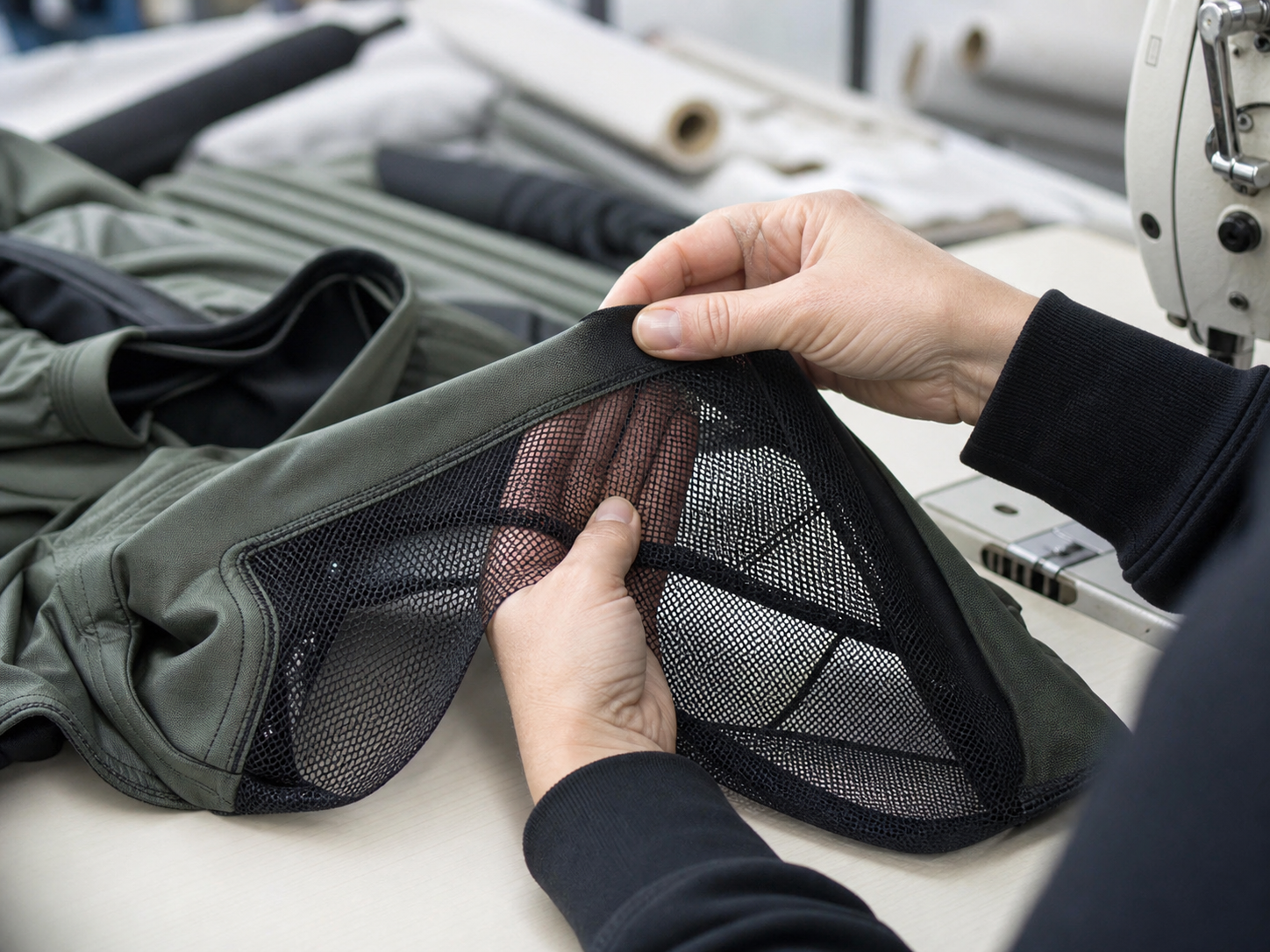
Test mesh with the neighboring material
Mesh is rarely used alone. It is often sewn to lace fabric, elastic, jersey, swimwear fabric, or lining. The neighboring material can change the result. A stable fabric joined to a very stretchy mesh may ripple. A firm elastic attached to a delicate mesh may pull holes out of shape. A lace overlay may hide some mesh behavior but also create color and tension issues.
For products that combine lace and mesh, review both materials together. Buyers can compare lace structures through the lace fabric category and then ask the factory which mesh support layer is most compatible. The sample should show the actual overlap, seam, and backing, not only two separate swatches placed side by side.
| Sample test | Simple method | Decision it supports |
|---|---|---|
| Resting after cut | Cut panels and measure again after resting. | Shows growth or shrink before sewing. |
| Seam tension | Sew the planned seam and inspect waviness. | Confirms whether machine setup needs adjustment. |
| Join with elastic | Attach elastic or trim and stretch lightly. | Checks recovery and hole distortion. |
| Layer review | Place mesh under or beside final fabric. | Checks color, show-through, and texture compatibility. |
When a mesh needs a different specification
If the sewing trial shows curling, distortion, or unstable recovery, the solution is not always to reject mesh as a material. The project may need a firmer structure, different weight, adjusted finish, smaller hole size, or changed stretch direction. Sometimes the garment construction can also change: wider seam allowance, binding, lining support, or a different seam type may solve the problem.
For custom mesh fabric, share the sewing trial result with the supplier. Photos and a physical failed sample are more useful than saying the mesh is not stable. The factory can then suggest a closer construction or modify finishing targets. This is where a direct mesh fabric factory relationship is more helpful than choosing only by price.
Common mistakes to avoid
The first mistake is approving only a hand swatch. Mesh must be tested as a panel. The second mistake is using the wrong seam during development and changing it later without retesting. The third mistake is checking stretch by pulling hard once, rather than checking recovery after repeated light handling. The fourth mistake is ignoring the neighboring material.
Another common mistake is ordering too little sample yardage. If you need to test direction, seam type, trim attachment, and wash response, a tiny cutting will not be enough. Ask for enough mesh fabric by the yard to build a realistic sample. The extra sample cost is usually lower than the cost of changing fabric after fit approval.
How to brief the sample room
A mesh sewing trial works best when the sample room receives clear instructions. Send the intended panel shape, seam type, seam allowance, direction of stretch, and neighboring materials. If the mesh will be sewn to elastic, lace trim, lining, or performance fabric, include those materials in the trial. A clean test on mesh alone does not prove that the final garment will sew cleanly.
Ask the sample room to note any machine adjustments. Needle size, thread type, stitch density, foot pressure, and operator handling can all change the result. These notes do not need to be complicated, but they help the bulk factory repeat the same setup later. Without them, a good prototype can still become a bulk production problem.
How to decide whether the mesh is production-ready
After the trial, review the mesh in three states: freshly cut, freshly sewn, and lightly handled. A production-ready mesh should keep its panel shape, recover after normal stretching, and show no obvious hole distortion near the seam. It should also remain comfortable and visually consistent when placed beside the final fabric.
If the sample fails one point, decide whether the issue belongs to fabric selection or garment construction. A firmer mesh may solve edge movement, but a different seam or binding may solve it with less change to hand feel. This decision should be made before the purchase order, because changing construction after bulk fabric arrives can slow production more than changing the fabric during development.
Final takeaway
Mesh fabric sourcing should include sewing behavior, not only hand feel, weight, and color. Edge stability affects cutting speed, seam quality, panel shape, and finished garment appearance. Buyers who sew before they buy can identify problems while there is still time to change fabric or construction.
Before approving wholesale mesh fabric or custom mesh fabric, cut real panels, test the planned seams, check recovery, and review the mesh with neighboring materials. That small trial gives the buyer, supplier, and garment factory a shared standard before bulk production begins.