Swimwear Fabric: Types, Nylon vs Polyester, Lining and How to Choose
A swimsuit that spends one summer in a hotel pool usually fails in the same way: the color still looks fine, but the seat goes baggy and slightly see-through, because chlorine attacks the stretch fiber long before it fades the dye. Most swimwear fabric is a fine knit of nylon or polyester blended with roughly 15–30% spandex: nylon blends feel softer and suit fashion swimwear, while polyester and PBT blends hold up better in chlorinated pools. This guide is for swimwear brands, small-batch manufacturers and designers choosing or specifying swim fabric, and it covers fibers, stretch, finishes, lining, durability and what to put on the spec sheet.
What Swimwear Fabric Is Made Of
Swimwear fabric is almost always a knit, not a weave, because it has to stretch in every direction and recover the moment the wearer moves. Most of it is warp-knit tricot: a smooth, flat knit made on high-speed warp-knitting machines, with a fine face on one side and a slightly textured back. Some swim and athletic fabrics are circular (weft) knits instead, which tend to feel softer but can curl at cut edges.
The fiber blend matters more than the knit. Every swim fabric pairs a “hard” fiber, which gives the fabric its body, color and surface, with spandex (also sold as elastane or under brand names like LYCRA®), which gives stretch and recovery. Our guide to spandex and elastane explains how the stretch fiber works on its own.
Nylon vs Polyester vs PBT: Which Fiber for Which Swimsuit
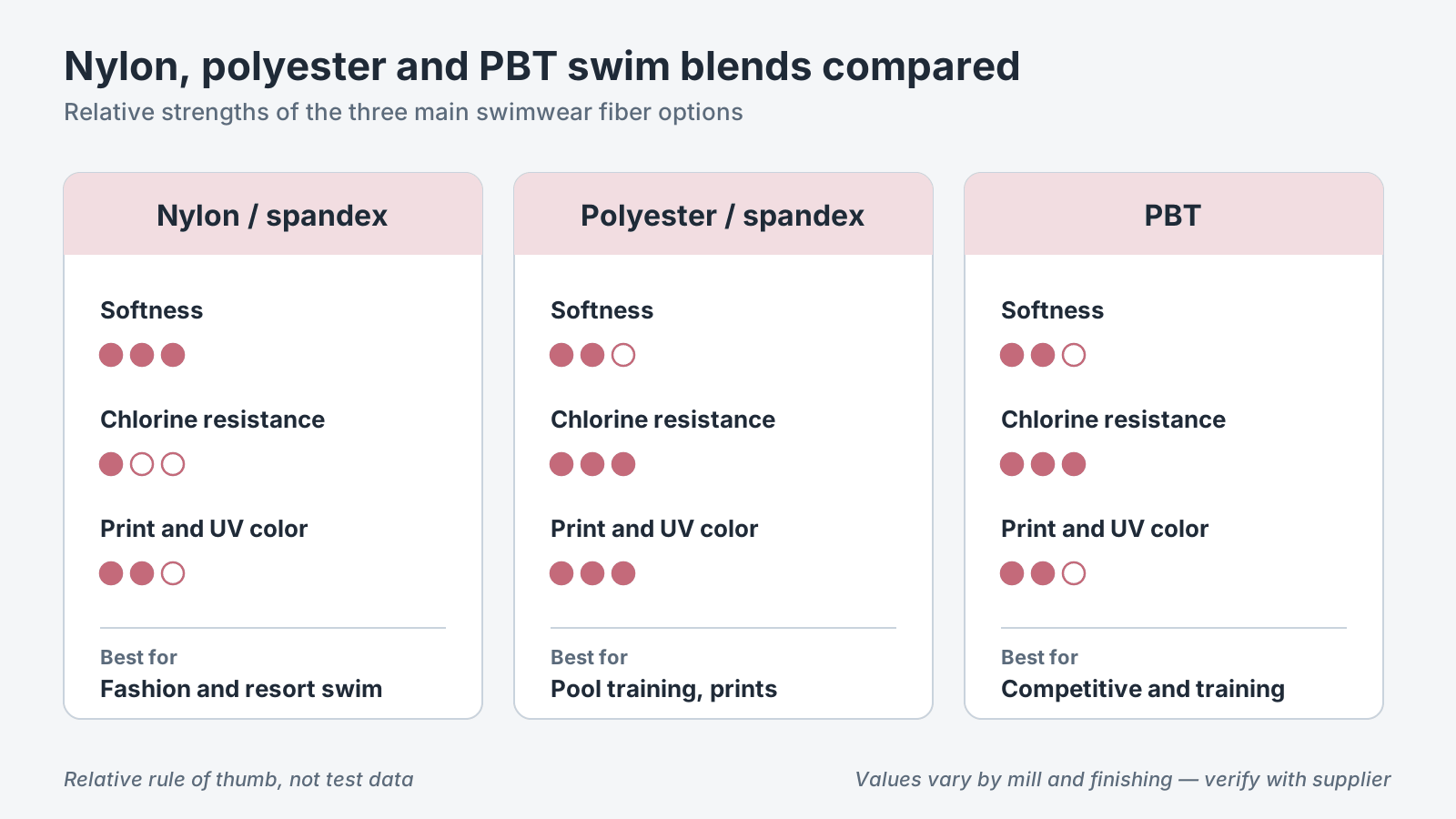
This is the decision most buyers start with. Each fiber suits a different kind of swimsuit.
| Nylon / spandex | Polyester / spandex | PBT (polybutylene terephthalate) | |
|---|---|---|---|
| Hand feel | Softest, smoothest, silky | Firmer, slightly crisper | Soft with natural stretch |
| Stretch and fit | High stretch, close body-hugging fit | Moderate stretch, holds shape | Built-in stretch; often used with little or no spandex |
| Chlorine resistance | Lower; spandex inside degrades faster in pools | Higher, especially in high-polyester blends | High |
| Color and print | Rich, deep solids | Excellent for sublimation prints; good UV color stability | Good |
| Drying | Fast | Fast | Fast |
| Typical use | Fashion and resort swimwear, bikinis, one-pieces | Pool training, team suits, printed swimwear | Competitive and training suits |
As a rule of thumb, nylon/spandex is the default for fashion swimwear because of how it feels and looks on the body, and polyester-based fabrics win when the suit will spend hours a week in chlorinated water. Our profile of nylon (polyamide) fabric covers why nylon dyes so deeply and feels so smooth.
💡 Pro Tip: If your customer swims in pools more than a couple of times a week, ask about chlorine-resistant spandex or a polyester-rich blend before you finalize the fabric. A nylon fabric that looks perfect in a showroom can lose its shape in a season of pool use.
How Spandex Content Changes Fit
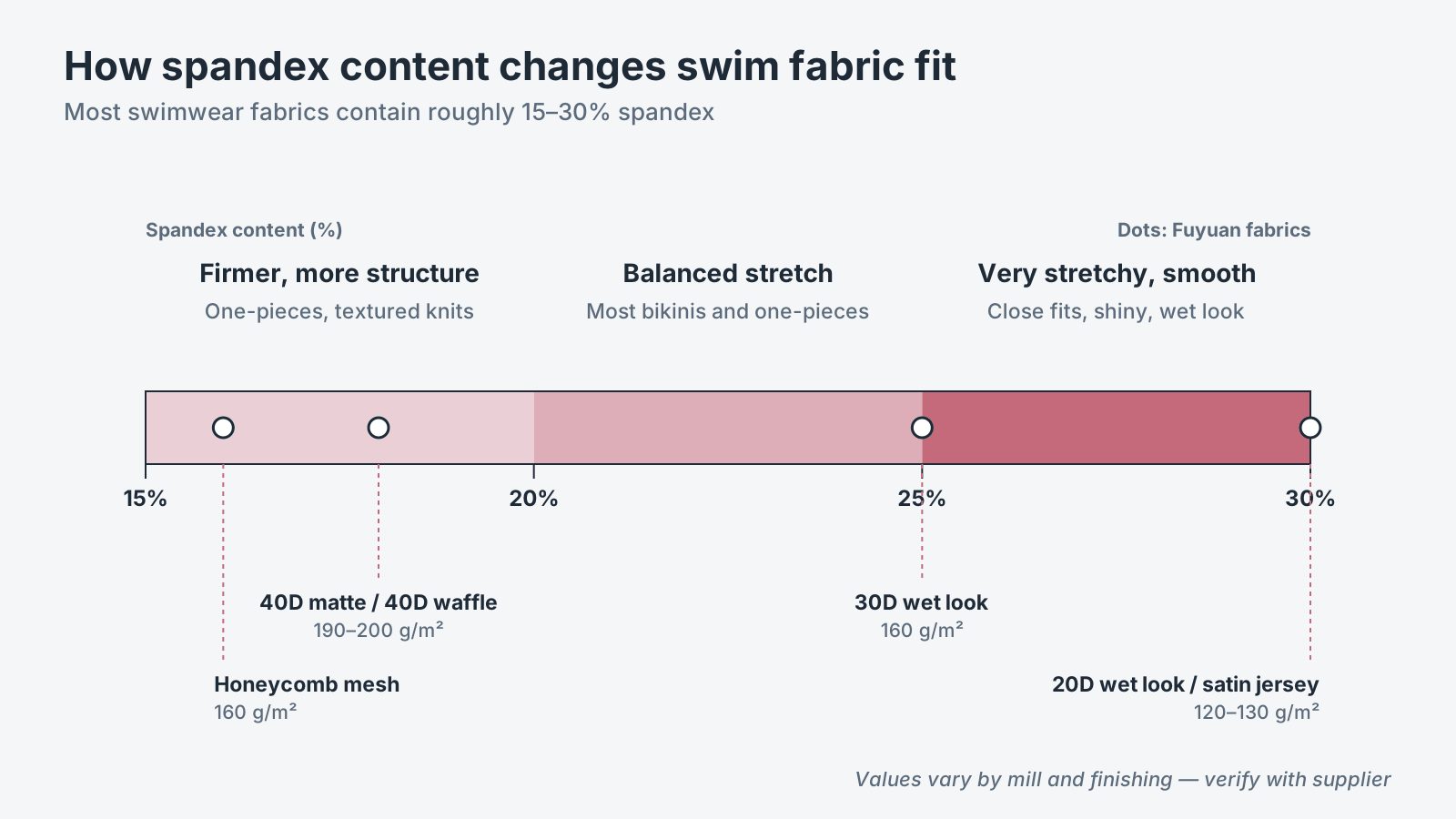
Spandex content controls how tightly the fabric holds the body and how much it snaps back. In practice, swim fabrics fall into roughly three groups:
- Around 15–20% spandex: firmer hand and more structure; suits one-pieces, shapewear-style swim and textured fabrics that need to hold their pattern.
- Around 20–25% spandex: the middle ground for most bikinis and fashion one-pieces.
- Around 25–30% spandex: very stretchy and smooth; used for close-fitting styles, shiny and wet-look surfaces, and lightweight fabrics.
Here are real examples from Fuyuan’s swimwear and performance range, to show how blend and weight move together:
| Fabric | Composition | Weight | Width |
|---|---|---|---|
| 40D matte swimwear fabric | 82% nylon, 18% spandex | 190 g/m² | 160 cm |
| 40D waffle fabric | 82% nylon, 18% spandex | 200 g/m² | 160 cm |
| Honeycomb mesh | 84% nylon, 16% spandex | 160 g/m² | 160 cm |
| 30D wet-look swimwear fabric | 75% nylon, 25% spandex | 160 g/m² | 160 cm |
| 20D wet-look swimwear fabric | 70% nylon, 30% spandex | 130 g/m² | 160 cm |
| 30D bright satin jersey (36 gauge) | 70% nylon, 30% spandex | 120 g/m² | 160 cm |
Values vary by mill and finishing, so confirm stretch, weight and width with your supplier on the actual production quality.
The “D” number (denier) describes the thickness of the hard yarn: a 20D fabric uses finer yarn than a 40D one, which usually means a lighter, smoother and more delicate fabric. Heavier deniers and higher weights give better coverage and durability.
Surface Finishes and Textures
Swimwear fabric is chosen as much by surface as by fiber. The main options:
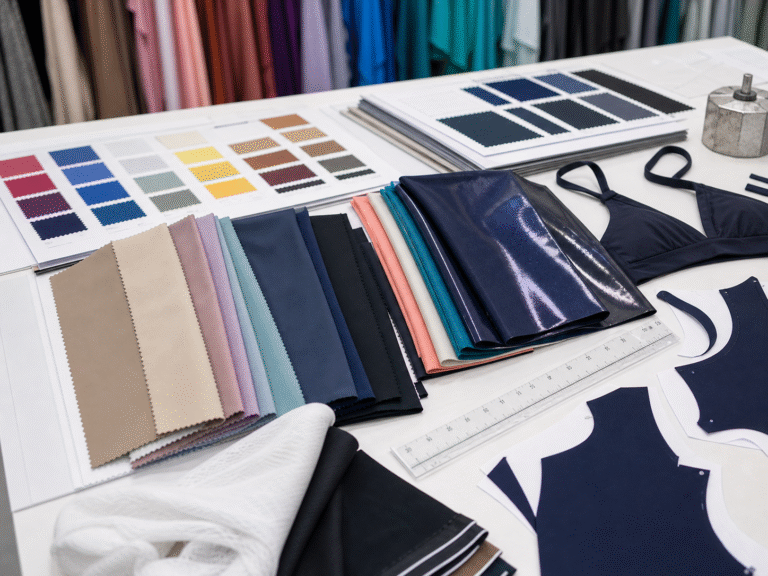
- Matte: a low-sheen, slightly dry-looking surface; reads as modern and minimal and hides minor fit imperfections. See our 40D matte swimwear fabric guide.
- Glossy or satin: a smooth, reflective face that makes colors look richer; common in resort and retro styles. Our guide to 30D glossy fabric shows how the shine is built.
- Wet look: a high-shine finish that looks wet even when dry, usually on a high-spandex base. Browse Fuyuan’s wet-look fabrics.
- Textured knits: waffle, honeycomb, rib and jacquard-style structures add visual interest and can hide wrinkles; they often need a lining because the structure is more open.
Swimwear Lining: When You Need It and What to Use
Lining stops a swimsuit going see-through when wet and gives it a smoother, more finished look. It is usually needed when:
- the shell fabric is light-colored (white, pastels, nude tones),
- the shell is lightweight (roughly the lighter end of the weights above) or has an open texture like honeycomb or waffle,
- the style needs extra support at the front or in the cups.
Most swim linings are a lightweight nylon or polyester tricot with spandex, chosen to stretch at the same rate as the shell so the two layers don’t pull against each other. Where more support is needed, brands add a firmer layer such as power mesh at the front panel or bust.
⚠️ Warning: Test the shell and lining together, stretched and wet, before you approve them. Two fabrics that look fine separately can show the lining’s seams through a light shell, or bag out at different rates after a few wears.
Durability: Chlorine, Sunscreen, Salt and UV
Swimwear fabric wears out mainly through the spandex. Chlorine, sunscreen, body oils, heat and UV all break down spandex over time, which is why a worn swimsuit loses its grip before it loses its color.
Ways brands extend fabric life:
- Chlorine-resistant spandex. Some fiber makers offer spandex treated to resist pool chemicals. LYCRA® XTRA LIFE™ fiber, for example, is claimed by its maker to last up to ten times longer than unprotected spandex, based on its own pool and lab testing (manufacturer’s public information, directional reference).
- Polyester-rich or PBT blends for suits made for frequent pool use.
- Colorfastness testing to chlorinated water, seawater, light and perspiration, especially for bright colors and prints. Ask your supplier which tests the fabric has passed and at what grade.
- Care instructions on the label: rinse in cool fresh water after swimming, wash gently, dry flat in the shade, and avoid tumble drying and hot tubs where possible.
For recycled swim fabrics, ask whether the recycled nylon or polyester is certified under the Global Recycled Standard (GRS), which tracks recycled material through the supply chain. For fabric worn against skin, an OEKO-TEX Standard 100 certificate shows it was tested for harmful substances. Fuyuan is GRS-certified.
How to Choose Swimwear Fabric for Your Product
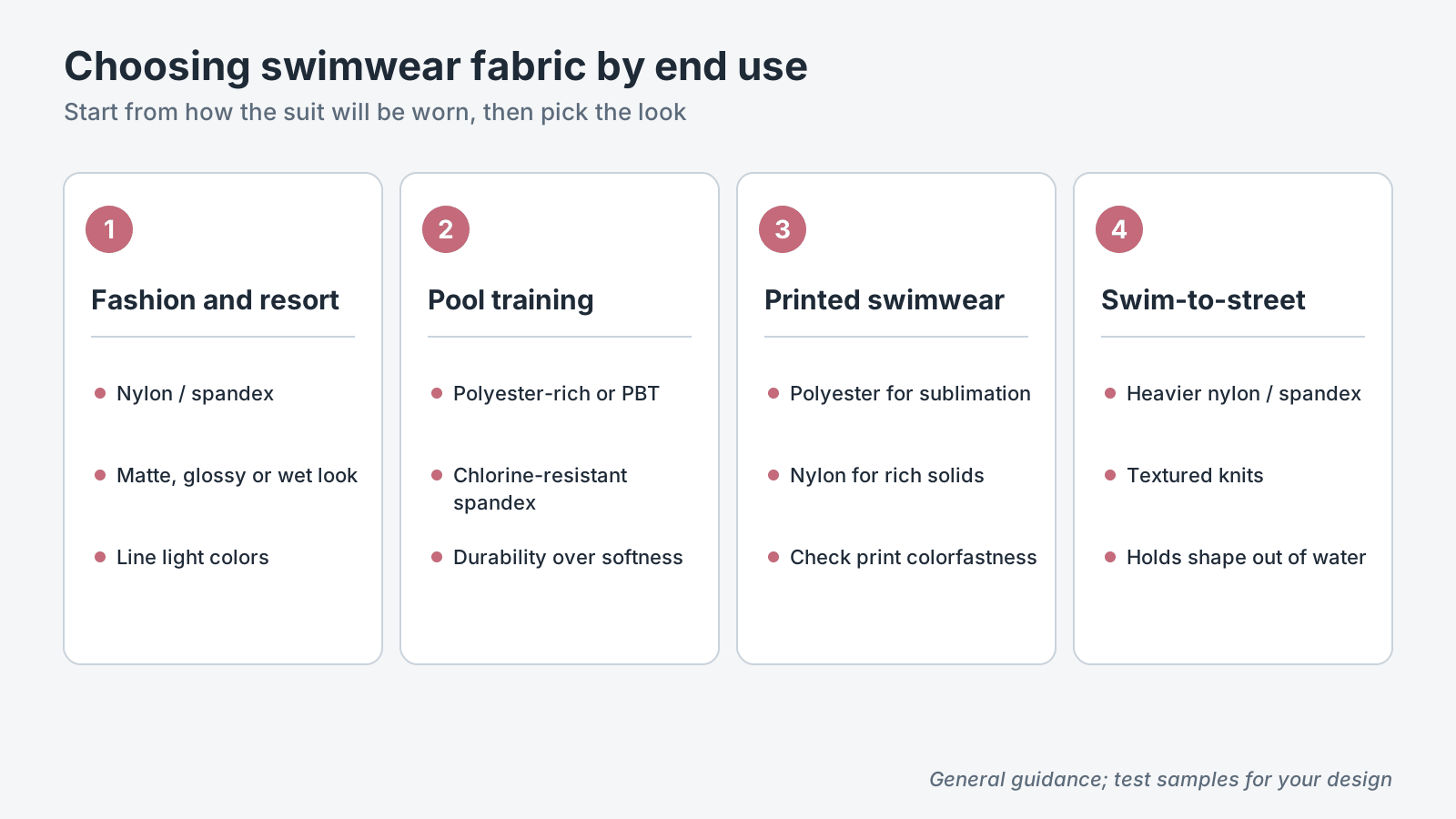
Start from how the suit will be used, then narrow by look:
- Fashion and resort swimwear (bikinis, one-pieces worn at the beach or by the pool): nylon/spandex, matte, glossy or wet-look; line light colors.
- Pool training and regular lap swimming: polyester-rich, PBT or chlorine-resistant spandex blends; prioritize durability over softness.
- Printed swimwear: polyester blends for sublimation printing; nylon for rich solid colors.
- Swim-to-street and activewear crossover (swim leggings, rash guards, bodysuits): heavier nylon/spandex or textured knits that look like apparel and hold shape out of the water.
Then put these on the spec sheet before asking for samples: composition by percentage, weight in g/m², usable width, stretch and recovery in both directions, finish (matte, glossy, wet look, textured), color standard, colorfastness requirements (chlorine, seawater, light, perspiration), lining needs and certifications. If you’re preparing a first order, our checklist on what to verify before bulk swimwear fabric orders walks through sampling and testing.
FAQ
What is the best fabric for swimwear?
There isn’t one best fabric. Nylon/spandex is the most popular choice for fashion swimwear because it feels soft and fits closely; polyester/spandex and PBT blends are better for suits that spend a lot of time in chlorinated pools.
Is polyester or nylon better for swimsuits?
Nylon feels softer and gives a more flattering fit; polyester resists chlorine and UV fading better and suits printing. Choose nylon for fashion swimwear and polyester for training or heavily used pool suits.
What percentage of spandex is best for swimwear?
Most swim fabrics contain roughly 15–30% spandex. Lower amounts give more structure; higher amounts give more stretch and a smoother, closer fit.
Can you use regular spandex fabric for swimsuits?
Only if it’s designed for swim. Many apparel “spandex” knits aren’t tested for chlorine, salt water or colorfastness when wet, and some go transparent. Ask for fabric sold as swimwear fabric, with test results.
Is cotton good for swimwear?
No. Cotton absorbs water, gets heavy, stretches out and dries slowly, so it isn’t used for swimsuits, though it can appear in cover-ups.
What weight should swimwear fabric be?
Swim fabrics commonly sit somewhere around 120–220 g/m², depending on the style; Fuyuan’s range runs from 120 to 200 g/m². Lighter fabrics usually need lining; heavier ones give more coverage and support. Confirm the right weight for your design with sample testing.
Sourcing Swimwear Fabric
Fuyuan Knitting makes nylon/spandex swimwear fabrics in matte, glossy, wet-look and textured finishes on its own high-speed warp-knitting machines, dyed in its in-house dye house, with low MOQs and fast sampling. Tell us your target composition, weight, finish and color, and we’ll send swatches to test.