What Is Mesh Fabric: How It’s Made, the GSM Ranges That Matter, and Where It Actually Belongs
Squeeze a swatch of power mesh between two fingers and let go — it snaps back tight enough to leave a faint crease line on your skin for a second. Do the same with a swatch of tulle and it just stays crumpled, no snap-back at all. That one reflex is basically the whole difference between the two fabrics, even though half the internet uses “mesh,” “netting,” and “tulle” as if they’re interchangeable words for the same thing.
They’re not, and the gap matters most if you’re the one specifying which one goes into a sports bra panel or a swimwear lining. This guide covers what mesh fabric actually is, the handful of ways it gets made — warp knit versus weft knit versus woven, and why that choice changes everything downstream — what the GSM numbers on a spec sheet are actually telling you, and where each type of mesh genuinely earns its place, versus where it’s just the fabric everyone defaults to out of habit.
What Is Mesh Fabric
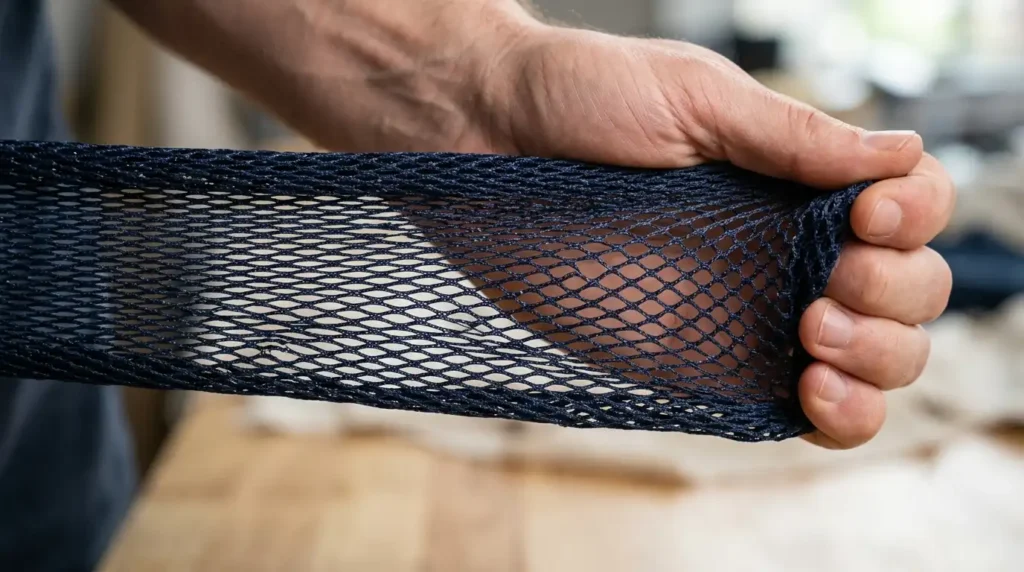
Mesh is an open, grid-like fabric built by knitting or weaving yarns into a regular pattern of evenly spaced holes, rather than a solid, continuous surface. That’s the core definition — everything else (fiber, hole size, stretch, weight) is a variable layered on top of that basic open structure.
Unlike tulle, which traces its name to a specific French town and a specific 19th-century machine, mesh doesn’t really have one clean origin story. “Mesh” just describes a structure, and versions of it go back a long way. One of the earlier commercial trademarks for a ventilated mesh fabric, Aertex, dates to 1888, when a Lancashire mill owner registered a woven cotton mesh designed to let air move through clothing. The instinct behind it — build gaps into the fabric on purpose, for airflow rather than decoration — is basically still the whole point of mesh today, just executed in synthetic yarn on much faster machines.
Core characteristics and feel
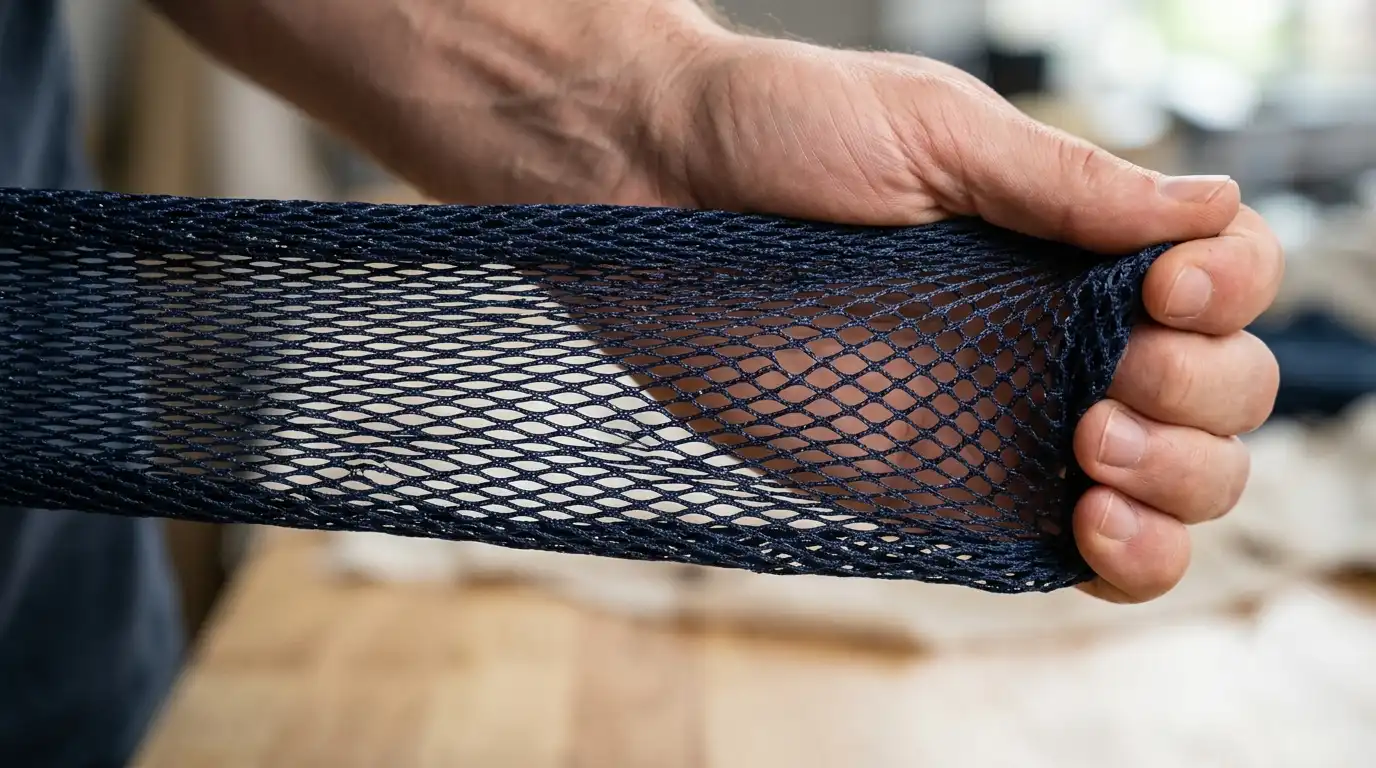
What separates mesh from most other open-structure fabrics is that it’s built to move with the body, not just drape over it. Add spandex or elastane into the yarn mix and a mesh panel can stretch 20–30% or more in one direction and spring back to its original shape almost immediately — that recovery, not just the stretch itself, is the property that actually matters in a garment. A fabric that stretches but doesn’t recover just goes baggy after a few wears.
Where it shines
- Activewear and sportswear — ventilation panels, side panels, racerback details
- Sports bras, shapewear, and foundation garments where compression and recovery matter
- Swimwear linings and structural layers
- Sneaker uppers, bag panels, and technical or medical padding (spacer mesh specifically)
Where it struggles
- Anywhere you need true opacity — mesh is defined by its holes, so full coverage always means layering it over something else
- Very fine, lightweight mesh can run and ladder at a cut edge under real tension, the same way a stocking does, if it isn’t finished properly
- Heavier structured mesh (power net, spacer mesh) isn’t the fabric to reach for if you want soft drape — it’s built to hold shape, not flow
How Mesh Fabric Is Made
Most fabric guides treat “mesh” as one thing. It isn’t. The construction method behind a specific piece of mesh determines almost everything about how it performs — more than the fiber does, honestly.
Warp knitting: tricot vs Raschel
The bulk of performance and apparel mesh comes off warp-knitting machines, and there are two distinct types that get lumped together constantly.
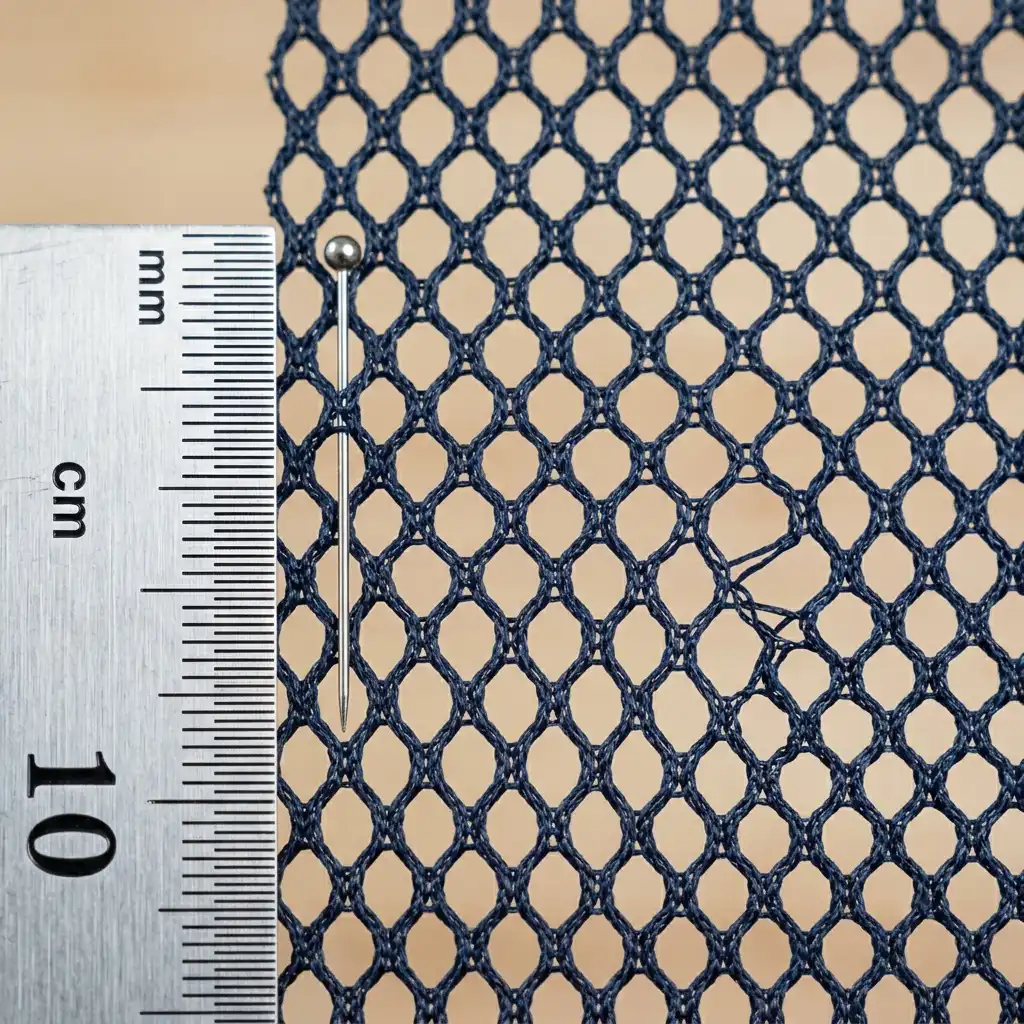
Tricot machines use fine needles and run fast — well over 2,000 stitches a minute on compound-needle machines — producing smooth, lightweight, closely knit fabric, generally under about four ounces per square yard. Tricot mesh sits at the finer, more apparel-friendly end of the spectrum.
Raschel machines run slower, use latch or compound needles, and carry far more guide bars — anywhere from about 4 up to 70, depending on the machine. This is the part most fabric guides skip entirely: more guide bars means more complex, more open structures, and heavier power net constructions flat-out cannot be made on a tricot machine. If a mill tells you their power net is warp-knit, it came off a Raschel machine. There’s no other way to make it.
Both are warp-knit, both are run-resistant and dimensionally stable compared to a weft-knit jersey, and both are why good warp-knit mesh doesn’t ladder the way a cheap weft-knit mesh can.
Weft knit, woven, and other constructions
Some athletic mesh is weft- or circular-knit instead, closer in construction logic to a t-shirt jersey with deliberate open areas engineered in. True woven mesh also exists, usually a leno or gauze weave, where pairs of warp yarns twist around the weft yarns to lock an open structure in place without any knitting at all — this shows up more in industrial and technical mesh than in apparel.
Laser-cut, bonded, and spacer mesh
Two more constructions worth knowing if you’re speccing modern activewear: laser-cut mesh, where a beam running well over 400°C melts and seals synthetic edges in the same motion it cuts them, so no serging or binding is needed on panel edges; and spacer (or 3D) mesh, where two outer knit layers are connected by a field of monofilament yarns acting like tiny springs, giving cushioning and airflow in one pass, mostly off Raschel machines. Spacer mesh is what’s inside a padded shoe upper or a technical backpack panel — not what’s in a t-shirt.
What determines stretch vs structure
Fiber blend does most of the work here. A mesh with roughly 10% spandex typically stretches somewhere around 20% one direction and 30–35% the other — genuine four-way stretch. Drop the spandex ratio and raise the polyester or nylon share, and the same basic construction turns into something closer to a stable, low-stretch technical fabric. Most of our warp-knit mesh runs across a handful of nylon-spandex ratios for exactly this reason — a 90/10 blend behaves nothing like a 68/32 blend coming off the same machine.
Limits to watch
- Cheap, thin mesh with a low spandex percentage loses recovery faster than the label suggests — after repeated wear and wash cycles it stretches out and stays stretched
- Laser-cut edges are fray-free but can feel slightly stiff or glossy right at the cut line compared to the body of the fabric
- Very open, low-GSM mesh isn’t the fabric to trust with a heavy embellishment or hardware attachment point without reinforcement underneath
Types of Mesh and What the GSM Actually Tells You
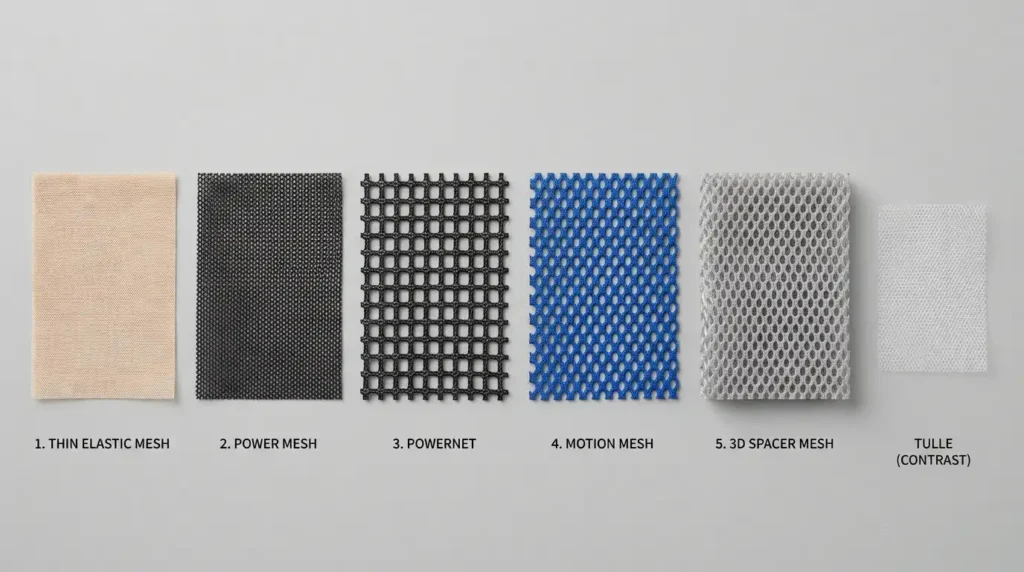
There’s no single ISO or ASTM standard that locks down exactly what “power mesh” or “athletic mesh” means in grams per square meter. These are trade conventions that vary a bit by mill, not hard specifications. Still, having rough bands to compare against beats guessing, so treat the table below as a starting reference to sanity-check a quote against — not gospel.
| Type | Typical GSM | Stretch & recovery | Common use |
|---|---|---|---|
| Lightweight/stretch mesh | ~60–100 gsm | High stretch, moderate recovery | Sheer overlays, linings, illusion panels |
| Power mesh | ~90–150 gsm | High stretch, strong recovery | Sports bras, waistbands, shapewear panels |
| Powernet | ~150–220+ gsm | Very high stretch, firm compression-grade recovery | Foundation garments, corsetry, heavy shapewear |
| Athletic/apparel mesh | ~120–180 gsm | Moderate stretch | Jersey ventilation panels, general activewear |
| 3D spacer mesh | ~200 gsm and up (often 250–300+ counting thickness) | Low stretch, cushioning instead of stretch | Shoe uppers, bag panels, medical padding |
💡 Pro Tip: if two suppliers quote wildly different GSM for the same “power mesh” description, ask what fiber ratio and machine type it came off before assuming one of them is wrong. A 79/21 polyamide-spandex compression mesh and a 90/10 general-purpose mesh are both fairly called “power mesh” in casual conversation, and they are not the same fabric.
Mesh vs tulle vs netting vs lace
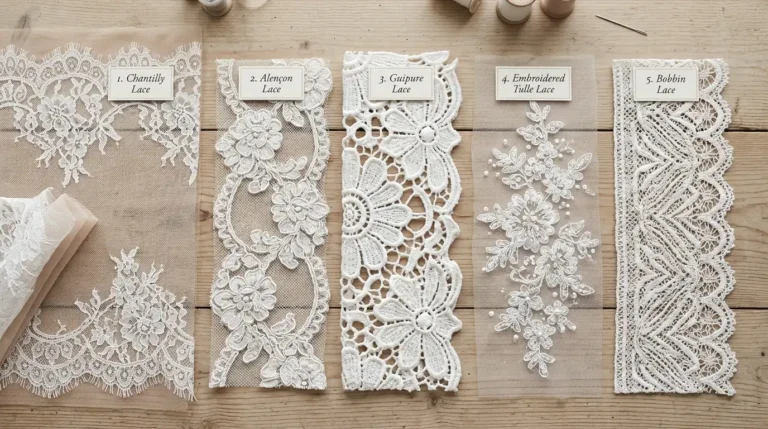
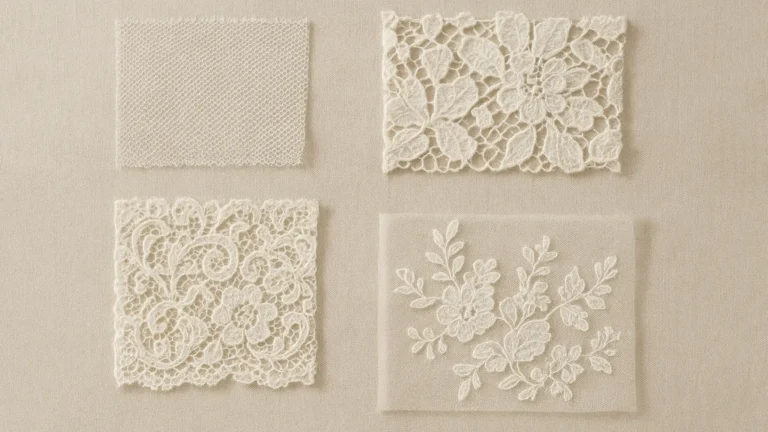
This is where a lot of buying decisions go sideways, because all four fabrics get called “mesh” or “netting” loosely in everyday conversation. Netting is a coarse, knotted or looped open construction with visible, often uneven holes. Tulle is a finer, lower-denier version of netting — stiff, sheer, almost no stretch, built for volume and decoration rather than function. Mesh is the engineered cousin: a uniform, deliberately consistent grid, usually stretch-capable, built to perform rather than to look good sitting still. Lace sits in a different category entirely — a patterned, often Raschel-knit or embroidered decorative structure where the visual motif is the point, not the ventilation. We’ve laid out the full lace-versus-mesh comparison in more depth elsewhere, since the two get confused constantly despite behaving almost nothing alike on a body.
Uses, Care, and Buying Tips
Where mesh actually gets used
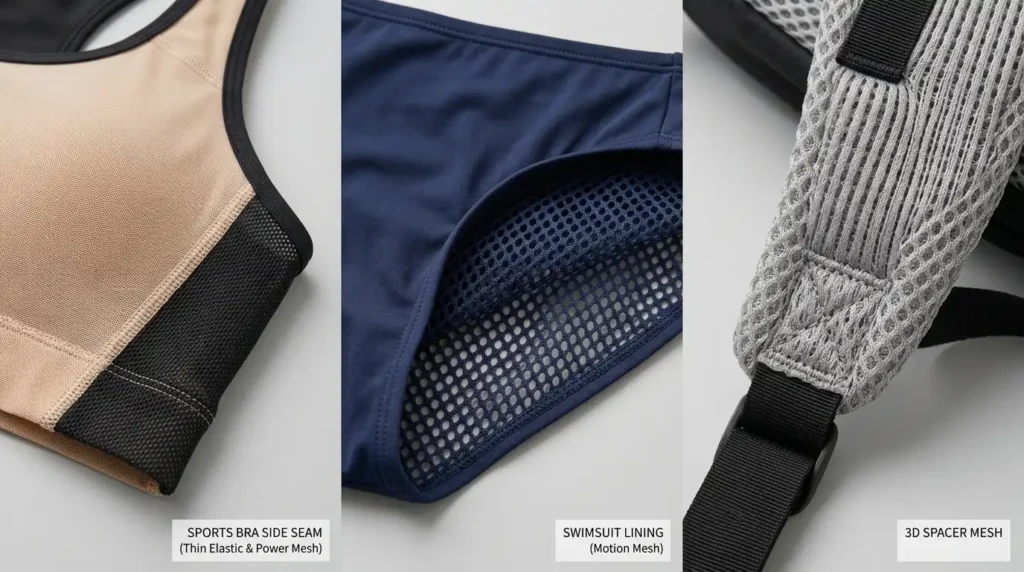
Activewear and sportswear account for most of the volume — ventilation panels, racerback details, and full garments in the case of running singlets. Sports bras and shapewear lean on power mesh and powernet specifically for a compression-and-recovery combination nothing else quite matches. Swimwear uses mesh as a structural lining under the visible fashion fabric more often than as the outer layer itself. Beyond apparel, mesh shows up in sneaker uppers, backpack straps and back panels, medical braces, and filtration screens — each one running its own fiber ratio and construction, even though “mesh” gets used as the catch-all word for all of it.
On weight, and buying by spec, not by feel
A swatch feels a certain way in your hand, but “feels stretchy” isn’t something you can put on a purchase order. Ask for GSM, the exact fiber ratio — not just “nylon-spandex,” the actual percentages — and stretch percentage in both directions if the application needs real four-way stretch. Our polyamide sourcing guide goes deeper into reading nylon-spandex ratios specifically, since that’s the fiber combination behind most of the mesh in this category.
Care essentials
- Washing: cold water, gentle cycle or hand wash, mild detergent. Skip fabric softener entirely — it coats the fibers and kills the moisture-wicking finish that’s often the whole reason the mesh was chosen in the first place.
- Drying: air dry or lay flat. A hot dryer breaks down spandex faster than almost anything else you could do to the garment.
- Bleach: never. It degrades synthetic fiber and strips color unevenly on blended yarns.
Troubleshooting quick hits
- Snagged a thread on a raw-cut edge? Don’t pull it — ease it back through with a pin, the same fix that applies to any knitted structure.
- Mesh gone baggy after a season? That’s the spandex losing recovery, not necessarily a washing mistake — it happens faster on lower-spandex-ratio fabric under heavy wear.
- Edges curling or fraying on a sample? Ask whether it was laser-cut or mechanically cut. Raw mechanical cuts on lower-elastane mesh do fray over time; laser-cut edges generally don’t.
⚠️ Warning: “Waterproof” gets attached to mesh in casual marketing copy more than it should be. Polyester and nylon mesh are water-resistant and dry fast, which is not the same claim as waterproof — water passes straight through an open mesh structure. If a spec sheet says “waterproof mesh,” ask what that’s actually supposed to mean before you rely on it.
Sustainability and Certifications
Virgin polyester and nylon are both petroleum-derived, and nylon production specifically releases nitrous oxide as a byproduct — a gas with a global warming potential estimated at around 273 times that of CO2 over a hundred-year horizon, by current IPCC accounting. That number almost never comes up in fabric marketing copy, which is exactly why it’s worth having in your back pocket. Recycled polyester mesh, often made from post-consumer bottles, has closed most of the performance gap with virgin fiber at this point — a well-made recycled power mesh holds four-way stretch and recovery close enough to virgin that most buyers can’t tell by feel alone.
If recycled content actually matters for a collection, the standard to ask about is the Global Recycled Standard (GRS), managed by Textile Exchange. It’s a tiered claim, not a yes-or-no label: a fabric needs at least 20% recycled content to use GRS as a B2B verification tool, at least 50% to carry consumer-facing GRS labeling, and a “100% recycled” claim specifically requires the content to land within 95–100%, since the standard builds in a 5% tolerance. Our warp-knit mesh runs through a GRS-certified facility, for what that’s worth — this isn’t an abstract standard to us.
OEKO-TEX Standard 100 is a separate, complementary certification. It doesn’t verify recycled content at all, but tests the finished product against over a thousand potentially harmful substances at every processing stage, with four product classes depending on skin contact — Class 1, for baby and children’s items, carries the strictest limits. Certificates are only valid for 12 months and get re-checked against updated limit values annually, so an OEKO-TEX claim that’s more than a year old is worth double-checking rather than taking on faith.
bluesign is a third, different kind of certification again. It evaluates the manufacturing system and chemical inputs at the mill level rather than certifying a specific finished fabric, and it shows up more often in outdoor and technical textiles than in fashion. None of these three substitute for each other — a mesh fabric can hold one, two, or all three, so ask which ones specifically apply. “Certified” on its own tells you almost nothing.
FAQs
What is mesh fabric made of?
Most performance mesh today is polyester, nylon (polyamide), or a blend of either with spandex/elastane for stretch. The fiber ratio changes the fabric more than people expect — a 90/10 nylon-spandex mesh and a 68/32 blend off the same machine behave like genuinely different fabrics.
How is mesh fabric made?
The majority is warp-knit on tricot or Raschel machines, which lock the structure with knitted loops and make it run-resistant. Heavier constructions like power net specifically require Raschel machines — tricot machines physically can’t produce them. Weft-knit and true woven (leno) mesh exist too, just less commonly in apparel.
What’s the difference between mesh and tulle?
Construction and purpose, mostly. Tulle is a fine netting built for volume and decoration, with little to no stretch. Mesh is an engineered, stretch-capable grid built to perform — compress, ventilate, or support — rather than just look voluminous. They get confused because both read as “open structure with visible holes,” but that’s about where the similarity ends.
Is mesh fabric breathable?
Yes, structurally — the open holes are the whole reason it gets chosen for ventilation panels in the first place. How breathable depends on hole density and fiber; a tightly knit power mesh breathes less than an open athletic mesh, even though both are technically “mesh.”
Is mesh fabric waterproof?
No, and this gets overstated in casual product copy. Polyester and nylon mesh are water-resistant and quick-drying, but water passes straight through an open structure — that’s not the same claim as waterproof, and a supplier who uses the word loosely deserves a follow-up question, not the benefit of the doubt.
Is mesh fabric stretchy?
It depends entirely on the spandex content, not on the fact that it’s mesh. A 0% spandex mesh — some athletic and industrial mesh falls here — barely stretches at all; a power mesh or powernet with 20%+ spandex can stretch 30% or more in one direction and snap back almost instantly.
Can mesh fabric be machine washed?
Most synthetic mesh can be, on a cold, gentle cycle — but skip the fabric softener, since it coats fibers and kills wicking performance, and skip the dryer’s heat setting, since heat is what actually breaks down spandex recovery over time. Air drying or laying flat is the safer call.
Related reading: If lace and mesh both show up in your sourcing conversations and you’re not always sure which one a supplier means, our full lace vs. mesh comparison breaks down exactly where they overlap and where they don’t. And if nylon-spandex ratios are the part of a spec sheet you find yourself squinting at, the polyamide sourcing guide is worth a read before your next order.
We run warp-knit mesh production in-house — GRS-certified, OEKO-TEX-compliant, across the nylon-spandex ratios covered in the table above — plus a separate performance fabric line built specifically for swimwear and athletic applications. If you’re speccing mesh for a collection and want swatches to compare GSM and stretch firsthand rather than trust a spec sheet alone, send over your requirements and we’ll get samples moving.