Lace Fabric MOQ: What Actually Sets the Number, and How to Talk It Down
Three suppliers, one fabric, three completely different numbers on the quote sheet: 500 meters, 2,000 meters, and “sorry, that pattern doesn’t run below 3,000.”
You didn’t send them different specs. So why the gap?
This guide is for sourcing buyers, merchandisers, and small-label designers trying to make sense of lace fabric MOQ. We’ll cover what sets the number, what moves it, and where you actually have room to negotiate.
We’re not going to define ten lace patterns you already know. We’re going to walk through the one number that decides whether your first order feels manageable or impossible.
What Is MOQ, Really?
MOQ stands for Minimum Order Quantity — the smallest amount of fabric a supplier will sell you in a single order. For lace, that’s usually measured in meters or yards.
Simple enough. Here’s where it gets confusing.
Most suppliers also work with an MCQ — Minimum Color Quantity. That’s the smallest amount required per color, not per order.
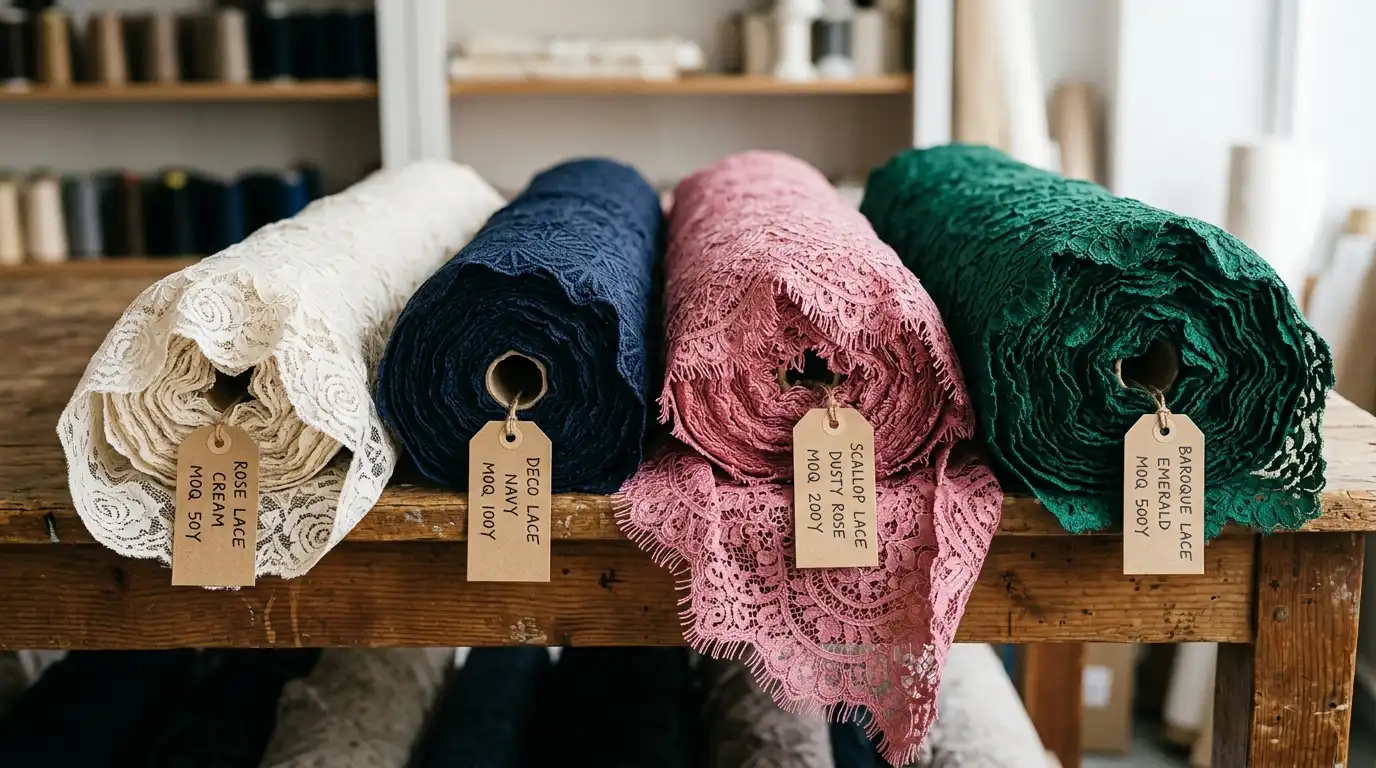
Say a supplier quotes an MOQ of 500 meters and an MCQ of 200 meters. Order one color, and 500 meters covers it easily. Split that same 500 meters across three colors, though, and you’ll likely fall short of the per-color minimum, even while hitting the total MOQ.
💡 Pro Tip: Always ask for both numbers, not just one. “What’s your MOQ” is only half the question.
Why Lace Even Has an MOQ
MOQ isn’t a sales tactic. It’s downstream of how the fabric actually gets made.
Three production realities set the floor:
- Dyeing. A dye bath is expensive to run and hard to run small. Most factories need several hundred meters just to justify filling the vat.
- Machine changeover. Switching a Raschel or jacquard machine to a new pattern means re-threading yarn and resetting tension — hours of labor before a single meter comes off the machine.
- Raw material batching. Yarn gets bought in bulk. A tiny order still needs its own yarn lot, and most mills won’t cut one just for you.
None of this is about squeezing more money out of you. It’s about the mill breaking even on setup before they even start weaving. Worth remembering the next time an MOQ feels arbitrary — it usually isn’t.
Four Variables That Actually Move Your MOQ
Ask five suppliers for a lace fabric MOQ and you’ll get five different answers. That’s not inconsistency. It’s four variables stacking on top of each other.
Design Complexity
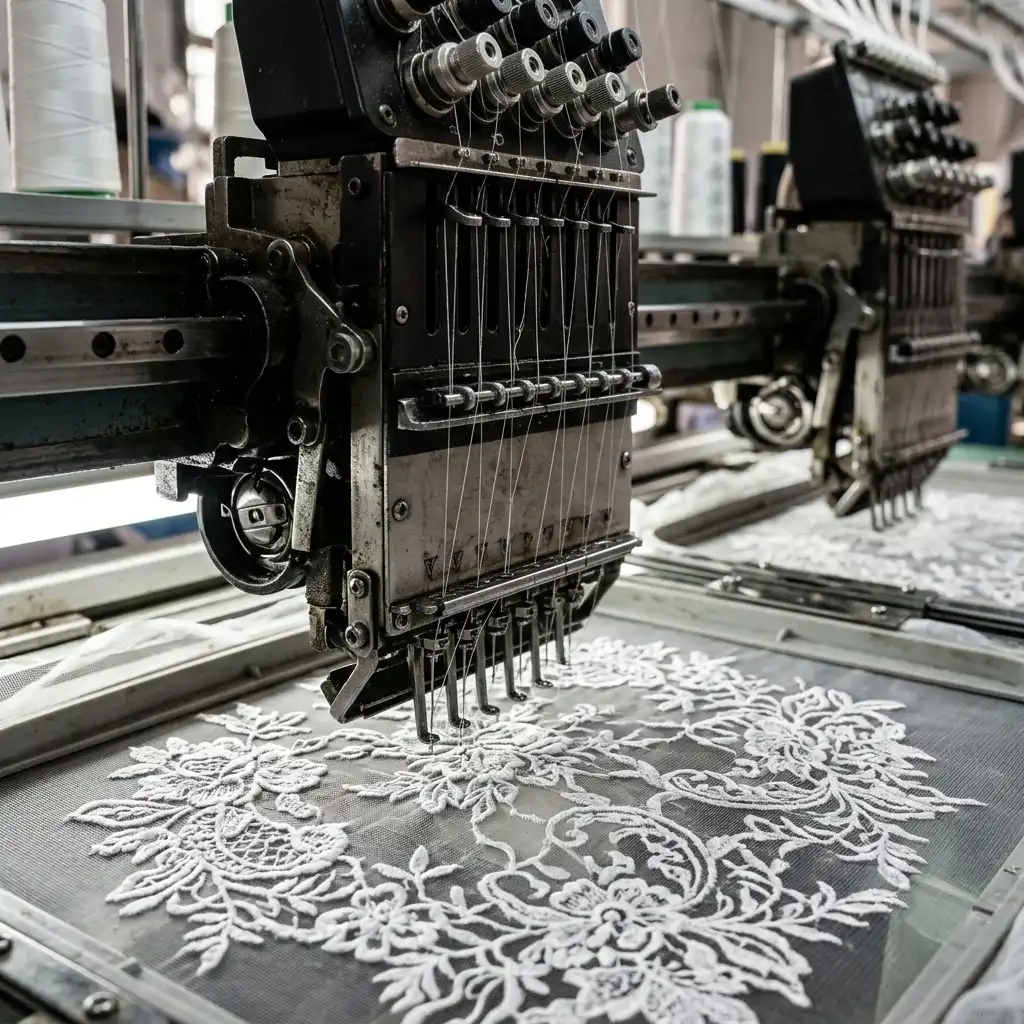
A simple Raschel mesh with an open floral repeat is cheap to set up. Dense embroidery, 3D florals, or beadwork are not — more stitches, more machine time, more room for error.
The rule of thumb: the more complex the pattern, the higher the MOQ. Complexity buys detail, but it also buys a bigger minimum.
Per-Color Minimums
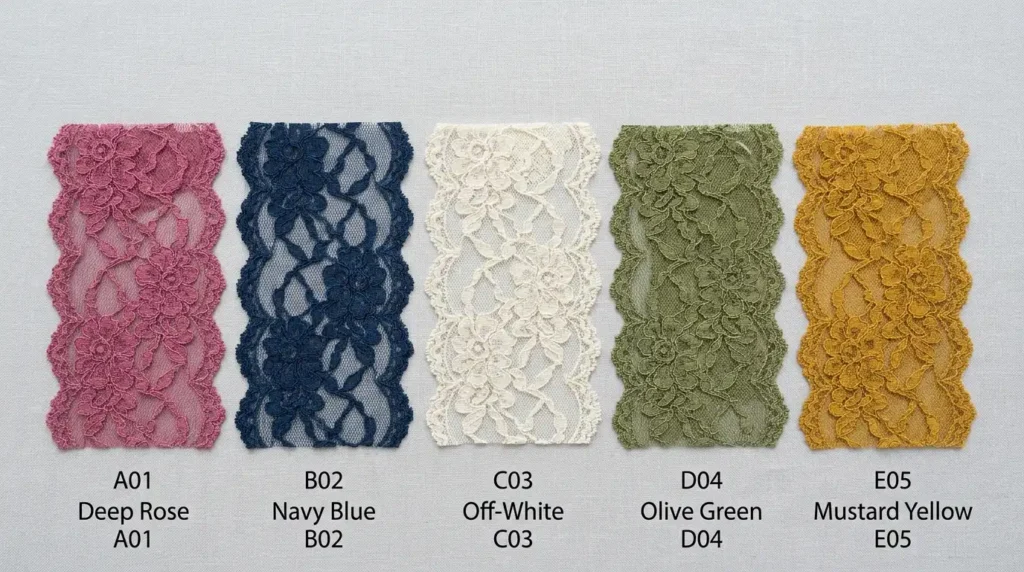
We touched on this above, but it deserves its own line: every additional color you order usually resets part of the MOQ math.
A single-color order of 500 meters is one production run. Five colors at 100 meters each is five separate dye lots — and most mills won’t quote that the same way.
Supplier Type
Not every “supplier” runs the same kind of business. The distinction matters more than most buyers realize.
| Supplier Type | Typical MOQ Behavior | Trade-off |
|---|---|---|
| Trading company | Often lower, since they pool stock from multiple mills | Limited customization, less technical depth |
| Factory / manufacturer | Set MOQs for custom work, usually higher | Full control over color, pattern, and quality |
| OEM factory | Highest MOQ, but full development support | Best fit for brands building a real product line |
Testing a few fabric options before committing to a collection? A trading company might get you there faster. Building a signature pattern you’ll reorder for years? A factory relationship pays off.
Sourcing Region
Where a supplier sits changes both the MOQ and the reason behind it. China’s lace clusters run on scale — Fujian for warp-knitted and eyelash lace, Guangdong for embroidery-heavy bridal styles — so their MOQs reflect efficient mass production.
European heritage mills work the opposite way. Weaving on antique Leavers looms is slow and artisanal, and the MOQ — and the price — reflect that.
Neither is wrong. They’re just tuned for different order sizes.
Our complete guide to sourcing lace fabric from China breaks down what to expect from each major production cluster, MOQ included.
These Same Variables Are Quietly Setting Your Lead Time Too
Here’s the part most sourcing guides skip: everything that pushes your MOQ up also pushes your lead time out.
A more complex pattern means longer machine setup and longer sampling. More colors mean more dye lots and more days waiting on approval. Custom development instead of a stock pattern adds weeks, not days.
Budget for both at once. A supplier who quotes a low MOQ but a six-week lead time hasn’t solved your problem — they’ve just moved it.
For a closer look at what can still go wrong between sample approval and bulk delivery, see our notes on testing lace fabric for shrinkage before bulk production.
How to Vet a Lace Supplier Before You Commit
MOQ is only half the decision. The other half is whether the supplier can actually deliver what they quoted.
A few checks worth running before you send a deposit:
- Ask to see the machines. A real factory sends photos or video without hesitation. Hesitation is the answer.
- Check for in-house dyeing. Suppliers who dye on-site control color consistency batch to batch — a real problem for anyone running repeat production.
- Ask about certifications. OEKO-TEX Standard 100 and GRS aren’t just paperwork. They signal a supplier used to working with brands that get audited.
- Request a technical data sheet, not just a swatch. A swatch tells you what the fabric feels like. A data sheet tells you what it is — fiber content, stretch recovery, GSM.
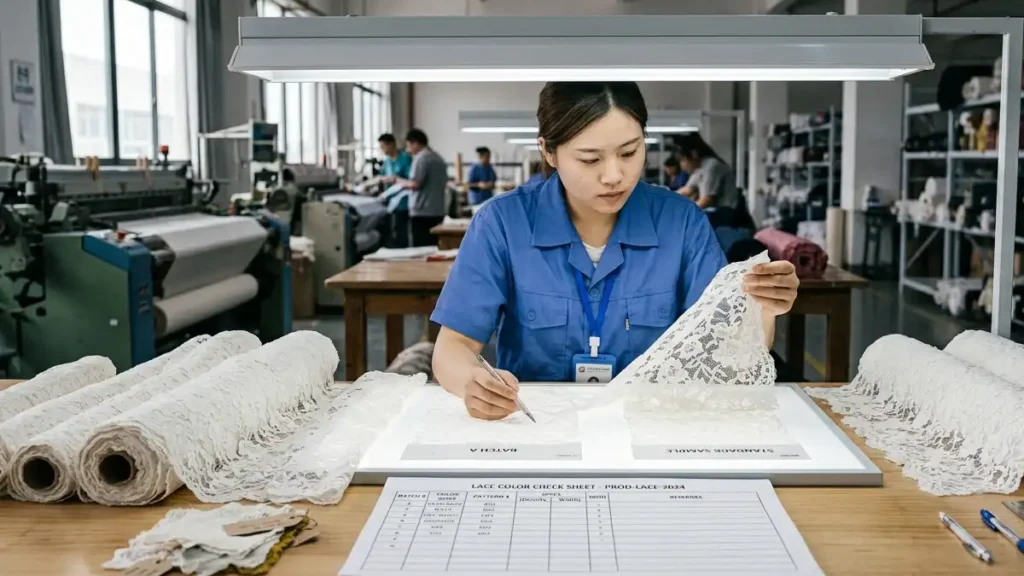
We built our own process around this same logic. Fuyuan runs its own dyeing facility instead of outsourcing it, which helps us hold consistent color across a full production run. We also provide OEKO-TEX and GRS documentation on request.
Our guide on where to buy lace fabric walks through a fuller version of this checklist.
⚠️ Warning: A supplier who can’t answer a direct question about MOQ — and instead gives you a vague range with no logic behind it — probably isn’t a factory. Probably a trader working off someone else’s price list.
Sample Fees and How They Relate to MOQ
Sampling isn’t a courtesy step. It’s risk management, and it usually costs something.
Most mills charge a sample fee — typically a modest, flat amount per swatch or strike-off. Here’s the detail buyers often forget to ask about: that fee is frequently credited against your first bulk order.
Skip sampling to save a few days, and you’re gambling on hand feel, stretch recovery, and color match — sight unseen. That’s a bad trade against a fee that usually gets refunded anyway.
Our checklist for sourcing lace trim by the yard covers exactly what to specify before requesting that first sample, so the round doesn’t need repeating.
First Order vs. Reorder: Why the Second PO Gets a Better Number
Almost nobody talks about this. It probably should come up more.
Your first order with a new supplier gets priced to cover their risk: an unknown buyer, no track record on payment or communication. Your second order isn’t priced that way.
Returning buyers routinely see softer MOQs, faster sampling, and more flexibility on payment terms. Suppliers would rather keep a known customer happy than chase a new one from scratch.
If a quoted MOQ feels tight for a first order, ask directly whether it loosens up on repeat business. Good suppliers will say yes — and usually explain by how much.
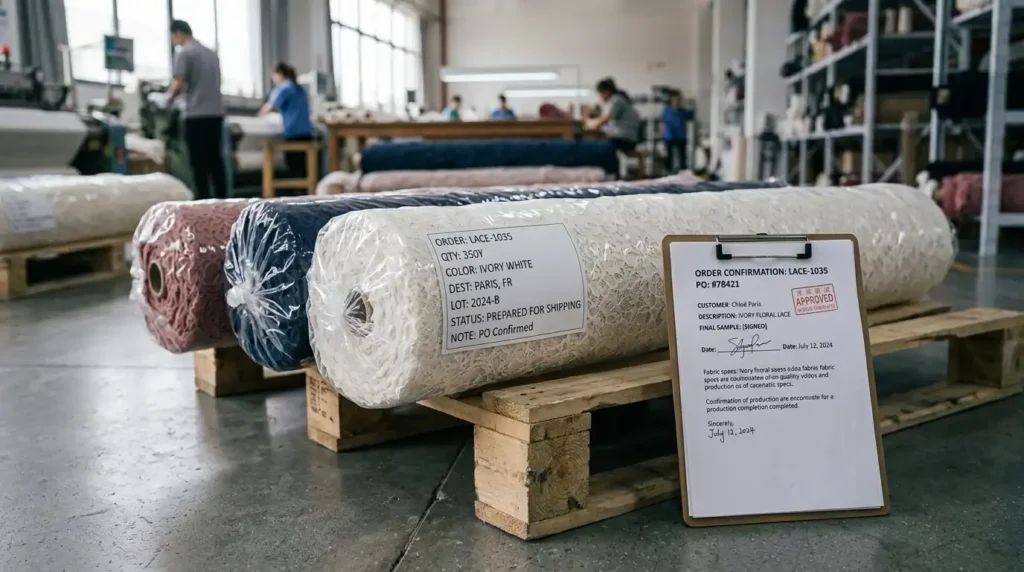
This is one reason low-MOQ, OEM/ODM-friendly manufacturers exist in the first place. They’re betting the relationship pays off over several seasons, not one PO.
How to Actually Negotiate Your MOQ Down
Everything above sets the stage for this part.
A few angles that move the actual number, not just the mood of the conversation:
- Ask if MOQ is calculated by color or by style. Sometimes one design can spread across several colorways and still hit a single MOQ threshold.
- Confirm whether waste is already included. Printing and finishing often carry 5–10% overage — ask if that’s baked into the quoted number or added on top.
- Ask about shared production runs. Some mills quietly combine multiple buyers’ orders on the same machine setup, especially for popular stock patterns.
- Time your order around off-peak production. MOQs can loosen during a mill’s slower season, when they’re filling machine capacity instead of turning business away.
- Start with a stock pattern, not a custom one. Existing patterns skip the tooling cost that drives custom MOQ up in the first place.
None of these work every single time. But asking costs nothing, and most suppliers respect a buyer who understands their own production constraints.
Where This Leaves You
MOQ isn’t a wall. It’s a number built from dyeing capacity, machine setup, color count, and how well a supplier already knows you.
Figure out which of those four is driving your number, and the rest of the negotiation gets a lot less mysterious.
Sourcing lace fabric or lace trim? You want a supplier who treats a small first order as the start of a relationship, not a hassle.
Fuyuan Knitting supports flexible MOQ, OEM/ODM development, and fast sample turnaround for bridal, lingerie, swimwear, and activewear brands. Reach out for a sample and we’ll walk you through what your specific pattern would actually require.