
Tulle vs Mesh vs Lace: A Fabric Buyer’s Comparison Guide
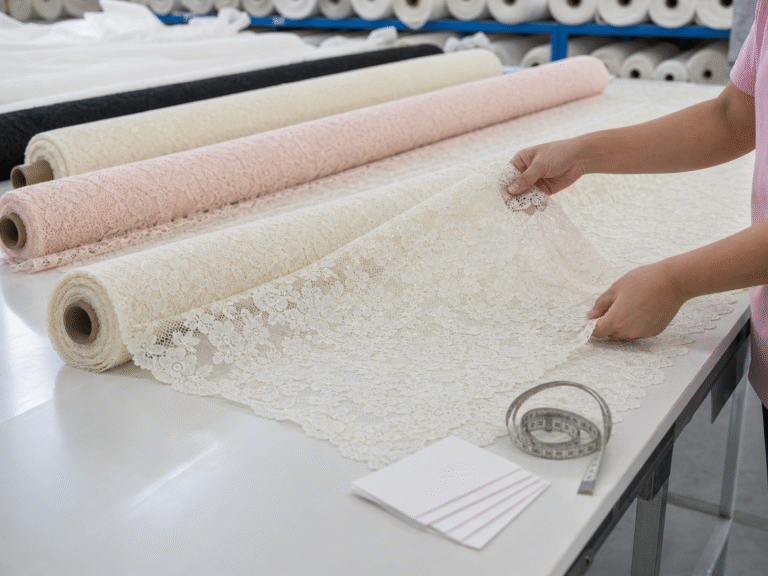
Hold a piece of Chantilly lace up to a window and look between the flowers: the see-through background is, in effect, a fine hexagonal net — tulle. Tulle is a plain, fine net used for volume and sheerness; mesh is an engineered open knit, usually with spandex, used for stretch, support and airflow; lace is an openwork fabric where the pattern is the point, and much of it is built on a net ground. This guide is for brand buyers, small-batch manufacturers and designers choosing between the three for lingerie, bridal, swimwear or activewear — and for anyone whose supplier has used all three words for the same swatch.
The short way to remember it: tulle holds volume, mesh does work, lace carries the design. The rest of this article explains why, shows how to tell them apart in your hand, and lists what to put on a spec sheet so you get the fabric you meant to order.
Tulle vs Mesh vs Lace at a Glance
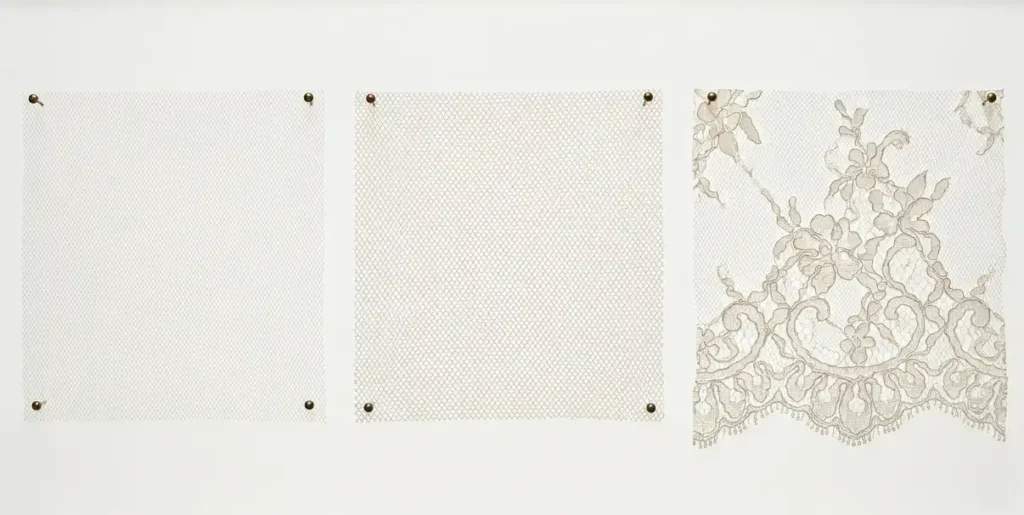
If you only have a minute, this table covers the differences that change a buying decision. Ranges are typical of the market, not fixed definitions.
| Tulle | Mesh | Lace | |
|---|---|---|---|
| What it is | Fine, plain net with small hexagonal holes | Engineered open knit; holes can be hexagonal, diamond, square or honeycomb | Openwork fabric with a decorative motif, often on a net ground |
| Main job | Volume, veiling, sheer overlays | Stretch, support, ventilation, linings | Visual design and surface interest |
| Usual construction today | Warp-knit (Raschel); bobbinet for couture | Warp-knit (tricot or Raschel); some weft-knit | Raschel, Leavers, or embroidery on tulle/mesh |
| Common fibers | Nylon, polyester; silk and cotton at the top end | Nylon or polyester with spandex | Nylon, polyester, cotton, viscose; often with spandex for stretch lace |
| Stretch & recovery | Very little; not built to recover | Low to very high, set by spandex content | None to moderate (non-stretch vs stretch lace) |
| Hand feel | Crisp to soft, depending on finish | Smooth and flat | Textured; raised motifs you can feel |
| Snag risk | High on fine grades | Low to moderate | Moderate to high, especially open or corded designs |
| What drives cost | Fineness, finish, bobbinet vs warp-knit | Fiber ratio, GSM, construction | Design complexity, repeat, machine time, width |
💡 Pro Tip: None of these three words is a fiber. A spec sheet that says only “tulle”, “mesh” or “lace” has told you the structure, not the material — always ask for the fiber percentages too.
Why These Three Get Mixed Up: They’re One Family of Nets
The confusion is understandable, because tulle, mesh and most lace are relatives rather than strangers. All three are open structures, and in modern production most of them come off the same broad family of warp-knitting machines. What separates them is what the net is designed to do.
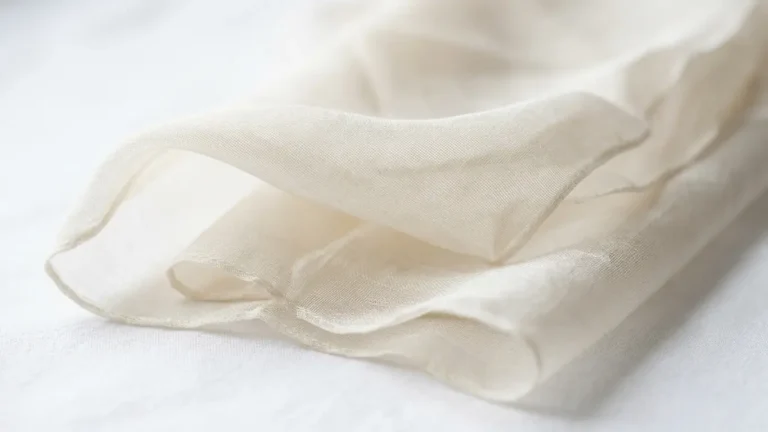
Tulle is the plainest member. It’s a fine net with small, regular hexagonal holes and no pattern. The name comes from the French town of Tulle, and the original machine-made version was bobbinet, where threads are twisted around each other rather than knitted. Most tulle sold today is warp-knit on Raschel machines, which is faster and cheaper; our guide to what tulle fabric is covers that difference in detail.
Mesh is the engineered member. The holes are still there, but their size, shape and the yarn mix are chosen for performance. Add spandex and you get stretch and recovery; tighten the structure and you get support. Holes don’t have to be hexagonal: diamond, square, honeycomb and “butterfly” structures are all common. See what mesh fabric is for the GSM ranges and construction types.
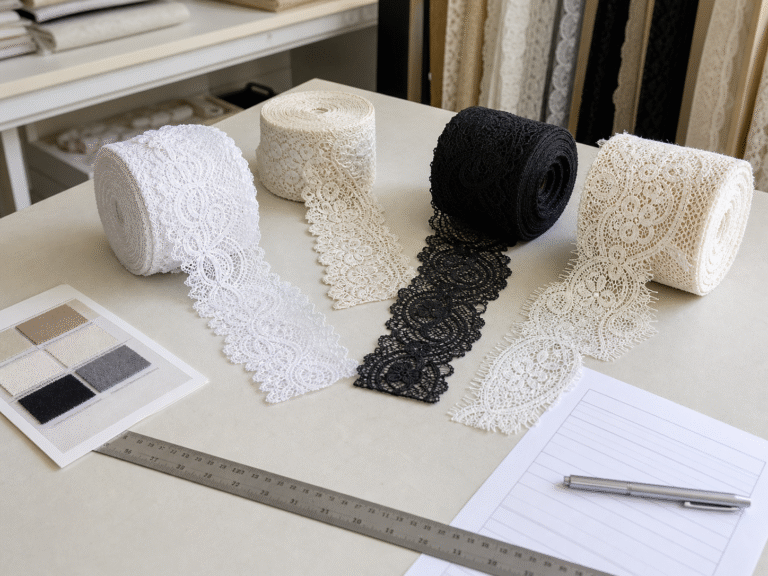
Lace is the decorated member. Its job is the motif — flowers, scallops, geometric repeats. Many classic laces, including Chantilly lace, place the pattern on a fine net ground, so the space between motifs is essentially tulle. Raschel lace knits the net and pattern in one pass; embroidered lace stitches the motif onto tulle or mesh afterward. Guipure is the exception: its motifs join with small bars and no net at all. The types of lace guide walks through each.
So when someone says “lace on tulle” or “tulle mesh”, they aren’t wrong, just imprecise. In the US, the FTC’s textile labeling rules (16 CFR Part 303) require fiber content on the label, not structure names — which is why a garment tag reads “nylon / spandex” and never “tulle”. The FTC’s plain-English guide, Threading Your Way Through the Labeling Requirements, is worth a read if you sell finished garments into the US.

How to Tell Tulle, Mesh and Lace Apart in Your Hand
You don’t need a lab to sort an unlabeled swatch. Four quick checks, done in this order, will identify it in under a minute and tell you most of what matters for production.
- The light test. Hold the swatch up to a window. Tiny, even hexagons with no pattern point to tulle. A regular grid of any shape — often slightly larger or more varied holes — points to mesh. Shapes that form a picture, or a pattern sitting on a background net, mean lace.
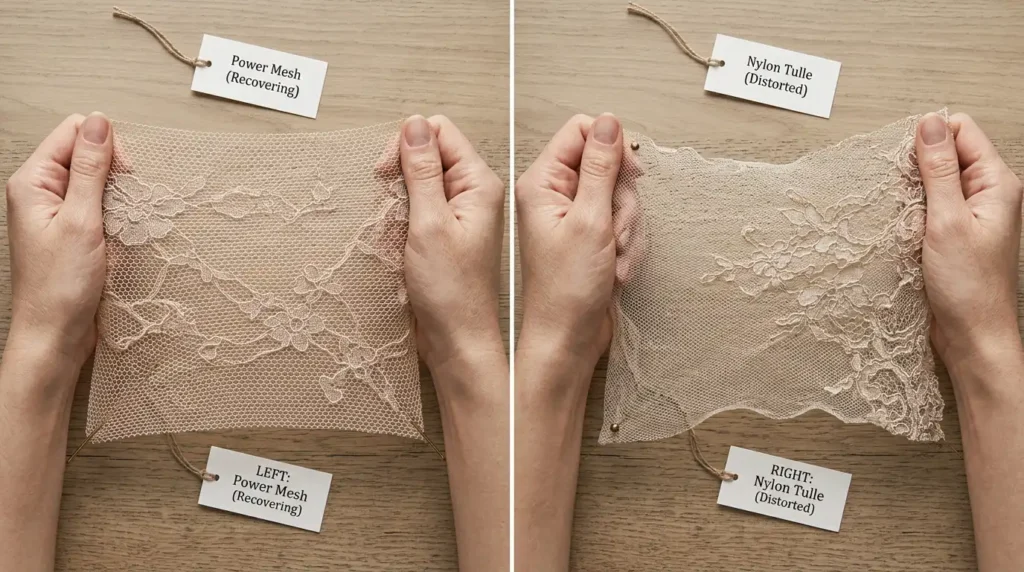
- The snap test. Stretch a corner by about a third and let go. Mesh with spandex springs straight back. Tulle barely gives, and what does stretch stays stretched. Lace splits the difference: stretch lace recovers, non-stretch lace behaves more like tulle.
- The crush test. Scrunch the swatch in your fist for five seconds, then open your hand. Stiff or medium tulle springs up with visible body — that is the volume it gives a skirt. Mesh lies flat and smooth. Lace depends on the yarn and finish, but usually relaxes rather than springing.
- The edge test. Cut a small slit and tug gently across it. Warp-knit tulle and mesh rarely fray, though fine mesh can run under tension if the edge isn’t finished. Lace edges hold well inside a motif and are weakest where the net ground meets an open area.
One extra check for lingerie and anything worn against skin: run your fingertip across the face. Mesh feels flat; lace has raised motifs you can feel; stiffer tulle can feel scratchy at a neckline or armhole.
⚠️ Warning: These are hand tests, not specifications. They tell you what a swatch is; they don’t replace stretch, GSM or colorfastness figures from the mill. If two swatches pass the same test differently, ask for the numbers before choosing.
Head-to-Head: The Properties That Decide the Choice
Each fabric wins on different criteria, and each has a cost you accept when you pick it.
Stretch and recovery
Mesh wins clearly — when it has spandex. The spandex percentage, not the word “mesh”, sets the behavior: a mesh around 5% spandex feels stable with light give, while compression-grade mesh and powernet at 20% spandex or more are built to shape the body and snap back fast. Tulle has almost no useful stretch; warp-knit tulle gives a little across the holes but doesn’t recover. Lace comes in both stretch and non-stretch versions, and stretch lace usually recovers less evenly than mesh because the pattern creates denser and thinner zones. Our warp knit mesh GSM and stretch guide goes deeper on reading these numbers. Stretch figures vary by mill and finish, so confirm them with your supplier.
Sheerness and coverage
All three can be sheer. Tulle reads as a soft haze, especially in illusion weights. Mesh coverage depends on hole size and GSM; fine, low-GSM mesh in a skin tone almost disappears on the body. Lace gives partial coverage — the motifs cover, the ground shows skin — which is why it’s so often lined or backed with mesh.
Volume and drape
Tulle is the volume fabric. Layered tulle holds shape in a skirt or petticoat without much weight, because air passes through the holes. Mesh doesn’t build volume; it hugs. Lace drapes according to its weight: light Chantilly-type lace falls softly, corded or heavy lace holds a sculpted line.
Durability and snagging
Mesh is the most hard-wearing of the three in daily wear, which is why it ends up in activewear and bra wings. Fine tulle snags easily on rings, zips and rough skin. Lace sits in between, but open designs and eyelash edges catch more than dense motifs do.
Comfort against skin
Flat, fine mesh is usually the most comfortable for all-day contact. Lace’s raised motifs can irritate sensitive skin, especially at seams. Stiff tulle is the least friendly at a neckline; soft or silk tulle is better there.
Care
All three in synthetic fiber dislike heat. Cold, gentle washing and air drying is a safe default; skip fabric softener on performance mesh. Steam, never a hot iron, for tulle and lace.
Cost drivers
The price logic differs. Tulle is usually the least expensive per meter, with fineness, finish and bobbinet construction pushing it up. Mesh price follows fiber ratio, GSM and construction. Lace is generally the most expensive because design work, pattern repeat, machine time and width all add up. Treat these as an industry rule of thumb, not a quote — compare actual prices on your own specs.
Which One to Use: Matching the Fabric to the Product
The right answer is often “more than one”. Most finished garments in these categories use each fabric for the zone it’s best at.
| Product / zone | Best fit | Why | Watch out for |
|---|---|---|---|
| Bra cups (decorative) | Stretch lace, often backed | Design lives here | Raised motifs under thin outerwear |
| Bra wings, back bands | Power mesh | Stretch, recovery, support | Low-spandex mesh bags out over time |
| Briefs and bodysuits | Mesh body, lace panels or trim | Comfort plus a visual detail | Matching stretch across seams |
| Bridal bodice | Lace over a stable base | Pattern + structure | Lace alone won’t hold shape |
| Bridal skirt, veil | Tulle | Volume and haze for little weight | Snags; scratchy if too stiff |
| Illusion necklines, sleeves | Soft tulle or fine stretch mesh | Near-invisible on skin | Non-stretch tulle can sag on a fitted line |
| Swimwear | Mesh (linings, inserts) | Quick-dry, stable | Choose chlorine-resistant grades; lace and tulle snag and fade faster |
| Activewear | Mesh | Ventilation and stretch | Hole size vs opacity |
| Eveningwear overlays | Tulle or lace | Sheer layers or pattern | Color shift when layered |
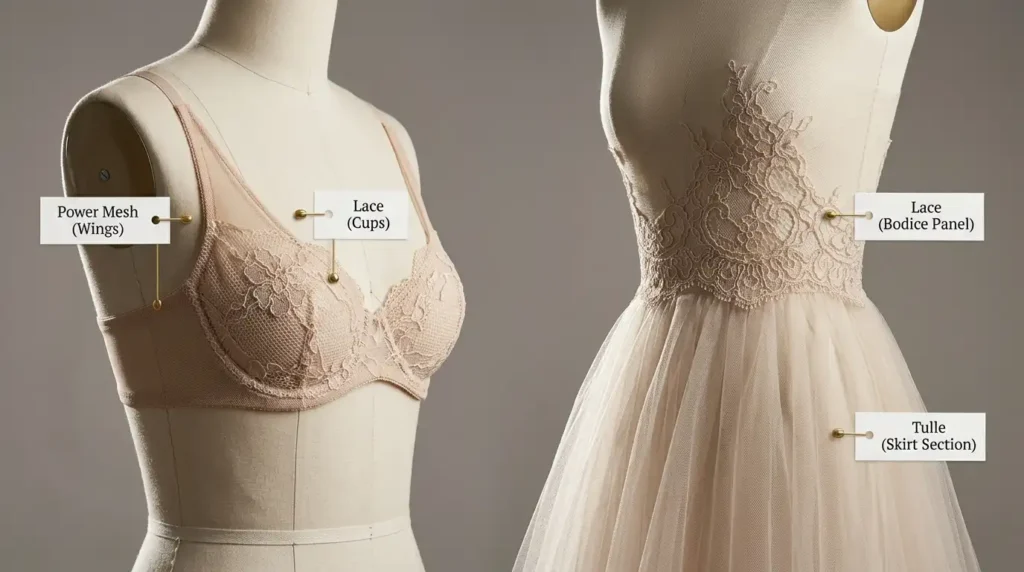
A few patterns stand out. Lingerie almost always combines lace and mesh: lace where the eye goes, mesh where the body moves. Bridal leans on all three — lace on the bodice, tulle in the skirt and veil, and stretch mesh hidden in linings and illusion panels; our wedding dress fabric sourcing guide covers how to test those layers together. Swimwear and activewear are mesh territory; lace appears mostly as trim on low-intensity or fashion-led pieces. Before committing to a swimwear lining, see what to check in swimwear fabric sourcing before bulk.
For illusion panels specifically, the choice is a real trade-off. Soft tulle gives the most invisible, airy look but has no recovery, so it can wrinkle or sag on a close-fitting line. Fine stretch mesh moulds to the body and stays put, but can look slightly flatter and more “technical” under strong light. Many bridal brands use tulle on loose areas like sleeves and stretch mesh on fitted areas like a plunging neckline.
Using Them Together: Layering Rules and the Color-Matching Problem
Combining the three is normal, and most problems come from two places: mismatched stretch and mismatched color.
Match stretch across every seam. Sewing non-stretch tulle to stretch lace in a zone that moves — a waistband, a cup edge, a fitted bodice — makes the seam pucker or pop. In moving zones, pair stretch lace with stretch mesh. Save tulle for areas that don’t need to stretch, or float it as a separate layer.
Check the stack, not the swatch. Lace over mesh, or tulle over a lining, changes how sheer and how bright the fabric reads. Pin the actual layers together and look at them against light and against skin tone before approving. Our mesh edge stability sewing trial shows the same principle applied to seams.
Color is where mixed fabrics go wrong. Nylon and polyester take dye differently, and three fabrics often come from three mills dyed in three batches. A lace cup, a mesh wing and a tulle overlay that each match the standard alone can still look like three shades side by side. Ask for all components to be dyed against one standard, ideally in the same dye house, and approve them as a set.
This is one place where who makes the fabric matters. Fuyuan Knitting runs lace machines, high-speed warp-knitting machines for mesh, and its own dye house under one roof, so lace and mesh for the same style can be dyed and checked together rather than matched across suppliers. Whoever you buy from, ask how they control shade across fabric types — not just roll to roll.
💡 Pro Tip: When ordering mixed components, put one shared color reference (a physical standard or lab dip) on every purchase order and ask for a shade report that lists each fabric against it under the same light source.
What to Put on the Spec Sheet
Because the three names are so loose, the spec sheet does the real work. These are the fields worth asking for on each, beyond price and lead time.
| Ask for | Tulle | Mesh | Lace |
|---|---|---|---|
| Construction | Bobbinet or warp-knit | Tricot, Raschel or weft-knit | Raschel, Leavers or embroidered; net ground or guipure |
| Fiber content | Exact %, not just “synthetic” | Exact nylon/polyester : spandex ratio | Exact %, incl. any cotton or viscose |
| Weight | Ask for the mill’s grade and a physical swatch | GSM | GSM or weight per meter |
| Hole / structure | Mesh fineness; soft or stiff finish | Hole shape and size | Pattern repeat size and direction |
| Stretch | Usually not specified | % stretch both directions, recovery | Stretch or non-stretch; % if stretch |
| Width | Usable width | Usable width | Width incl. or excl. scallop edges |
| Shade control | Dye lot per roll | Dye lot per roll | Dye lot per roll; shade vs other components |
All performance figures — stretch, GSM, recovery — vary with the mill and the finishing, so confirm them with your supplier on the actual production quality, not a catalog entry. For lace, also ask how the repeat lines up across the width; it affects cutting yield more than most buyers expect. If shrinkage matters for your fit, our note on testing lace fabric shrinkage before bulk lays out a simple method.
Certifications and sustainability
All three fabrics are mostly made from nylon or polyester today, so the environmental questions are the same for each: what fiber, how much recycled content, and which chemicals touched it.
- Recycled content: ask whether recycled nylon or polyester is certified under the Global Recycled Standard (GRS), which tracks recycled material through the supply chain. A GRS claim can be checked; “eco tulle” on its own can’t. Fuyuan’s production is GRS-certified.
- Skin contact: for lingerie, swimwear and anything worn close to the body, ask for OEKO-TEX Standard 100 certification and check the product class. Class 2 covers products with direct skin contact; certificates are issued for one year, so check validity on the OEKO-TEX Label Check.
- Natural-fiber options: silk or cotton tulle and cotton lace avoid synthetic polymers but trade away stretch, durability or easy care. They make sense for heritage or natural-fiber lines, less so for performance pieces.
FAQ
Is tulle a type of mesh?
In the broad sense, yes — tulle is a fine net, and every net is an open mesh structure. In trade use, though, “mesh” usually means an engineered knit chosen for stretch, support or airflow, while “tulle” means a plain fine net chosen for volume and sheerness. Order by the trade meaning and spell out the specs.
Can I use mesh instead of tulle in a skirt?
Only if you want a different effect. Mesh clings and drapes; it won’t build the full, floating volume tulle gives. Stretch mesh can work for a fitted, body-skimming overskirt, but not for a petticoat or ball-gown silhouette.
Is lace stronger than tulle?
Usually, yes, because lace motifs add yarn and density that a plain fine net doesn’t have. The net ground between motifs is about as delicate as tulle, though, so lace tends to snag in those open areas first.
Which is the most breathable?
Open athletic mesh, in most cases, because it’s designed around airflow. Tulle also breathes well but is rarely worn in a way where that matters. Lace breathes less where motifs are dense.
Can lace be made on mesh instead of tulle?
Yes. Embroidered lace can be stitched onto stretch mesh, which gives a lace look with mesh-like stretch and recovery. It’s common in lingerie and fitted eveningwear. Check that the embroidery doesn’t stiffen the stretch zones.
Does tulle or mesh fray when cut?
Warp-knit tulle and mesh generally don’t fray, which is why raw edges are common. Fine mesh can run under tension if an edge is left unfinished in a high-stress area, and cotton tulle frays more than synthetic tulle.
Choosing Your Next Swatch Set
If you’re deciding between the three for a new style, the fastest route is to put real swatches through the four hand tests above and then compare spec sheets on the same fields. For lace fabric and warp-knit mesh, Fuyuan Knitting supports low MOQs, OEM/ODM development and fast sampling, with in-house dyeing for shade matching across components. Send us your product and target specs and we’ll suggest swatches to test side by side. If lace and mesh are the two you’re weighing most, our deeper lace vs mesh comparison is the next read.