Corded Lace Fabric: The Construction, the Comparison, and a Two-Tone Trick Most Buyers Miss
A spec sheet lists “corded lace” with one line underneath: elegant two-tone effect. A buyer’s first assumption is usually that this means an extra dyeing step, maybe a second run through the vat.
That assumption is often wrong. Sometimes the two-tone effect isn’t added on top of the fabric — it’s built into the yarn itself.
This guide is for fashion and eveningwear brand buyers and small-batch designers. It’s for anyone trying to understand what “corded” actually means before writing it into a spec sheet.
We’ll cover how corded lace is knitted and where it sits next to Guipure and Chantilly. Then we’ll get into how a two-fiber blend can create color contrast without a second dye job.
What “Corded” Actually Refers To
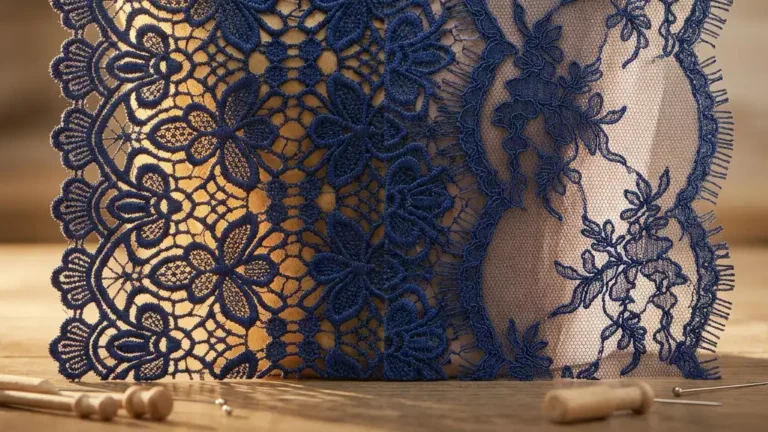
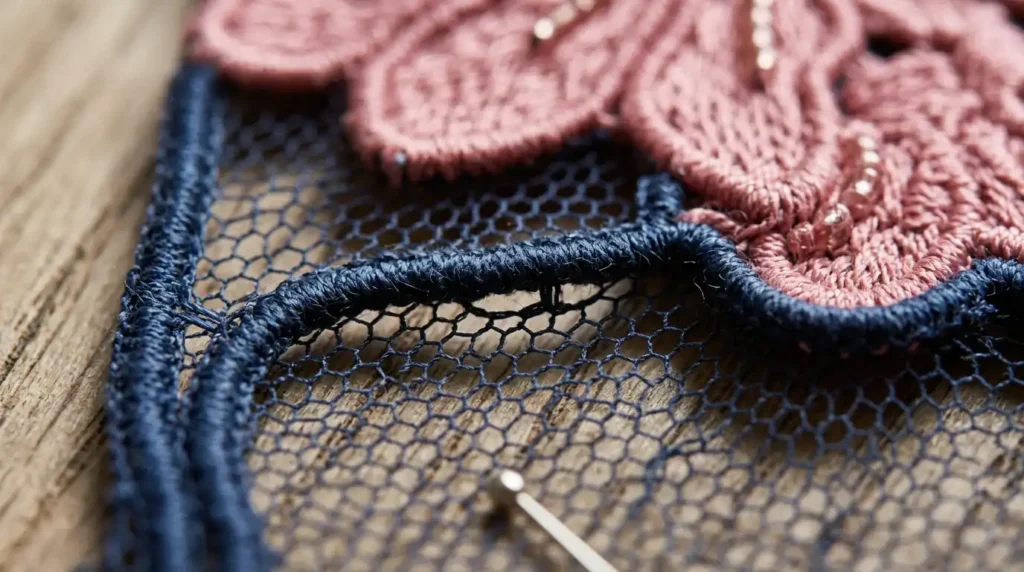
Corded lace gets its name from a thicker, raised thread — the cord — that outlines the motif on top of a base lace structure.
That cord is what creates the 3D effect. Run a finger across corded lace and you can feel the outline before you can see it clearly.
The cord itself can vary. A fine cord adds subtle texture without much extra weight. A heavier cord adds real dimension, but it also adds body — the fabric gets less fluid as the cord gets thicker.
How the Cord Gets Knitted In
Corded lace isn’t embroidery stitched on afterward. On a warp-knitting machine, it’s built in during construction.
A base set of guide bars knits the lace ground and floral outline. A separate guide bar feeds the thicker cord yarn, laying it along the motif edges as the fabric forms. It’s not attached after the fact — it’s knitted into the structure itself.
That’s the real difference between corded lace and a flat embroidered pattern. Embroidery sits on top of a finished base. A cord is part of the base from the first pass through the machine.
💡 Pro Tip: If a “corded lace” sample has zero raised texture when you run a fingernail across the motif outline, be skeptical. It’s likely a flat embroidered lace mislabeled as corded, not the real construction.
Where Corded Lace Sits Next to Guipure and Chantilly
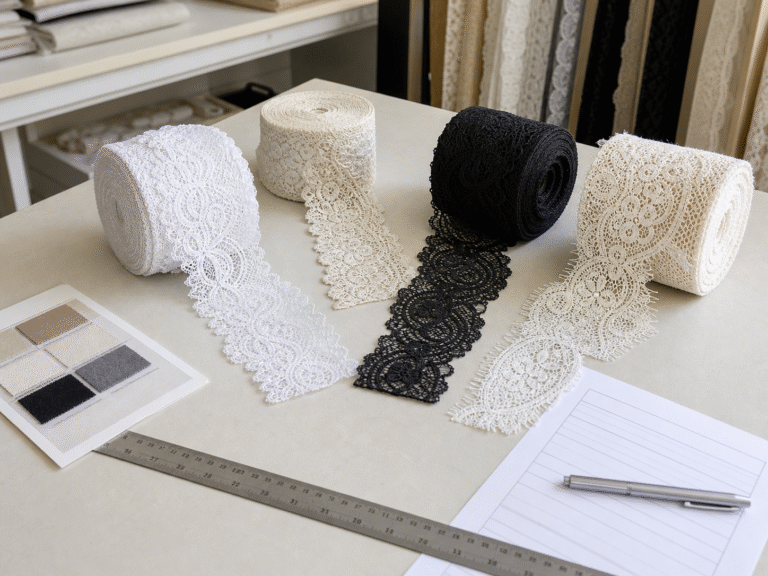
Three lace types get confused constantly, and they’re not interchangeable.
| Type | Base Structure | Drape | Best For |
|---|---|---|---|
| Chantilly | Sheer net ground | Light, fluid | Overlays, veils, sleeves |
| Corded | Net ground with raised cord outline | Medium, structured | Bodices, statement motifs |
| Guipure | No net ground at all | Heavy, stiff | Standalone panels, no lining needed |
Chantilly is the lightest of the three — no cord, no raised outline, just delicate pattern on sheer net. Guipure sits at the opposite end, with no net ground, connected motifs, and enough body to stand on its own.
Corded lace lands in between. It keeps the net ground Chantilly has, but the cord gives it more structure and presence than a flat pattern ever could.
Our types of lace materials guide covers how these construction differences trace back to fiber choice and knitting method. For a closer look at a lighter, uncorded lace type, our guide to Chantilly lace is a useful comparison point.
A Two-Tone Effect Without a Second Dye Job
Here’s the part most sourcing guides skip entirely.
Nylon and cotton absorb dye differently. Nylon typically takes up acid dyes, while cotton takes up reactive dyes.
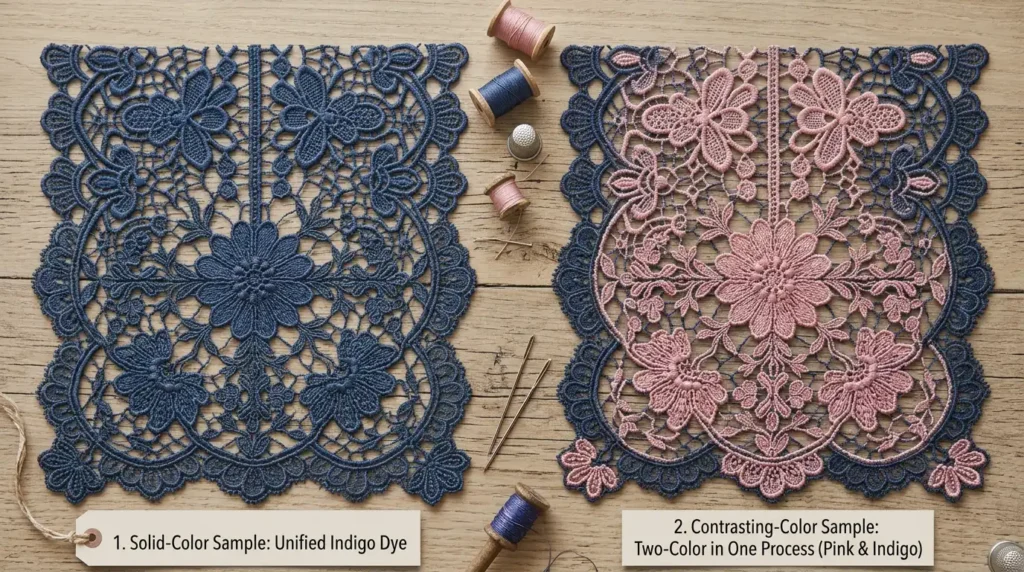
Run a nylon-and-cotton blend through a single dye bath formulated around that gap, and the two fibers can come out two different colors. That happens from one dye pass, not two.
Textile buyers call this cross-dyeing. It isn’t always intentional — sometimes it’s an unwanted side effect in a blend meant to be a solid color.
But when a mill designs for it on purpose, the payoff is real. It becomes a genuine two-tone effect with no extra dye run, no separate yarn-dyeing step, and no color-matching headache between two dye lots.
⚠️ Warning: Cross-dyeing only works reliably when the fiber ratio and dye formulation are controlled from the start. Asking a mill to “just get a two-tone version” of a single-fiber lace after the fact usually doesn’t work. The fiber split has to be designed in from the beginning.
In-house dyeing matters here more than usual. Getting two fibers to land on two specific, matching shades takes tighter process control than dyeing a single-fiber lace one flat color. Our guide to sourcing eyelash border lace covers dye-lot consistency in more general terms, if color matching across a bulk order is a concern.
Border Motifs vs. Allover Repeat: Using Both in One Panel
Corded lace panels often carry two different layouts in a single piece of fabric. That’s easy to miss if you’re only glancing at a swatch.
A border section runs along one edge, usually a scalloped arc of larger, more prominent motifs. An allover section fills the rest of the panel with the same pattern repeating steadily.
The border section is built for a hemline, neckline, or any edge that needs a defined finish. The allover section is built for the body of a garment, where the pattern needs to repeat cleanly without an obvious “front” or “edge.”
Our guide to testing lace fabric before bulk production covers how to check motif placement before approving a bulk order. That’s worth doing before cutting into a panel that mixes both layouts.
Case Study: G89 Corded Lace Fabric
G89 is a direct example of the cross-dye effect described above, not a separate topic.
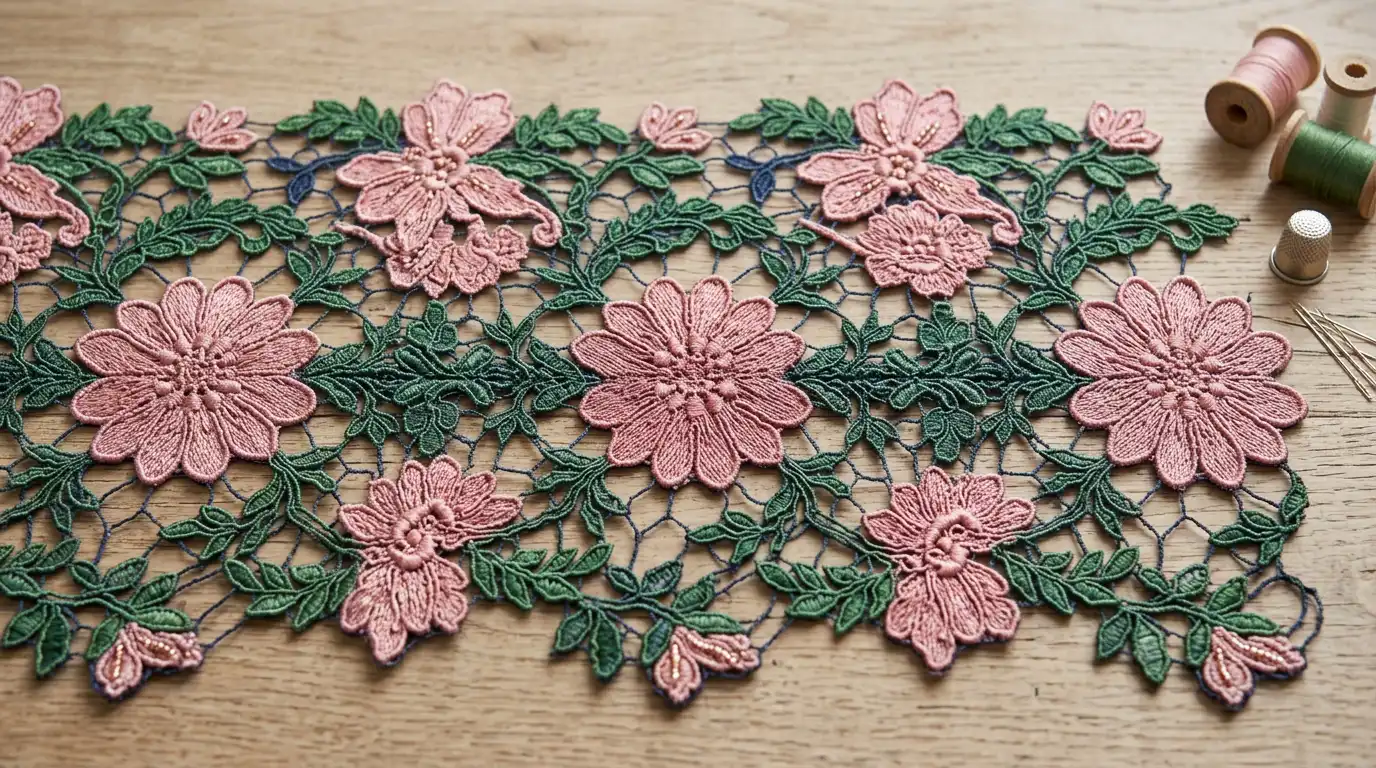
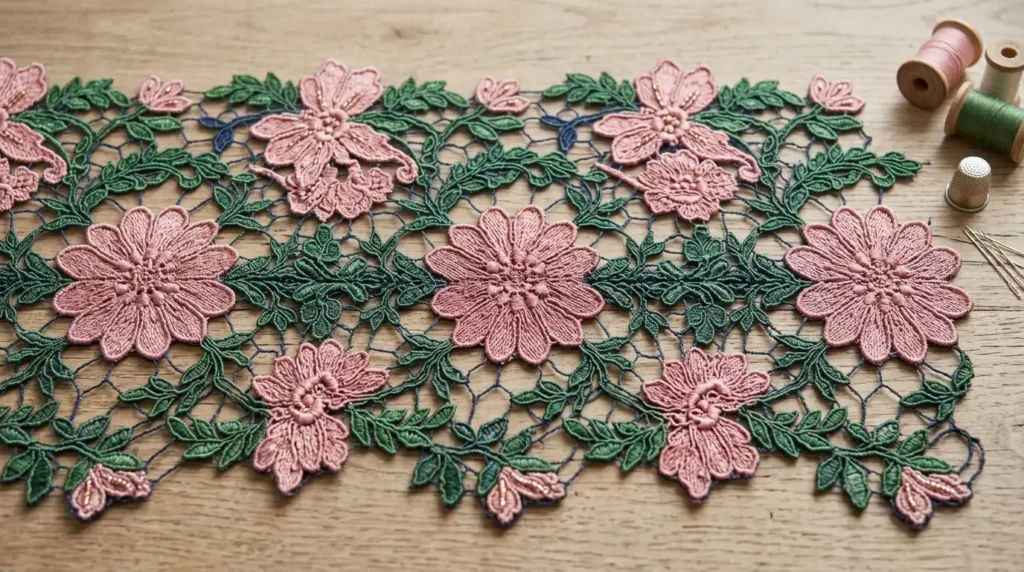
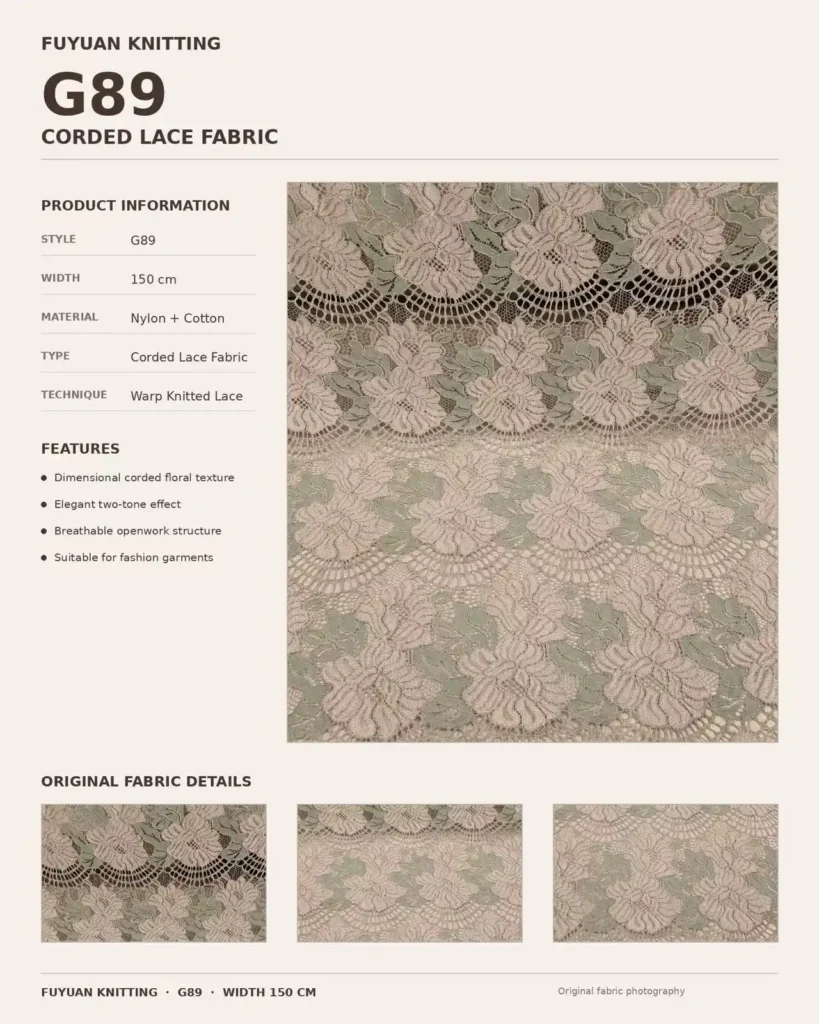
It’s a nylon and cotton corded lace, 150cm wide, with a floral motif in blush pink set against sage green leaves. That’s the fiber split from earlier in this guide, put into an actual product: two fibers, two colors, one dye pass.
The pattern itself carries both layouts from the section above. A scalloped border runs along one edge.
The same floral motif then continues as an allover repeat through the rest of the panel. That gives a buyer both a finished edge and a fillable body in one fabric.
If a corded lace with a built-in two-tone effect fits your next collection, our lace fabric collection is a reasonable place to start browsing constructions.
Read the Spec Sheet Before You Assume the Dye Job
“Corded” tells you about texture. It doesn’t tell you about color, layout, or how the fabric was actually made — those need their own questions.
Fuyuan Knitting develops corded lace with in-house dyeing, including cross-dyed two-tone constructions like G89’s.
Reach out for swatches and ask specifically how a two-tone effect was achieved. The answer tells you a lot about the quality of what you’re buying.