A-Line Lace Wedding Dress: Lace Choice, Hem and Construction Guide
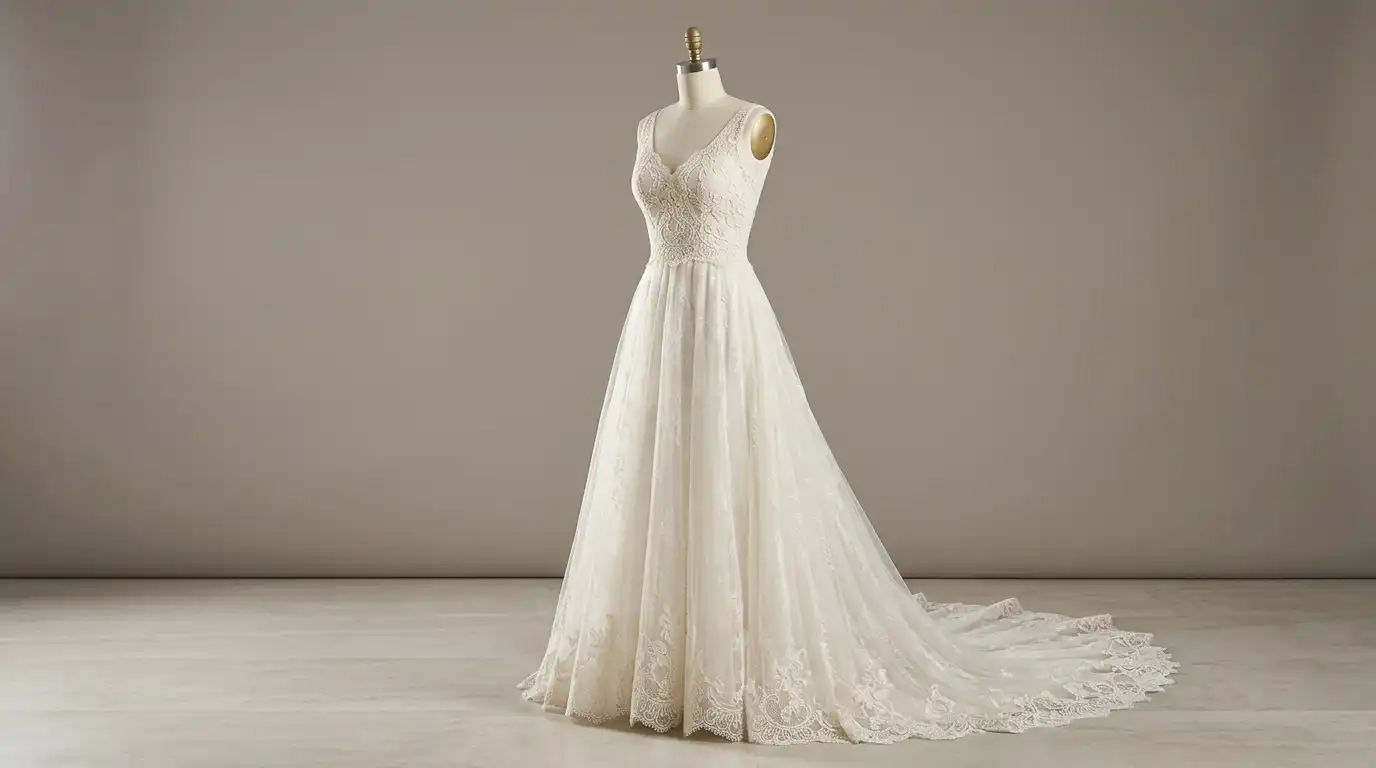
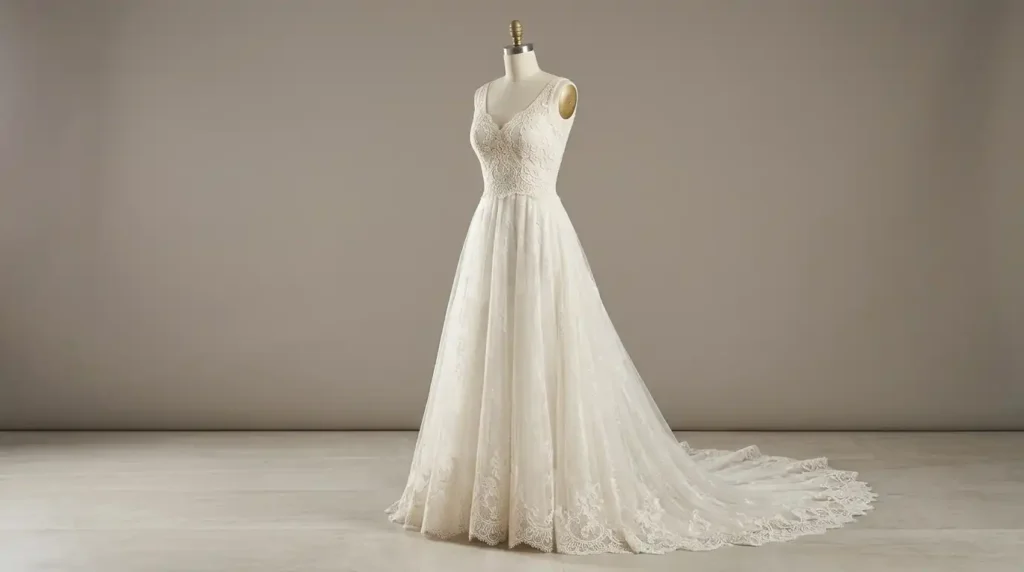
Pin a straight scalloped lace border along the hem of an A-line skirt and it sits flat at center front, then starts to buckle as the hem curves up toward the side seams. An A-line lace wedding dress pairs a fitted bodice with a skirt that flares gradually from the waist to the hem, and it looks and wears best when a structured lace sits on the bodice while a lighter lace, or lace motifs on tulle, covers the skirt so the flare can drape instead of stiffen. This guide is for bridal brands, designers and small-batch dressmakers developing an A-line lace style, and for anyone who wants to know what separates a well-built one from one that only photographs well.
The silhouette is among the most widely offered in bridal, which makes it easy to underestimate. Most of the problems show up in three places: where the lace goes, how the skirt is built, and what happens at the hem.
Why an A-Line Treats Lace Differently
An A-line skirt is cut from panels (gores) that are narrow at the waist and wide at the hem. That shape changes how lace behaves in three ways.
The grain turns. At center front the lace runs straight down. Toward each side seam, the panel edge runs at an angle, so the lace sits partly on the bias. Knitted lace cut this way can stretch slightly under its own weight when the dress hangs, which is why flared lace skirts are usually left to hang before the hem is set.
The hem is a curve. A flared skirt’s hem is an arc, not a straight line. A border lace with a finished scallop is straight. The two only meet cleanly if the border is cut and reshaped, which we cover below.
Motifs meet at more seams. A sheath might have two or three skirt seams; an A-line often has more panels to create the flare. Every seam is a place where the motifs either line up or visibly break.
None of this makes lace a poor match for an A-line. It means the lace choice and the cutting plan need to be made together, not one after the other.
Zone by Zone: Which Lace Goes Where
The most reliable A-line lace gowns don’t use one lace everywhere. They use the right weight for each zone.
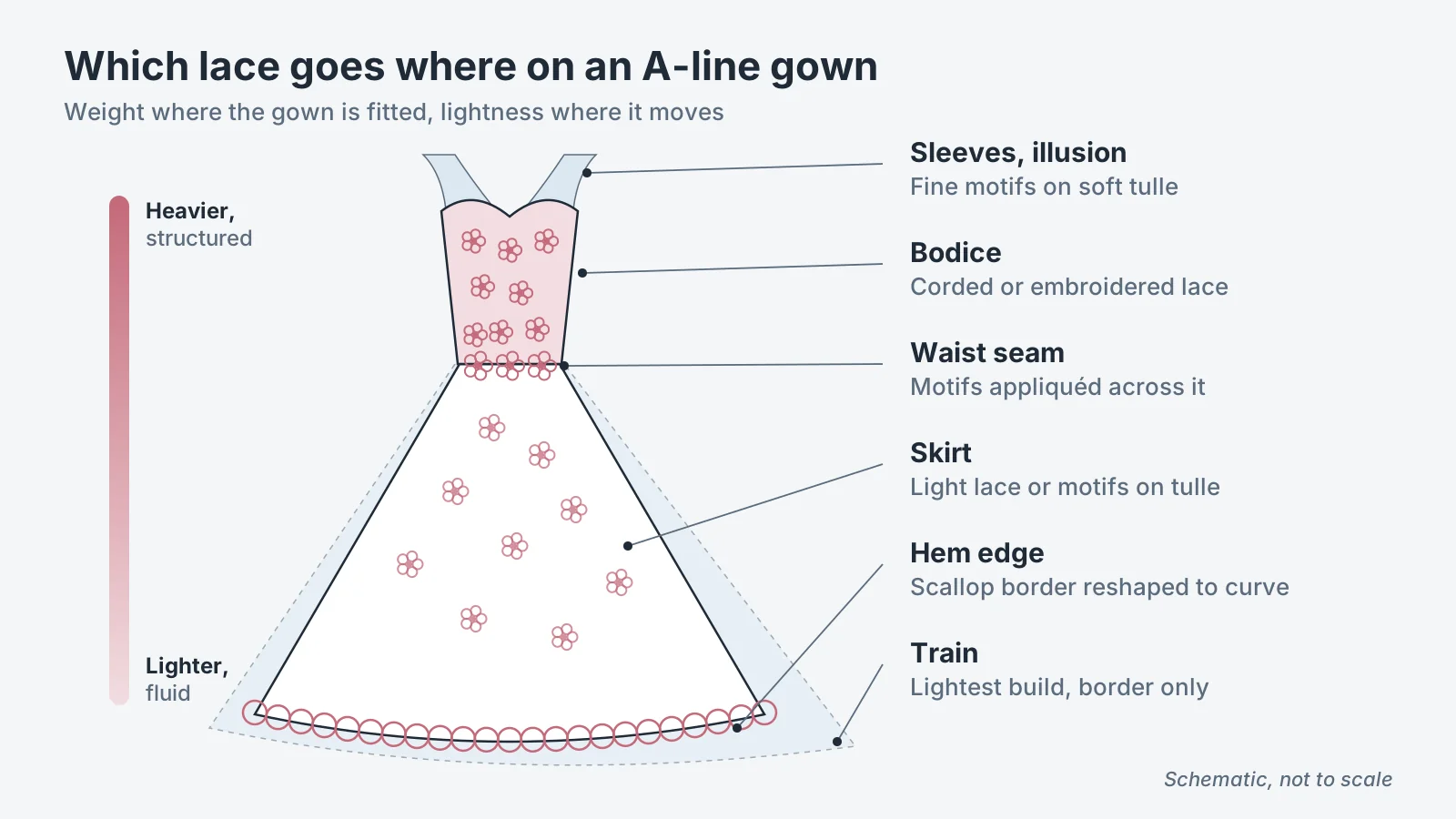
| Zone | What it needs | Lace that usually suits it | Watch out for |
|---|---|---|---|
| Bodice | Structure, clear motifs, a clean fit | Corded (Alençon-style) or embroidered lace over a structured base | Raised cording adds bulk at darts and seams |
| Waist seam | A smooth transition into the flare | Motifs appliquéd across the seam to hide it | A straight seam line cutting through motifs |
| Skirt | Drape and movement | Light Chantilly-style lace, or scattered motifs on tulle | Heavy lace stiffens the flare and adds weight |
| Hem edge | A finished, curved edge | Scalloped or eyelash border, reshaped to the curve | A straight border eased onto a curve ripples |
| Train | Light weight over a long length | Same as skirt, or tulle with lace border only | Full heavy lace makes a long train hard to move |
| Sleeves, illusion back | Near-invisible base, light motifs | Fine lace motifs on soft tulle | Stiff tulle reads as fabric, not skin |
The logic is simple: weight belongs where the gown is fitted and supported, and lightness belongs where it moves. A heavy corded lace that looks superb on a bodice can make a full A-line skirt feel stiff and heavy, while a fine Chantilly lace on its own may not hold a sculpted neckline. If you’re still comparing lace families in general, our framework for choosing bridal lace covers type, fiber, weight and edge in more depth.
Stretch lace matters less here than in a mermaid gown. Only the bodice of an A-line is fitted, and that fit usually comes from the base layer underneath, not from the lace itself.
Three Ways to Build the Skirt
The skirt decides most of the cost, the weight and the sewing time. In practice, A-line lace gowns tend to follow one of three builds.
| Build | Look | Weight | Lace yardage | Sewing time | Best for |
|---|---|---|---|---|---|
| Full lace overlay on every skirt panel | Lace from waist to hem | Medium to heavy | Highest | High (motif matching at every seam) | Classic, romantic collections |
| Lace bodice + tulle skirt with appliquéd motifs | Lace fading down the skirt | Light | Low to medium | High (hand placement of motifs) | Airy, modern looks; summer collections |
| Lace bodice + tulle or chiffon skirt with lace border hem | Clean skirt, lace at top and bottom | Light | Lowest | Medium (border shaping only) | Price-sensitive lines, destination styles |
A full overlay gives the most “lace dress” impact but asks the most from the fabric: you need a lace with a manageable repeat, enough width to cut wide skirt panels, and extra yardage for matching. The appliqué build uses less lace but more hand labor, because motifs are cut out and placed one by one on the tulle. The border build is the most economical in both yardage and labor, and it relies heavily on getting the hem right.
💡 Pro Tip: For a full overlay, ask for the lace’s usable width before you finalize the skirt pattern. If the widest gore is wider than the lace, you’ll need an extra seam in every panel, and every extra seam is another place to match motifs.
The Hem Problem: Fitting a Scalloped Border to a Curve
This is where A-line lace gowns most often go wrong. A scalloped border is a straight strip; the hem of a flared skirt is a curve. Easing the border onto the hem in one piece makes it ripple at the sides, and gathering it looks home-made.
The standard fix in bridal workrooms is to cut the border and rebuild it along the curve.
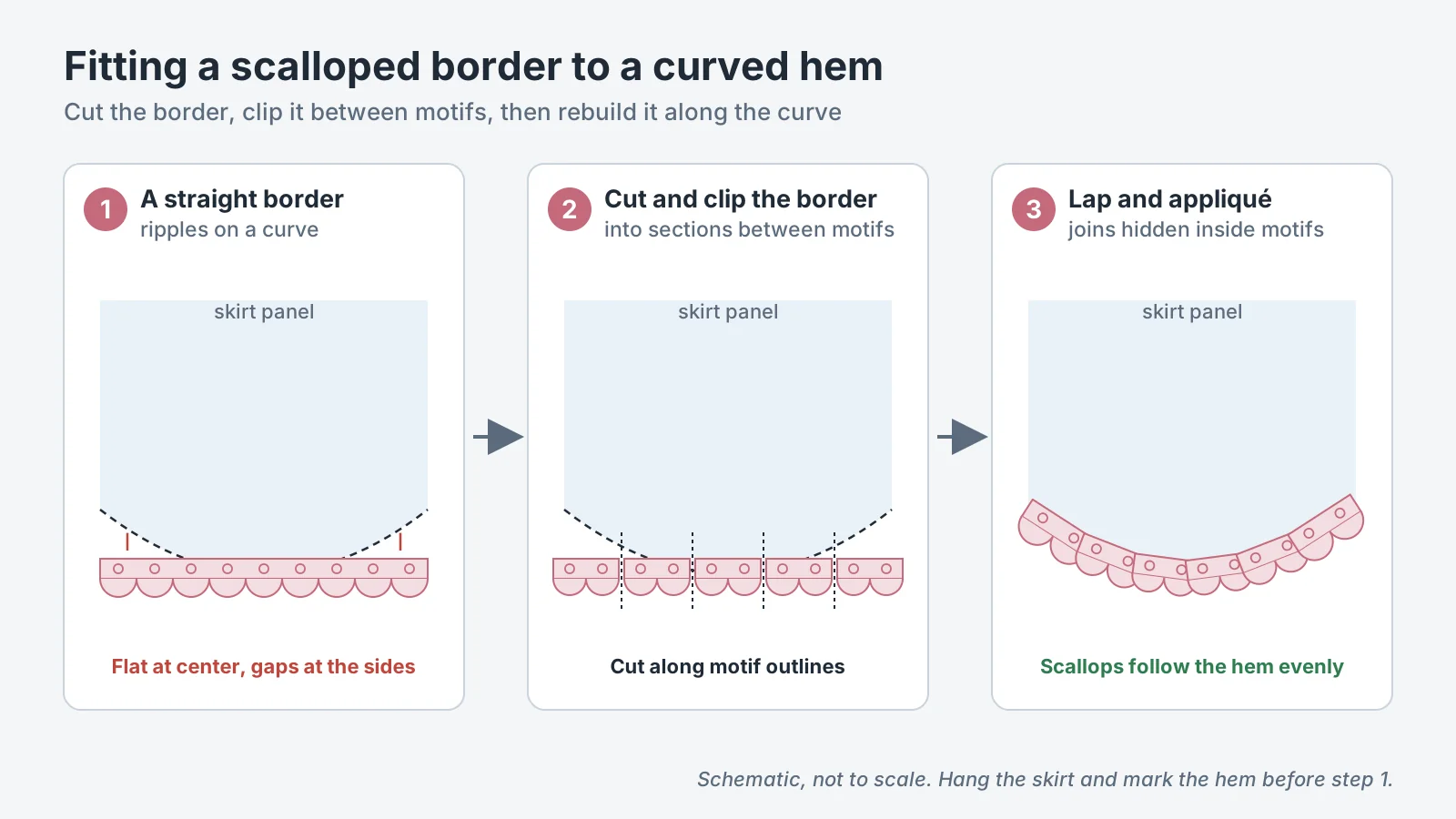
- Hang the skirt first. Let the assembled lace and lining hang on a form, ideally overnight, so any bias stretch at the side panels shows up before the hem is marked.
- Mark the finished hem line on the hanging skirt, level all the way round.
- Cut the scalloped border away from its lace panel, following the outline of the motifs rather than a straight line.
- Clip the border into sections between motifs. Each section can then be angled to follow the curve.
- Lap each section over the next where motifs overlap, and pin them along the hem line so the scallops point down evenly.
- Appliqué by hand along the motif outlines with fine, matching thread, then trim the excess lace and the skirt fabric behind the border.
Done well, the joins disappear inside the motifs. The trade-off is labor: border shaping on a full A-line hem and train is a skilled hand-sewing job, and it should be costed as one.
⚠️ Warning: Don’t approve a bulk lace order on a flat swatch alone if your style uses a border hem. Ask for enough border to rebuild one full sample hem. A border whose motifs are spaced too far apart leaves gaps when you clip it for a tight curve.
What Goes Under the Lace: Layer Stacks
Lace is almost never the whole story. What sits under it decides how the lace reads and how the gown wears.
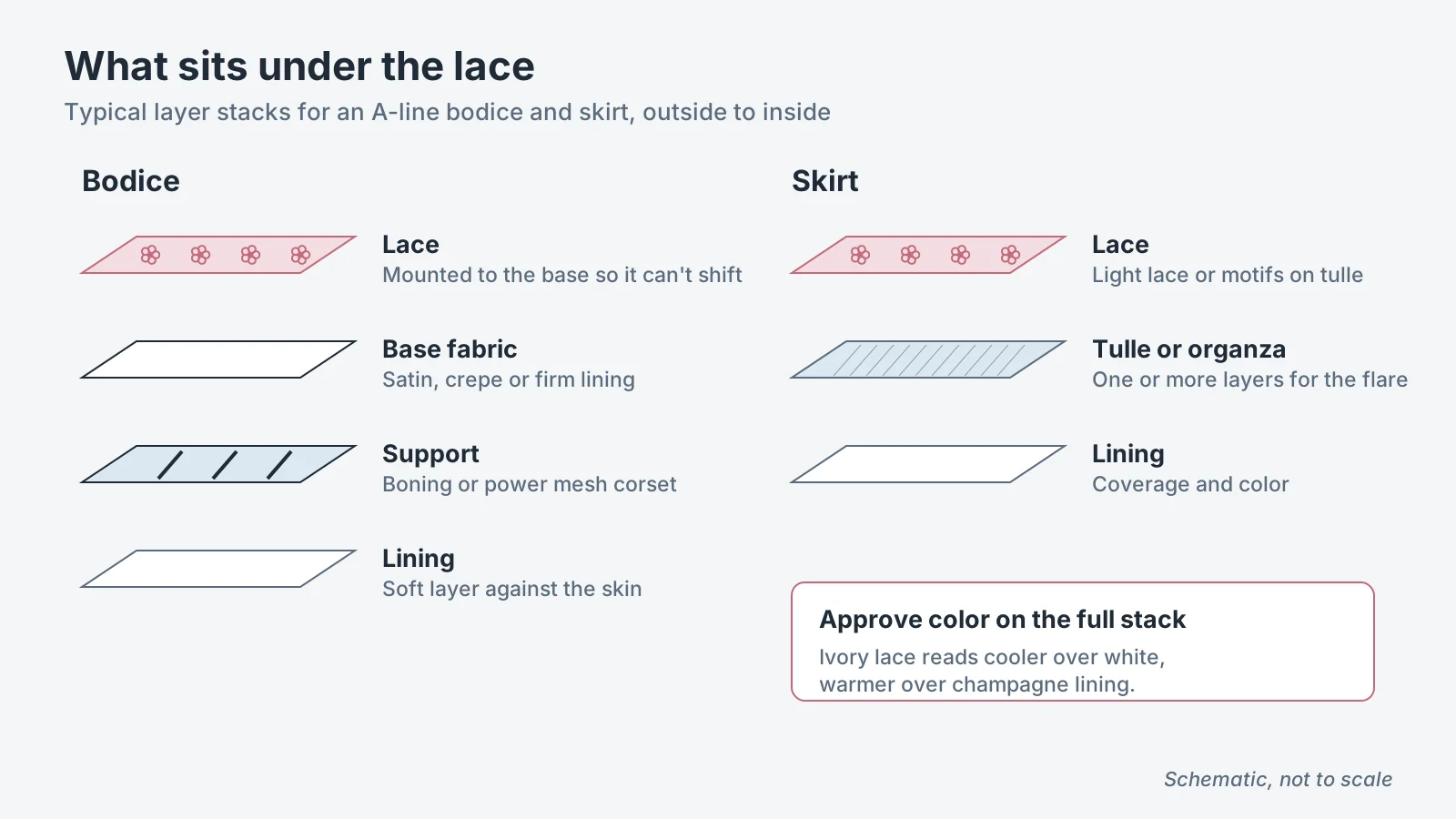
Bodice stack. Lace on the outside, then a stable base fabric (satin, crepe or a firm lining) that the lace is mounted to, then a support layer such as boning channels or a power mesh corset, then a soft lining against the skin. Mounting the lace to the base keeps it from shifting or bagging at the bust.
Skirt stack. Lace on the outside, then one or more layers of tulle or a light organza to give the flare its shape, then a lining. An A-line doesn’t need a hoop, but extra tulle layers at the back help a train fan out instead of collapsing.
Color changes with the stack. The same ivory lace looks cooler over a white lining, warmer over champagne, and more “floating” over a nude base. Approve lace color with the actual layers stacked together, not as a single swatch. Our wedding dress fabric sourcing guide walks through layer-card testing for exactly this reason.
Planning Yardage and Matching Motifs
An A-line lace skirt uses noticeably more lace than a plain calculation suggests. The pattern pieces are wide at the hem, and motifs have to line up at each seam. Rather than a single number, plan around the factors that drive it:
- Usable lace width against the widest skirt panel.
- Pattern repeat length, since matching a seam can mean shifting a piece by up to one full repeat.
- Number of skirt seams that need matching.
- Train length, which adds length at the back panels.
- Border needs, if the hem uses the lace’s own scalloped edge.
- One-way motifs, which stop you rotating pieces to save fabric.
As an industry rule of thumb, allow at least one extra full repeat for every seam you plan to match, then cut a test skirt before confirming bulk yardage. Repeat sizes and widths vary by mill and design, so check them with your supplier.
On the seams themselves, the cleanest A-line lace gowns don’t use straight seams on the lace layer at all. The lace is overlapped and stitched by hand along motif outlines (a lapped or appliqué seam), so the seam follows the pattern instead of cutting through it. It takes longer, but it’s the main reason high-end lace skirts look seamless. Curved panels make this harder than on a straight skirt; our guide to lace for skirts shows why motifs drift on a curved cut.
Checks Before You Commit to Bulk
Most A-line lace problems can be caught on one sample gown. Before you place a bulk lace order, check these:
- Hang test. Hang the assembled skirt for at least a day and re-measure the hem. If side panels have dropped, adjust the pattern or the lace choice.
- Shrinkage and steam. Lace and lining can move differently under steam. Run a quick shrinkage and relaxation test on the actual lace and lining before cutting.
- Shade across components. Lace, tulle and lining usually come from different mills. Ask for every component to be matched to one physical standard and approved together under the same light.
- Motif direction. Confirm whether the design is one-way. If it is, mark the nap direction on every pattern piece.
- Seam visibility. Hold the finished skirt to a window. Seam allowances on the lining and tulle show through lace more than most people expect.
- Weight on the body. Weigh the sample skirt. If it pulls on the bodice or straps, lighten the skirt lace or switch to an appliqué build.
Recycled fiber and skin-contact safety
Most bridal lace today is nylon or polyester. If recycled content matters to your collection, ask whether it is certified under the Global Recycled Standard (GRS), which tracks recycled material through the supply chain. For linings and any layer that touches skin for hours, OEKO-TEX Standard 100 certification shows the textile was tested for harmful substances; check that the certificate is current and covers the right product class.
FAQ
Is lace a good choice for an A-line wedding dress?
Yes, as long as the lace weight follows the silhouette. Structured lace on the fitted bodice and lighter lace or tulle on the skirt keeps the flare moving. A heavy lace used everywhere tends to make an A-line skirt stiff and heavy.
What type of lace works best on an A-line skirt?
Light, fluid laces such as Chantilly-style lace, or lace motifs scattered on tulle, usually drape best through the flare. Corded and guipure laces suit the bodice or accents better than a full skirt.
Can I use a scalloped lace edge on a flared hem?
Yes, but not as a single straight strip. The border is cut away, clipped into sections and re-appliquéd along the curved hem so the scallops follow the line evenly.
Does an A-line lace wedding dress need a lining?
Almost always. Lace is open, so the skirt needs at least a lining for coverage and usually tulle layers for shape. The lining color also changes how the lace color reads.
Why does my lace skirt hem look uneven after hanging?
Lace on the angled side panels of an A-line can stretch slightly under its own weight. Hanging the skirt before marking the hem, and re-checking after steaming, prevents most uneven hems.
Is an A-line lace dress heavy?
It depends on the build. A full lace overlay on every skirt panel is the heaviest option; a lace bodice with a tulle skirt and lace accents is far lighter. Weigh a sample skirt early if wearer comfort is a selling point.
Developing an A-Line Lace Style
An A-line lace gown comes together when three decisions are made as one: which lace goes on which zone, how the skirt is built, and how the hem is finished. Get those aligned on a sample, and bulk production becomes a matter of repeating it.
Fuyuan Knitting produces bridal lace and lace fabric in corded, embroidered and eyelash-edge designs, with low MOQs, fast sampling and an in-house dye house, so lace can be dyed to your tulle and lining standard rather than the other way round. Send us your sketch and target fabrics and we’ll suggest lace for the bodice, skirt and hem to test on your first sample.