Stretch Fabric: What Actually Makes It Stretch, and Why Not All Stretch Is the Same
Two swatches, both labeled “stretch fabric.” One stretches to five times its length and snaps right back. The other barely stretches 15% — but it’ll still be doing that 15% after five years of industrial washing.
Neither one is “better” stretch fabric. They’re built to survive completely different jobs.
This guide is for apparel and textile buyers and small-batch designers. It’s for anyone who wants to actually understand stretch fabric before writing it into a spec sheet.
We’ll cover what makes fabric stretch, the two fundamentally different ways manufacturers build that stretch in, and where lace fits into all of it.
What “Stretch Fabric” Actually Means
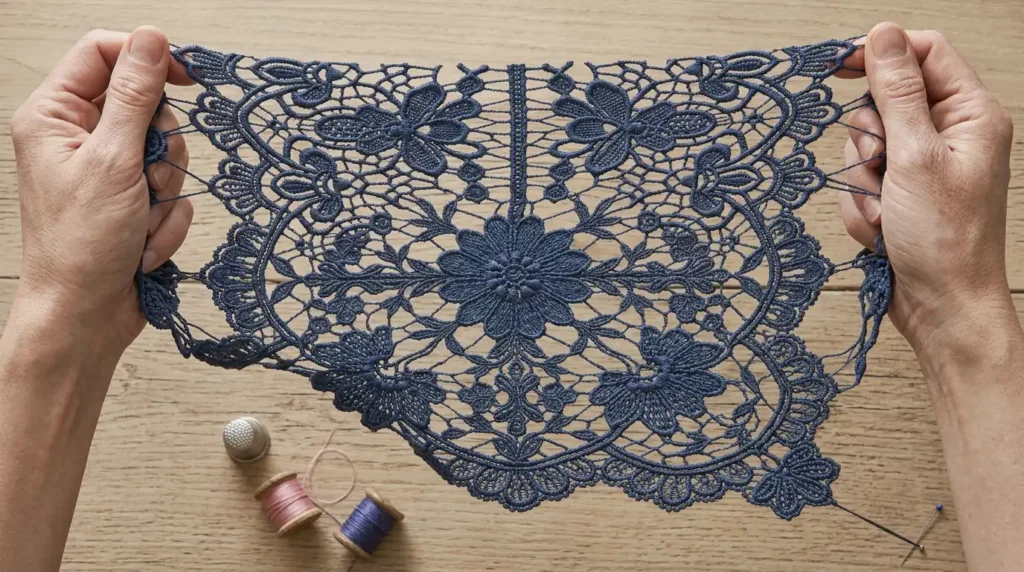
Stretch fabric is any textile that extends under tension and, ideally, returns to its original shape afterward.
That stretch comes from one of two sources. Either an elastic fiber is blended into the yarn, or the fabric structure itself allows movement even when the yarn isn’t elastic. Both count as stretch fabric, but they behave very differently — which is exactly what the rest of this guide covers.
2-Way vs 4-Way: The First Distinction to Get Right
Before fiber content, before construction, this is the first thing to nail down.
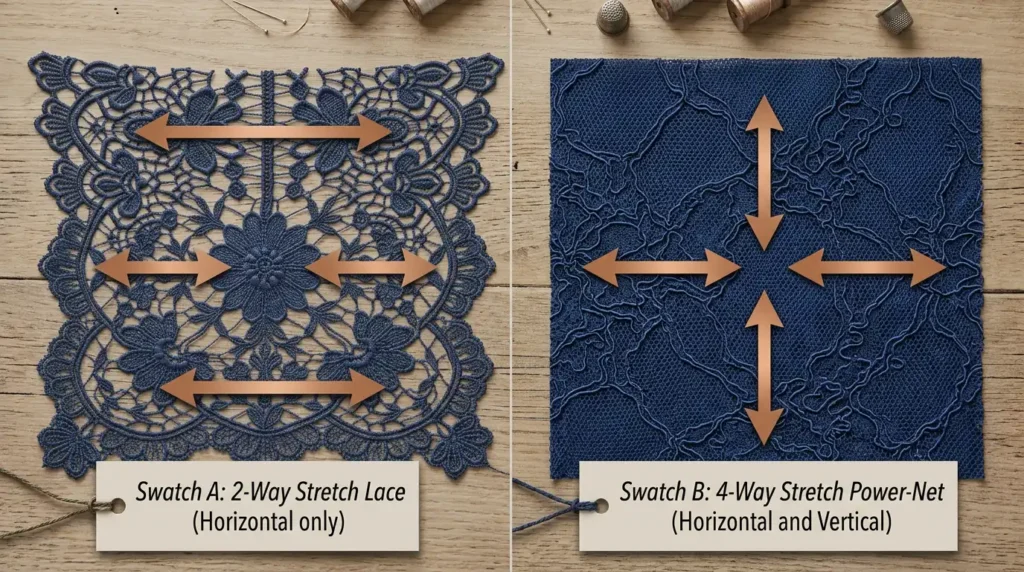
2-way stretch fabric extends in one direction only — usually crosswise, from selvedge to selvedge. It moves side to side but stays stable top to bottom.
4-way stretch fabric extends in both directions at once, crosswise and lengthwise. It’s the standard for anything that needs to move freely with the body, like activewear or fitted swimwear.
💡 Pro Tip: Always confirm stretch direction against your pattern layout, not just the fabric spec sheet. A 2-way fabric cut on the wrong grain won’t stretch where your garment actually needs it to.
The Physics of Why Fabric Actually Stretches
Stretch has two separate properties, and buyers often confuse them.
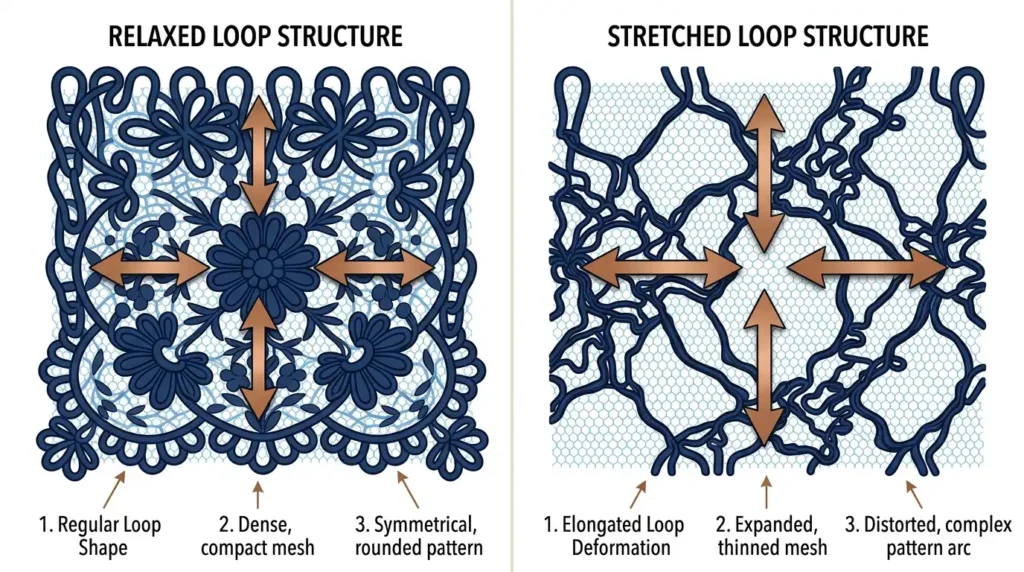
Elongation is how far a fabric can extend — expressed as a percentage of its original length. Recovery is whether it springs back afterward. A fabric can have great elongation and terrible recovery, or the reverse.
Knit fabric stretches for a structural reason. It’s built from interlocking loops of yarn, and those loops can straighten out under tension — even if the yarn itself has zero natural stretch.
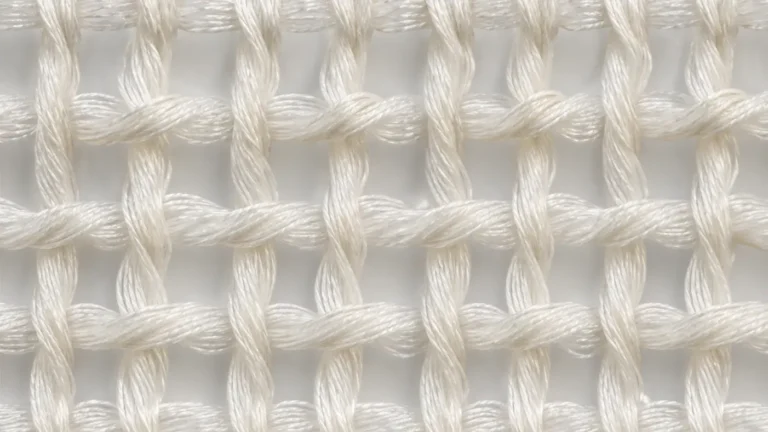
Woven fabric works differently. A standard weave barely stretches at all, except along the bias — the diagonal, roughly 45 degrees off the straight grain. That’s where the crossing threads have room to shift.
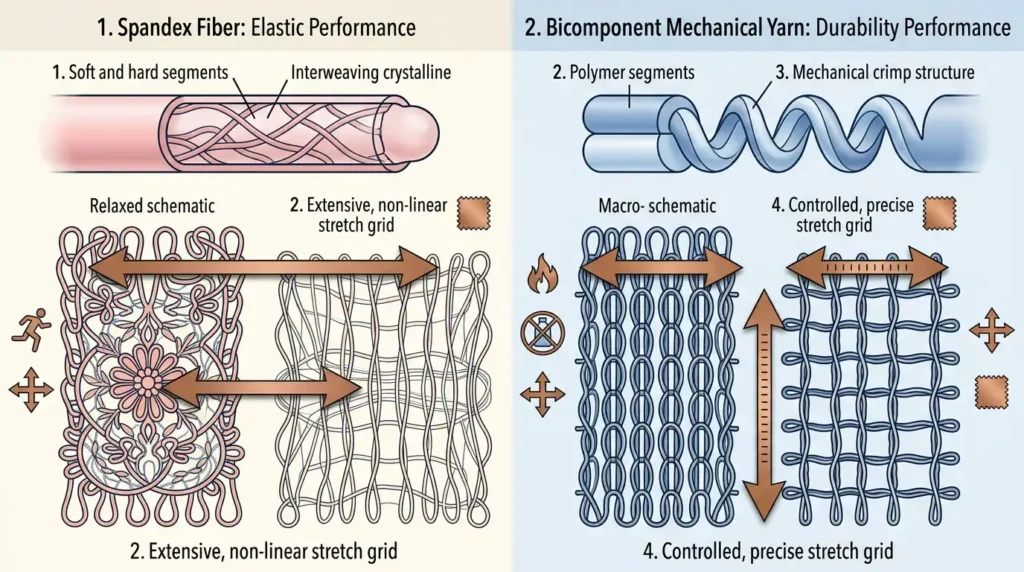
Spandex adds a third mechanism entirely. Its fiber contains short, rigid segments mixed with long, flexible ones. Tension straightens the flexible segments out; releasing it lets them recoil back to their resting shape.
Mechanical Stretch vs Chemical Stretch: Two Different Technologies
Most people assume all stretch comes from spandex. It doesn’t.
Chemical stretch — spandex, elastane, Lycra, all the same fiber under different regional names — delivers huge elongation, often 500% or more, with strong recovery. It’s the gold standard for maximum stretch. But repeated exposure to high heat, chlorine, and industrial-strength washing gradually breaks the fiber down, and recovery weakens over time.
Mechanical stretch comes from yarn or weave geometry instead — crimped fibers, bicomponent yarns like T400, or a bias-cut weave. There’s no elastane involved at all.
The elongation is more modest, typically 10-18%, but it doesn’t degrade. Heat, bleach, and repeated industrial laundering barely touch it.
⚠️ Warning: Don’t assume “stretch fabric” on a spec sheet means spandex. Ask directly which mechanism is providing the stretch — the care requirements and long-term durability are completely different between the two.
Neither one is the universal answer. Chemical stretch wins when you need maximum range of motion. Mechanical stretch wins when the fabric has to survive years of hard use without losing performance.
Stretch Lace: Putting the Principles to Work
Lace runs on the same rules as any other stretch fabric — just with a few extra variables.
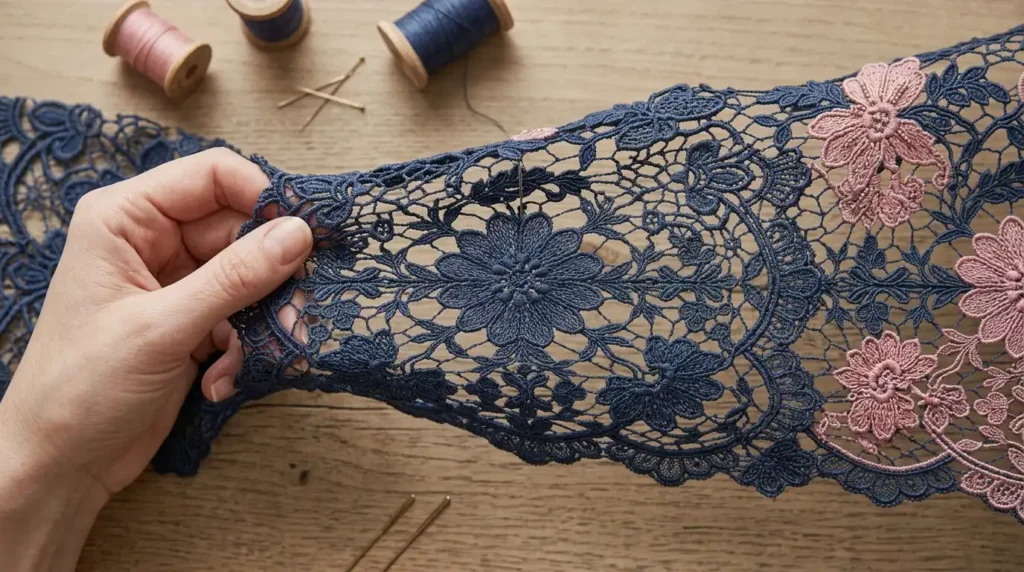
Typical stretch lace blends around 90% nylon and 10% spandex. That small spandex share is doing all the work: it’s the difference between lace that clings to the body and lace that fights it.
Three factors decide how a specific stretch lace actually performs:
- Direction — 2-way or 4-way, same as any other stretch fabric.
- Spandex percentage — more spandex means more stretch, but also more cost and a different hand feel.
- Modulus — how much force it takes to stretch the lace. Low modulus feels soft and gives easily. High modulus takes more effort but provides real structural support.
Non-stretch lace, by contrast, usually runs 100% nylon. It holds a shape instead of moving with one.
That’s exactly why it shows up in corset panels and bridal overlays, where dimensional stability matters more than flexibility. Our guide to lace vs. mesh breaks down this composition difference in more detail.
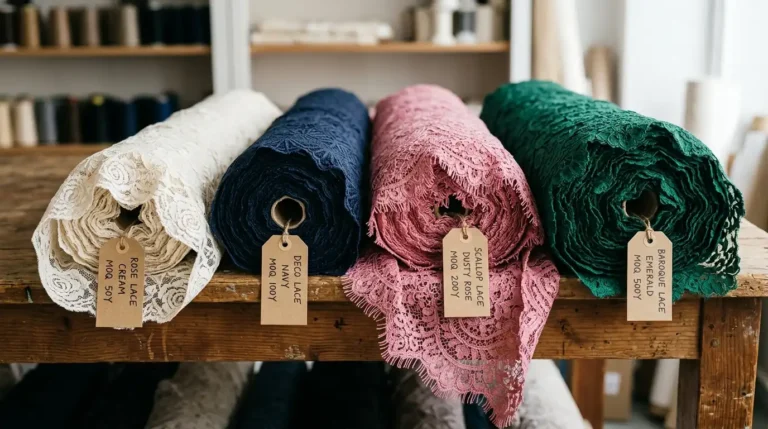
A mechanical-stretch version of lace exists too, though it’s less common. It applies the same yarn-geometry approach used in wovens to a lace ground instead of spandex. Our complete guide to eyelash lace fabric covers stretch and non-stretch construction options in more depth.
Where Stretch Fabric Actually Gets Used
Different applications lean on different parts of the stretch equation.
Activewear and sportswear need high elongation and fast, reliable recovery — chemical stretch is almost always the right call here.
Intimates and lingerie want moderate stretch that conforms without compressing. This is stretch lace’s home turf, where modulus matters as much as elongation percentage.
Swimwear adds another constraint on top of stretch: chlorine and UV exposure. This is one place where the heat-and-chemical durability of mechanical stretch genuinely competes with spandex, especially for linings and structural panels.
Everyday apparel — workwear, tailored separates, structured basics — often uses just a small amount of stretch for comfort, without needing the extreme range activewear demands.
Our guide on checking mesh and stretch panels before sewing covers how to test stretch and recovery against neighboring fabrics before a bulk order. That applies regardless of which application you’re sourcing for.
The Trade-offs: What You Gain, and What It Costs You
Stretch fabric isn’t a free upgrade over non-stretch. It’s a trade.
What you gain: comfort, better fit across a range of body shapes, and simpler pattern-making. A stretch garment can use less ease than a rigid one and still move well.
What it costs you: spandex-based fabrics lose recovery over years of heat and chemical exposure. Mechanical stretch has a hard ceiling on how far it can extend. Stretch fabric also needs different handling at the sewing table — ballpoint needles, different seam types, and careful cutting so pattern pieces don’t distort.
None of this makes stretch fabric a worse choice. It just means the decision has to match the garment, not the other way around.
Stretch Fabric vs Similar Materials: A Quick Comparison
Here’s how the main categories stack up against each other.
| Type | Typical Elongation | Recovery | Durability Under Heat/Chemicals | Best For |
|---|---|---|---|---|
| Non-stretch woven | Near zero (except bias) | N/A | High | Structured garments, tailoring |
| Mechanical stretch woven | 10–18% | Good, stable | High | Workwear, uniforms, industrial laundering |
| Stretch knit (spandex) | Up to 500%+ | Excellent, degrades over time | Moderate | Activewear, swimwear, fitted apparel |
| Stretch lace | 15–100%+ | Good, depends on spandex % | Moderate | Lingerie, bridal, fitted eveningwear |
Our types of lace materials guide goes further into these construction differences, if lace is the direction you’re sourcing in.
The Word “Stretch” Doesn’t Tell You Enough
“Stretch fabric” on a spec sheet is a starting point, not an answer.
Direction, elongation, recovery, and which mechanism is actually producing the stretch — those four details decide whether a fabric fits the garment or fights it.
Fuyuan Knitting develops both spandex-based stretch lace and mechanical-stretch constructions, with in-house testing for recovery and durability before anything ships in bulk. Our guide to sourcing lace fabric from China covers the wider sourcing process if stretch lace is only part of what you’re developing.
Reach out for swatches and tell us how the fabric actually needs to perform — that’s a more useful starting point than the word “stretch” alone.